Humanities HUB › LITERARY CRITICISM › Medieval
BISAC LIT011000
Current paper · Semantic Scholar
Negotiating Arabic and Persian: Rhetorical Adaptation and Autonomy in Persian Literary CriticismAbstract This article reframes the traditional view of Persian rhetoric as merely a derivative of Arabic tradition by examining its development through four key manuals: Muhammad ibn ʿUmar Rādūyānī’s Tarjumān al-Balāgha, Rashīd al-Dīn Vatvāt’s Hadāʾiq al-Sihr, Shams-i Qays-i Rāzī’s al-Muʿjam, and Sayf-i Jām-i Hiravī’s Jāmiʿ al-Sanāyiʿ. It is an exploration of the historical and cultural contexts in which these works…
Reference · Wikidata
Medieval imagination and memorybook chapter in The Cambridge History of Literary Criticism (2005)
Book · DOAB
In Search of the CulpritDespite poststructuralist rejections of the idea of a singular author-genius, the question of a textual archetype that can be assigned to a named author is still a common scholarly phantasm. This volume sets new standards by applying current theoretical approaches to the question of concepts of authorship in medieval and early modern literature. The basic thesis is that authorship is a narratological function rather…
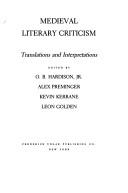
Image · DPLA
Issue 30.2 of the Review for Religious, 1971.
Archive — earlier papers (0)
No earlier picks on file yet.
Archive — earlier Wikidata picks (1)
- Middle Ages11 Aug 2026
Archive — earlier DOAB picks (0)
No earlier picks on file yet.
Archive — earlier Open Library picks (0)
No earlier picks on file yet.
Archive — earlier DPLA picks (0)
No earlier picks on file yet.