Humanities HUB › LITERARY CRITICISM › Shakespeare
This category
LITERARY CRITICISM / Shakespeare
Paper · Semantic Scholar
Love Drives the Greatest Evil: Humanistic Analysis of Shakespeare’s Othello, The Moore of VeniceThis study examined the human attributes, reflections of life, and emotional responses portrayed in William Shakespeare’s Othello, the Moor of Venice. It was anchored in Humanism and M. H. Abrams’ Mimetic and Affective theories of literary criticism, with Reader-Response theory supporting the analysis of readers’ emotional engagement. A qualitative-descriptive literary research design was employed using structured t…
Book · DOAB
Chapter 3 A Voice for Shakespeare in Modern JapanOffering the first book-length study in English on Tsubouchi and Shakespeare, Gallimore offers an overview of the theory and practice of Tsubouchi’s Shakespeare translation and argues for Tsubouchi’s place as ""the Japanese Shakespeare."" Shakespeare translation is one of the achievements of modern Japanese culture, and no one is more associated with that achievement than the writer and scholar Tsubouchi Shōyō (1859…
Full text · Open Library
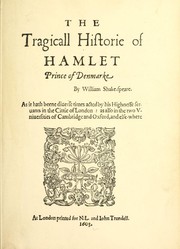 Hamlet
In this quintessential Shakespeare tragedy, a young prince's halting pursuit of revenge for the murder of his father unfolds in a series of highly charged confrontations that have held audiences spellbound for nearly four centuries. Those fateful exchanges, and the anguished soliloquies that precede and follow them, probe depths of human feeling rarely sounded in any art. The title role of Hamlet, perhaps the mo…
Image · DPLA
Caption: "Shakespeare, The Fourth Folio, 'And art alive still, while thy Booke doth liue' - Ben Jonson, printed by H. Herringman, E. Brewster, and R. Bentley, London, 1685. In terse, restrained language, Sir Sidney Lee, in his life of Shakespeare, gives us a fine example of criticism when he writes, 'In knowledge of human character, in wealth of humor, in depth of passion, in fertility of fancy and in soundness of j…