Interpretations
It is more of a job to interpret the interpretations than to interpret the things, and there are more books about books than about any other subject: we do nothing but write glosses about each other (Montaigne 1588).
My research provides an insight into contemporary western mainstream culture. It shows the extent that the Internet and Web are integral aspects of this culture. The relationship is mutually reciprocal and interdependent. The Web is shaped by wider cultural practices and experiences and it in turn helps to further shape the practices and experiences of everyday life. This interconnection makes a clear statement regarding the cultural significance of Web-based exchange practices; these practices are part of contemporary everyday life. The complexity is in the detail. What types of exchange are occurring, what is being exchanged, to what (or which) culture do these practices relate and what can be understood of this culture itself?
It is this detail that is discussed here in light of the description and analysis of the gathered data presented in the previous chapter.
Types of Exchange
The exchange practices of the Web are symbolic in the sense that the activities being conducted - and especially those discussed in the previous chapter - are not directly economically motivated. The activities described as eCommerce, including the sale of access to pornographic web sites, presents a more definitively economic perspective to the Web. These commercial activities are, however, oriented around and orbit the constant and more central defining activity - the consumption of signs. Miller and Slater (2000, 20) observe that a “website in a network of hyperlinks can expand the ‘fame’ of its creator by placing them in an expanded circulation of symbolic goods.” Symbolic exchange is also hallmarked by the absence of an expectation regarding immediate reciprocation or of profit. Symbolic exchange is a “spontaneous exchange or communication which is based, neither upon the dominating logic of the ‘code’, nor upon the logic of general equivalence, in which everything has its price in terms of something else, via the intermediary abstraction of the market, but upon open and spontaneous communication” (Connor 1994, 53). Symbolic exchange practice allows for the effectively unlimited opportunity for the exploration of desires and the seeking out of artefacts ranging through the full gamut of possibilities from the most mundane to the most exotic.
Despite the range of possibilities for the artefacts that can be sought out, these exchange practices fall into a relatively narrow and consistent series of categories. The tight scope of categories reflects a cultural logic of exchange practices that is tied to prevalent structures of social power as a point of resistance and as a mechanism for the reinforcement of power. The Web distanciates the ultimate act of exchange between human actors through the mediation of many artefacts. The users of Web-based search engines seek out and desire an identifiable collection of cultural artefacts through the interface of the Web itself with the expectation of immediately finding relevant results. These results are indiscriminately supplied by indefinite and undifferentiated creators and suppliers. These actors are so indefinite that distinguishing between a personal or corporate identity is problematic in the context of Web pages. However, in the context of cultural exchange practices, the original source, creator or disseminator of a cultural artefact is not directly relevant to the process of exchange in the context of contemporary western mainstream culture consumption or accumulation. The cultural artefacts that are sought and desired embed the cultural logic of exchange - they are integral parts of the culture that creates them as they are also part of the cultures that desires, obtains and utilises them.
Exchange in this discussion, and in the observed environment, is a consumption oriented process that does not necessarily represent or reflect antecedent processes of production. Baudrillard claims a complete effacement of this relationship. “Production, the commodity form, labour power, equivalence and surplus-value, which together formed the outline of a quantitative, material and measurable configuration, are now things of the past.” (Baudrillard 1995, 9). Consumption and the variety of cultural practices that beget and support this consumption have become according to Baudrillard (1987, 60) defining hallmarks of contemporary culture. It is the act of consuming itself that is itself of central importance rather than the actual artefact that is ‘being’ consumed. This consumption is best and most immediately reflected in the fame aspects of contemporary culture and this is confirmed in the data gathered for my research. The desire for fame in the form of ‘pop’ or film stars is a relatively constant feature of the most popular searches from week to week. However, no one star is of sufficient interest to sustain more than a few weeks as a popular desire of Web-search engine users. A similar observation can be made regarding the shifting popularities of individual pornographic web sites. While the popularity of these sites within the weekly ranking of search terms varies from week to week, the volume of interest ensures that these sites appear more regularly than individual actors or musicians. Still more revealing of the degree to which the act of consumption is distanced from acts of production and creation are the popularity of search terms such as ‘incest’ and ‘incest stories’, both terms appear in every week that data was collected. A further refinement on these two terms is ‘free incest stories’ implying that ‘incest stories’ have some form of commercial value but also recognising that a particular economic form is required. The desire for ‘incest’ may be entirely innocent and driven by a quest for knowledge. However, other terms that are classified with ‘incest’ are more blatantly sexual and further reveal the disregard for the innocent people involved in the process of creation and production that provides the opportunities for consumption that are represented by searches such as ‘bestiality’, ‘Childxxx’, ‘Underagesex’ and ‘rape’. Other than ‘beastility’ [sic] which appears in each week of the gathered data these terms appear rarely in the list of most popular searches. Bestiality is a recurrent theme for electronic pornography. Shade (1996, 17) has previously noted the variety of interests and scale of activity on the alt.sex.bestiality newsgroup. Mehta & Plaza (1997, 56) suggest that because “users select which images are posted, pornographic images on the Internet will reflect the taste of consumers and might not have the same frequency of themes as images in sexually oriented magazines and videos.” However, Mehta & Plaza (1997, 57) further define these consumers with the assumption that “it should be no surprise that those who use the Internet most frequently are posting pornographic material that suits the predilections of young men.” The presence of these terms in this list at all however suggests that these interests are relatively common and not necessarily restricted to such an indefinite and imprecisely defined cohort. One (complex) term that appears once during the entire period of data gathering suggests some level of tension among Web search engine users between searching for pedophilic material and the consequences that the production of this material has on innocent people - ‘virtual child porn’. The implication of this search is that while the search reveals a desire for morally difficult pornographic material its ‘virtualness’ further separates it from the processes of production that are involved.
Similar explanations also have meaning in relation to the terms ‘anime’ and ‘hentai’ which are seen as forms of Japanese cartoon art and have an increasingly wider provenance on the Web as forms of pornographic imagery. While ‘anime’ is a general description for the distinctive form of Japanese animation, ‘hentai’, more bluntly, is the Japanese word for perverted (www.lelola.net/misc/hentaifree/definition.shtml; Poitras 1999, 12; www.urbandictionary.com/define.php?term=Hentai). Very little academic literature recognises the significance of this material in relation to the Internet and more broadly within contemporary everyday life. Such theoried inattention is despite the popularity of both terms and their appearance in the majority of the weekly lists of search terms. The consumption focused argument clarifies the prevalence of these sexually oriented and often violent images as forms of voyeuristic escapism that are readily created and distributed. Virtuality enables anime and hentai images to accommodate ‘specialist’ interests and desires that go beyond the conventionally acceptable range of sexual practices. A limitation of the gathered data is that it can provide no definitive indication of the basis for the persistent popular desire for these images. A combination of possibilities is suggested by other simultaneously popular terms from the weekly lists. The ‘cartoon’ form of these images may be interpreted by consumers of these images as a victimless consumption of pornography. The people who create these images are cartoonists in the relatively conventional sense of the art and this production quality removes the direct association of pornography with the variety of exploitative practices associated with actors involved in the production of photographic or filmic images. To suggest that hentai and anime are completely free of this exploitation overly binds such images to individual, politically neutral and ethically closed cycles of production and consumption. The cartoonist producer and Web using consumer cannot be morally dislocated from the wider context of cultural practice. Hentai and anime remain aspects of the broader cycle of the exchange of pornography incorporating and contributing to all the morally questionable and exploitative acts associated with this broad category of practice. While women or children are not being directly exploited in these images the role of the woman as the object of male sexual fantasies and the vessel for male activities is repeatedly – and sometimes violently - reconfirmed (Easton 1994, 8; Dines, Jensen & Russo 1997, 12 & 100). The capacity for unbound fantasy in these images offers broad (and specialist) appeal - in effect any fetish image or practice can be accommodated. Graphical images such as these utilise archetypically ‘Japanese’ characters that may be yet another basis for their appeal and popularity. As drawn representations of film and media celebrities and political or historical figures they can all be incorporated into these pornographic cartoons. The association of hentai with homosexually specific images offers a further explanation for sustained interest. The popularity of ‘gay’ and ‘gay.com’ in the gathered weekly data shows the extent that sexual orientations beyond hegemonic mainstream male heterosexuality have become central aspects of contemporary culture. Hentai images offer alternative non-stereotypical views of male homosexuality that appeal to a wider variety of consumers including women. Broad popularity of hentai and anime also reveal a normalisation (and recuperation) from pre-Victorian moralities of certain images that were previously seen within western mainstream culture as obscene. The process of normalisation can be attributed in part to the persistent western belief that cartoon and comic images are youth oriented or even “child-like”. While none of these explanations solely explain the popularity and desire for hentai and anime the combination of these factors offers a tentative explanation for their popularity as search terms.
Six Traits of Contemporary Western Mainstream Culture
The exchange practices that can be identified from the gathered data reveals six predominant traits of contemporary western mainstream culture. These traits are discernable not only in the gathered data itself but can be confirmed through mass media reports and other observations of contemporary culture. The six traits are defined here as a series of cultural practices and attitudes that are represented through a variety of desired attitudes and qualities. They are desires for freeness, participation, customisation/DIY, anonymity/privacy, perversion and information richness. Identifying these traits is not a definitive summation of all the gathered search terms and not all the terms gathered through the research can readily be identified through these six traits. However, the ‘core’ most popular and regular terms that appear in the collected data (discussed in Section 5.1) can more readily be identified as being associated with one or more of these qualities and attitudes. The importance of these six traits is not specifically that they can be identified in the gathered search data but the degree to which they epitomise contemporary western mainstream culture’s consumption oriented and event-driven exchange practices. The identification of cultural traits has been criticised as an unnecessary and artificial approach to culture (Aunger n.d., 0724.013). Aunger (n.d.), however, makes the argument that “seeing culture as an integrated whole that transcends the minds of individuals – is analytically barren, since there is no contesting a representation that is built up by the imagination of the ethnographer.”
Evidence for the significance of these attitudes and qualities within the cultural complex represented by this search data can be confirmed by general trends in the gathered information and from other sources that trace the development of the Internet including newspapers indexes such as InfoTrac Executive and the Recall search engine which offers the capacity for full text searching of regular archival footprints of the Internet over the past seven years. The results of Recall searches reveal the number of relevant web sites that were available in response to a search term at a specific point in the Web’s history. Web-based and proprietary document archives indicate the number of newspaper articles relevant or related to these six traits over a comparable period of time. The newspaper indexes from ArticleFirst, InfoTrac Executive and the Guardian newspaper offer particularly useful data as they can be searched year by year across a range of newspapers. InfoTrac Executive searches the primarily UK based Daily Telegraph, The Sunday Telegraph, The Independent, The Independent Sunday, The Mirror, The Sunday Mirror, The Times, The Sunday Times and The New York Times.
Freeness
Information wants to be free (various attributions)
You should think of “free”’ as in “free speech”, not as in “free beer”. (Free Software Definition, gnu.org/philosophy/free-sw.html)
One of the most prominent qualities evidenced throughout the gathered data is the desire for ‘freeness’. Jones (1994, 85) identifies the desire for freeness as a cyberpunk attitude that has a heritage in popular literature and with inventors such as the enigmatic Tesla – “what puts him squarely in the ranks of the cyberpunk is his desire to transmit his information for free to any point on the planet.” Castells (2000, 275) in a similar vein claims that “the Internet is indeed a technology of freedom.” The trait that desires freeness is most readily evidenced by the regularity that the term ‘free’ is used to qualify popular search terms; 2017 times over 66 weeks for the surge term lists and 1498 times over the same period for the consistent performers list. Freeness is not a quality specifically confined to particular classes of artefacts and is used to qualify many of the artefacts that can be identified as being at the core of the cultural complex. Cards, fonts, ringtones, email, credit reports, erotica, pornography and music (in a variety of forms) are all regularly popular ‘free’ searches (Section 5.2). The pervasiveness of this attitude is also revealed by the popularly of the generic search terms ‘free’ and ‘free stuff’. While ‘free’ does not appear by itself on a weekly basis in the consistent performers or surge lists it does appear in the majority of the weekly lists. The appearance of searches for ‘free’ by itself - generally ½% of the total search in both lists is an unusually high volume for a term that is otherwise used as a non-specific adjective. Equally significant is that the total number of all searches utilising the term ‘free’ - in some form - is consistently between 8% and 10% of all the collated search terms. This makes the desire for freeness a predominant type of search (Figure 36).
Evidence for increasing importance of the term ‘freeness’ can be identified in other data sources. The Recall Machine at the Internet Archive documents the number of web sites that returned positive matches for a search term during specific historical periods. The results for both ‘free’ and ‘free AND internet’ between 1996 and 2002 chart a steady rise in the number of media reports that have covered these - admittedly broad - searches (Figures 35 and 36). Another Internet-based source Google Groups provides the means to search postings on netnews group forums over an even longer period of time. Between 1995 and 2002 the number of references to ‘free AND internet’ also reflects a steady rise in relevant postings. Searches for the term ‘free’ conducted through Google’s news search shows 39 million references each year between 1995 and 2002 revealing an undocumented limitation in the engine’s capabilities rather than a consistent interest. Both these sources of data must be considered in the light of an increasingly large and popular Internet. The increasing number of web pages indexed by major Web-based search engines (searchenginewatch.com/reports/article.php/2156481) reflects this increase, as does data from the Office of Californian Library Cooperation (OCLC) (wcp.oclc.org).
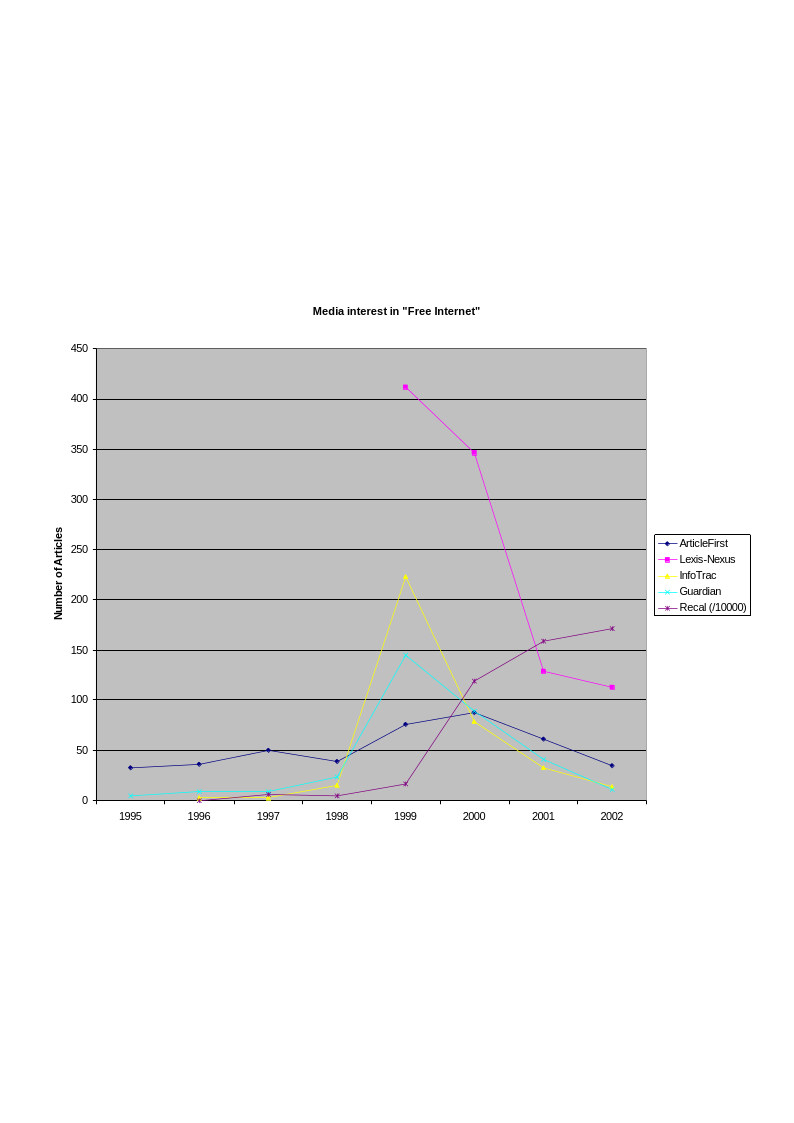
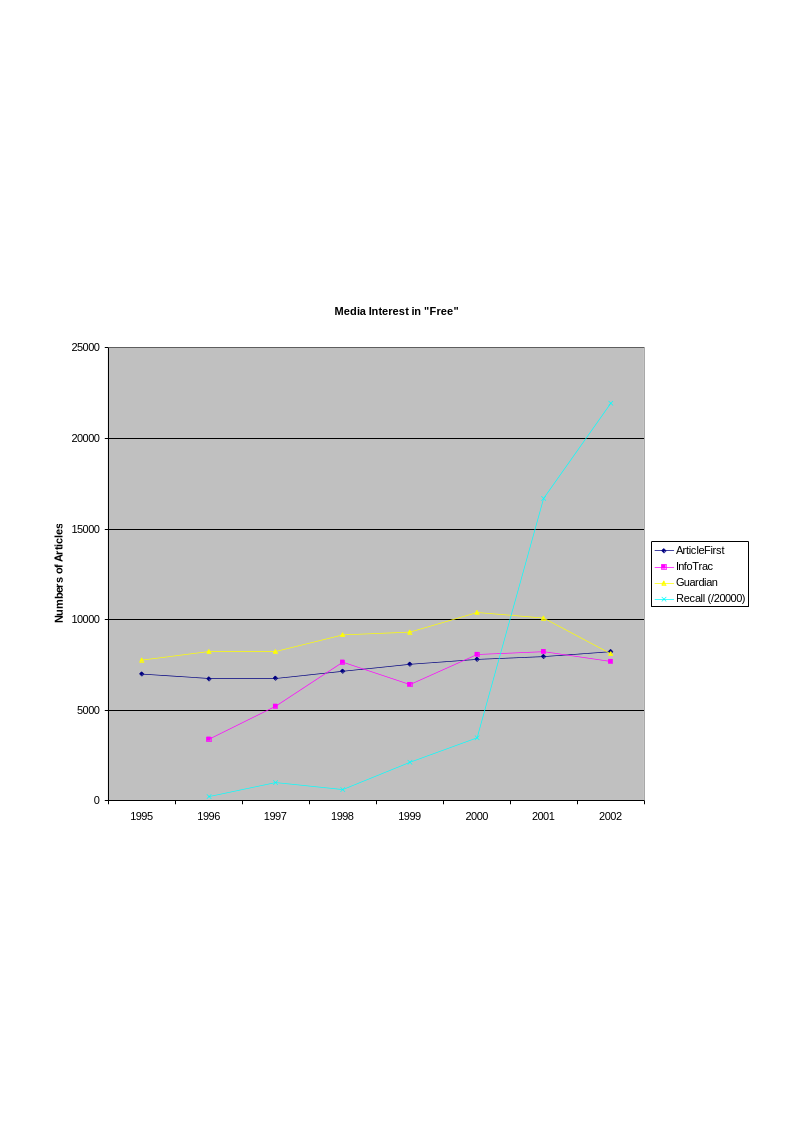
Media index sources also confirm the increasing importance placed upon the quality of freeness in a broad cultural sense with greater degrees of subtlety. The Guardian Newspaper database, the InfoTrac Executive newspaper database and ArticleFirst can all present results on a year by year basis. These multiple sources of data verify a broad and increasing interest in freeness that is not ‘simply’ a consequence of the design or format of an individual database. While the increase is not as dramatic as that found through web-based indices the increasing presentation of ‘free’ and ‘free AND internet’ within articles indexed by these services is still noticeable. These print indexes also reveal that the increasing interest in freeness has slowed and that in the case of ‘free AND internet’ the number of articles has returned to 1998 levels after a surge of interest in 1999 and 2000. The ebb and flow of activity can be partly explained by the collapse of the speculative ‘dotcom’ boom when many of the ‘free internet’ providers failed to achieve their claims and were forced to change their business models (McCarthy 2001, 222; Savitz 2001).
Participation
The village had institutionalized all human functions in forms of low intensity.… Participation was high and organization was low. This is the formula for stability (McLuhan 1994).
Hot media are, therefore, low in participation, and cool media are high in participation or completion by the audience. Naturally, therefore, a hot medium like radio has very different effects on the user from a cool medium like the telephone (McLuhan 1994).
The attitude for participation is not as readily evidenced in the collected research data as the quality of freeness. The classification process of the collected data presents a rudimentary and subjective distinction of search terms. One of these divisions represents actions and separates them from classes of objects, specific items or indefinite terms (Appendix 3 - Union list, alphabetical listing). Identification of action was not a simplistic classification of all the search terms that could be constituted as verbs. Search terms were identified by the results that are generally return and the expected relationship that the person conducting the search would have with these results. Terms were marked as being actions if they implied that the person conducting the search would consequently be engaged in some form of related physical activity associated with the term. Terms such as ‘education’, ‘lesbian’, ‘lifestyles’, ‘hairstyles’, ‘pumpkin carving’, ‘download music’, ‘masturbation’, ‘send flowers’, ‘mortgages refinance’ and ‘lingerie modelling’ were all classified as implying a directly consequent human action. Other terms were classified as actions because they implied specific actions even though they might not necessarily be conducted by the person actually conducting the search, including terms such as ‘jihad’, ‘fisting’, ‘human cloning’, ‘nudism’, ‘underagesex’ and ‘terrorism’.
Some specific terms have a clear connection between a desire for participation and the gathered search terms including most notably ‘chat’ and ‘chat rooms’. However the importance and significance of the desire for participation is that it is not restricted to any specific part of the Universal Decimal Classification scheme or to particular groups of terms. Desire for participation can be found in all aspects of the classification scheme reflecting an underlying cultural attitude (Appendix 4: Union List of Terms sorted by Classification).
The desire for participation is also closely associated with other traits of the cultural complex and most particularly the desire for freeness and customisation. The anonymity and perversion aspects of the cultural complex also interact with the desire for participation but these qualities moderate the clarity with which a desire such as this can be identified through the research data. Chatterjee (2001, 75) argues with respect to Internet-based pornography that this material “may be implicated in the construction of new cyber identities - users of pornography in cyberspace can no longer be seen only as passive and inert consumers, but also potentially constructed and deconstructed through their interaction with cyberpornography.” Tyler (2002, 203) also identifies a “group of people whose life might be changed by the Internet are those who have some taboo aspects of their identity, whether the desire to engage in socially frowned-upon activities, the desire to express extreme views or some other issue.” Participation is an essential aspect of perpetuating cultural practice in general and can be discerned in some way with the examination of any cultural material. The gathered data reveals a specific range of activities and the specific forms of participation in contemporary cultural practice that individuals searching the Web seek to gain knowledge of and, possibly, undertake.
Previous research that considers the impact of the Internet upon the degree and form of individual participation supports the claim of this research that participation is a central aspect of contemporary western mainstream culture. Baudrillard (1993, 77) observes the significance of participation in contemporary culture. “Deplore it as one might, the fact is that two hundred seats smashed up at a rock concert is a sign of success. Where exactly does participation pass over into too much participation?”
Do-it-Yourself / Customisation
If you want transparent screws to match your acrylic case, or for any other modding purpose, then this guide will show you how to go about making them. If you make your own screws does that make you hardcore? Yes (http://www.casemodgod.com/howto.htm).
A long-lasting and persistent aspect of computing in general is the desire to do-it-yourself and for customisation. The desire to customise predates the widespread adoption of graphical user interfaces such as Microsoft Windows and was a capability available in the earliest multi-user Unix based systems in the form of, for example, .login, .logout and .cshrc files (Sobell 1985, 268). While the initial reason for this flexibility was to enable individual users to customise their operating system’s environment in order to allow them to accommodate their technical requirements it was also utilised to personalise the environment in a more aesthetic sense. The original Apple computer was Steve Wozniak’s do-it-yourself project developed in his garage to impress his friends at the ‘Home-Brew Computer Club’ (Cringely 1996, 62). The Apple Computer company and its Macintosh range of computers have subsequently become one of the key hallmarks for computer-based customisability and aesthetics.
The capacity for customisation has been extended and increasingly represented as a feature of the recent releases of operating systems based around graphical user interfaces. Major contemporary systems include Macintosh OS, the many variants of Linux as well as the range of Microsoft Windows releases. As operating systems have become increasingly modularised the number of aspects of the system that can be modified to suit personal tasks has increased. Increased technological capacity has resulted in the introduction of ‘skins’ - the configurable visual components of an application that ‘wrap around’ the functional aspects of the software.
The technical capability of an artefact to be customised does not in itself create the desire for an individual to actually undertake some form of customisation. A key factor that limits an individual’s ability to customise an operating system is the need for appropriate, alternative graphical images. Different items of the computer system that can be customised have different technical requirements and more mundanely require a ‘good’ image to use. It is this need for alternative images that provides the clearest and more direct indication for the prevalence of this attitude. The customisable items found in the data gathered from the Web based search engines include ‘winamp skins’, ‘fonts’, ‘wallpaper’, ‘icons’, ‘screensavers’ and ‘wav files’ (a format more commonly used for Windows system sounds than for music files). The rising interest in these specific types of customisations is reflected in data obtained from the Recall search engine (recall.archive.org). Comparing the results for these specific artefacts against the estimated number of Web sites (wcp.oclc.org) between 1998 and 2002 shows a steadily rising number of opportunities to customise a computer (Figure 38).
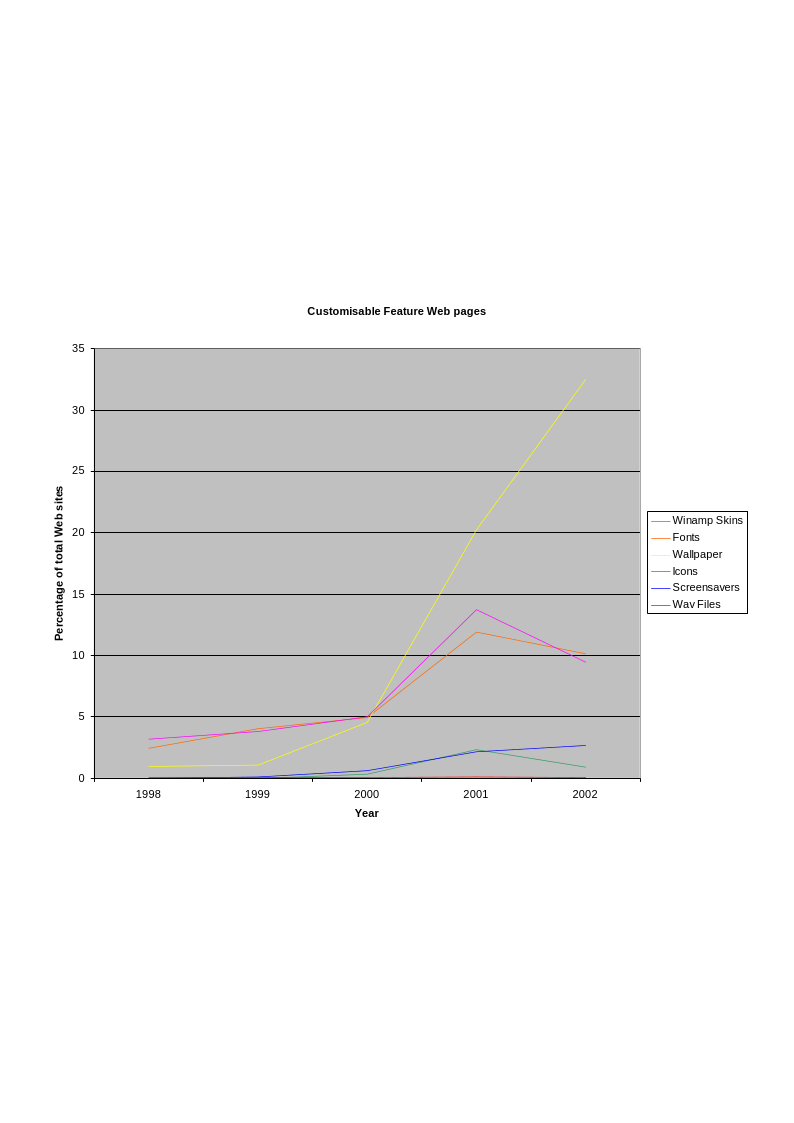
There is a history of customisation within material culture studies that relates to artefacts which predates information technology by thousands of years. Carvings and markings on Neolithic tools and pottery reflect similar practices of customisation (Edmonds 1997, 26 & 35; Gibson 2002, 66). In the context of information technology the practice of customisation is also a method for constructing the computer as a newly mundane household artefact. An examination of free wallpaper, screensaver and theme Web sites reveals that the most common freely available on-line images primarily relate to non-technology themes such as film or television personalities, sports stars and fantasy images. More recent releases of Microsoft Windows have also enabled customisations that remove the limits of a rectilinear window format and allow windows to be a range of non-rectilinear shapes. These capacities also enable the computer to become less ‘computery’ and increase its recognition as a household appliance. Turning the computer into a household item also gives the customer (and presumably its primary user) control over a complex and ill-understood technology. The desire for customisation of computer technology is not - in this sense - far removed from the carving of an abstract symbol into a utilitarian tool. Customisation ultimately provides an illusory sense of control and power over artefacts (Spier 1973, 5). Providing a level of superficial surface flexibility through computer technology enables issues of political and hegemonic control to be obscured from the majority of ‘users’.
The prevalence of the desire to customise and control technology is also revealed by the increasing number of specific and technical customisable features for information technology. A range of software is available to simplify the process of customizing and modifying a computer system. Software such as EzyWin and mySB from the Australian publisher SayeSoft (www.sayesoft.com.au) allow users to change and animate the startup screen, start buttons and system menus of a Windows XP installation. More technically skilled users of computer technology customise their computer cases, add larger internal fans, incorporate cool fluorescent tubes, build water cooling systems and add full sound systems (e.g. www.hitechmods.com). Computer customisations known as ‘mods’ shift from the simple manipulation of software to encompass the entire computer system. Sophisticated modifications allow a computer to run faster (more accurately the CPU has been overclocked and the modifications cool the machine rapidly enough to prevent it from burning out) all these technically adept activities underlie the more central issues that humans seek to exert control over artefacts and to individually ‘mark’ the artefacts that they possess.
Anonymity & Privacy
Anonymity Is Dead. Long Live Pseudonymity (Brøndmo 2004).
Jones (1994, 81) suggests that the significance of anonymity and privacy in relation to contemporary culture is an unsurprising relationship by claiming that “the social construction of reality is precisely what information gathering is to many people – with the difference that electronic media permit (and necessitate) that construction to be private.” Foster (1997, 26) comments on the dangers of this desire within computer-mediated communication and particularly the Internet when he identifies “solipsism, or the extreme preoccupation with and indulgence of one’s own inclinations is potentially engendered in the technology. The reification of private space occurs as one’s own idiosyncratic world view acts as a protective enclosure against the onslaught of a brave new world of information.” Desire for privacy has been practically expressed in a number of recent developments of Internet technology; the most visible of these being the concern that eCommerce must protect the details of credit cards being sent electronically (Bradley et al 1996). Filesharing and Peer-to-Peer (P2P) networks also emphasise to various degrees the anonymity of the exchanges that are occurring. In the context of the gathered research data it is the search terms themselves that show the extent that users of search engines are confident of their anonymity and privacy. The range of terms that reference sexual violence and deviance reflects a specific (anonymous) relationship between the individual searching for terms, the search engine, the Internet and mainstream culture. The seemingly aberrant nature of these terms shows how these activities are understood as being enacted privately outside the public realm of experience. Other terms also indicate this situation. The brief surge of interest in ‘pro ana’ and ‘pro anorexia’ is part of a more consistently sustained interest in medical and health related issues; ‘depression’, ‘dieting’, ‘apathy’, ‘women’s health’ and a variety of others.
The private aspect to the use of Internet search is also reflected in the day-to-day mundaneness of many search terms. The popularity of ‘gardening’, ‘recipes’, ‘fishing’, ‘sweet potato pie’, ‘house plans’ and ‘driving directions’ shows the domestic side of the Internet. These terms reflects the degree to which the Internet and the use of search engines have become part of the everyday life of contemporary mainstream western culture.
Literature regarding the issues of privacy and anonymity in relation to the Internet present two separate concerns. The concern that is dominant in studies of technology and management focuses upon notions of trust and the creation of trust networks (Rutter 2001, 374). Anonymous users must be positively recognised in some way by the eCommerce system in order to prevent fraudulent transactions. At the same time these anonymous users must be reassured that their financial details will not be intercepted by an (equally anonymous) third party. These discussions are generally centred upon the successful facilitation of eCommerce strategies (Jarvenpaa, Tractinsky & Vitale 2000).
The alternate and opposite perspective expresses critical concern regarding the disembodied aspects of Internet-based interaction (Miller, 1996; cf. Champion 2004). Dislocation from physical reference points in the context of online activity is discussed within both positive and negative frameworks. As a negative and destructive force the Internet impedes the perpetuation of conventional social networks and participation. More positive and utopian approaches see the same disembodied form of interpersonal communication as a facilitator for political and social action that is released from conventional constraints. Hardey (2002) synthesizes this range of perspectives to claim that the anonymity of the Internet encourages trust relationships and real world relationships.
The pervasive desire for anonymity and the enactment of searches that presume anonymity exists within the framework of a much more complex cultural situation where an immediate and apparent social anonymity is ever-present but is itself achieved in an environment that is readily surveilled and retrospectively logged. The complex interaction of technological artefacts means that nicknames and online identities are fluid and can be phantasmal. However, the location of the person crafting and manipulating this fluid identity can be geographically pinpointed with increasing accuracy (Woolley 2000, 332). Anonymity in this context is created through obfuscation - it is generally too difficult for the everyday user to access and interrogate the various disparate data sources required to identify an ‘anonymous’ Internet user.
Perversion
We called sadism a sexual perversion; but you must first have the idea of a normal sexuality before you can talk of its being perverted; and you can see which is the perversion, because you can explain the perverted from the normal, and cannot explain the normal from the perverted (Lewis 1996, 50).
Pornography is only the paradoxical limit of the sexual, a realistic exacerbation and a made obsession with the real - this the “obscene,” etymologically speaking and in all senses. But isn’t the sexual itself a forced materialisation, and isn’t the coming of sexuality already part of the Western notion of what is real - the obsession peculiar to our culture with “instancing” and instrumentalising all things? (Baudrillard 1987, 22)
An expected quality that is identified as part of the Internet and the cultural complex of contemporary culture is the pervasive presence of perversion. Perversion is defined here as being an activity or practice that is considered ‘unusual’ or ‘unexpected’ in contemporary culture. Freud (1974) presents five forms of perversion that connect closely with what is found in popular search terms. They are: disregarding the barrier of species, overstepping the barriers against disgust, against incest, against members of ones own sex and transferring the part played by the genitals to other organs and areas of the body (Freud 1974). Freud’s now dated and at least homophobic list reveals the shifting understanding of what a culture will define as perversion and by inference the extent of activities that can be recuperated by the mainstream. In the context of the Web, perversion is also activities and practices that are publicly stated as culturally unacceptable but are enacted privately. The contradictions of public and private in the context of the Internet are an indication of the close interrelationship between the six traits identified in this thesis. Perversion in the contemporary sense of the Web is culturally constructed with specific activities fluidly defined as being perverse. Baudrillard (1987, 15), in the context of discussing pornography, observes that there is a
new sprial of sexual simulation in which sex finds a second existence and takes on the fascination of a lost frame of reference… It may well be that pornography is there only to reactivate this lost referent in order to prove a contrario, by its grotesque hyperrealism, that there is however some real sex somewhere.
The gathered search terms reveal the private aspect of Web usage and the extent to which there are no boundaries within contemporary western mainstream culture to the human interest in perversion. Mehta & Plaza (1997, 58) point out the role of PGP (Pretty Good Privacy) – an encryption scheme, and anonymous servers in the distribution of pornographic material including child pornography. Internet-based tools enable the scope and forms of perversions to be experienced amongst a far larger audience with shared ‘specialist’ interests. Anthropology has famously proclaimed that the only universal prohibition to human activity is incest; this is one of Freud’s (1974) own five categories. Yet, the collected data reveals that both ‘incest’ and ‘incest stories’ are popular search terms each week in both consistent and surge lists. There is no suggestion here that those searching for these terms are intending to act upon them directly. However, the constant level of voyeuristic interest clearly assumes that representations of incest are readily (and freely) accessible and documented on the Web.
The identification of perversion as significant within the cultural complex is not solely a reflection of the impact of pornography and pornographic Web sites on the Internet although this is a significant influence in the identification of this quality. The OCLC’s estimate of the number of pornographic Web sites shows that while there are an historically persistent percentage of ‘adult’ sites on the entire Web it does not constitute a large percentage (Table 37). Balnaves (2001, 82) claims that the percentage of pornographic sites in 1999 was only 1.5% of the total Web. These authoritative estimates must be balanced against the often-cited 1998 estimate in USA Today that pornographic Web sites represent 30% of all the Web (Zyla 1998, 15). The quality of perversion, however, also represents other important aspects of the Internet including the infringement of copyright, interest in the details of ‘sensational’ murders and cheats for console games.
| Adult Sites | Number of Sites | Percentage of Public Sites |
| 1998 | 34,000 | 2.3% |
| 1999 | 42,000 | 1.9% |
| 2000 | 68,000 | 2.3% |
| 2001 | 74,000 | 2.4% |
| 2002 | 102,000 | 3.3% |
- OCLC estimate of total adult Web sites (source: wcp.oclc.org)
One Web site that reached the surge list in sixteen of the examined weeks summarises a broader interest in perversion - rotten.com - and in Freud’s terms represents an overstepping of the barriers of disgust. The site proclaims itself as “an archive of disturbing illustration.” Effectively, it is a collection of crime-scene, autopsy, physical deformities or abnormalities and other intentionally disturbing photographs. The site is not directly pornographic - although it does offer links to pornographic sites - and exemplifies the use of the Web as a means to circumvent the censorship applied to broadcast and print mediums in Western nations. The entertainment value of rotten.com - as this can be its only intended purpose - is founded on the ability of individual images to offend and horrify in a high technology equivalent of the circus freakshow. Baudrillard’s (1993, 76) comments on the terrorist attack in Belgium in 1985 when he described interest in the event as “the sort of fascination, of mass appeal, exercised by the terrorist model” can also be applied to the interest in rotten.com.
Almost every class of the collected data incorporates some form of perversion. The ‘000’ class includes cracking, hacking and warez terms, almost the entire ‘100’ class references specific pornographic web sites or general categories of sites, the ‘300’ class includes terms relating to underage sex, serial murders and cheats. Classes such as ‘600’ which groups together terms relating to ‘applied science and technology’ more subtly reflect this interest in pornography in the form of references to specific human body parts including ‘boobs’, ‘tits’, ‘vagina’, ‘clitoris’, ‘penis’ and ‘penis enlargement’. The ‘600’ class also reveals a long-term interest and detailed but private cultural knowledge of a vast range of pornographic movie ‘starlets’. However, interest in any individual ‘starlet’ is momentary with their popularity usually rising and falling in the space of a single week in a pattern that reflects the more mainstream media figures also represented in this class. Interest in pornographic starlets is only discernable in the weekly surge lists, which requires a numerically smaller number of searches to show this interest. The knowledge of specific starlet’s names, even if this is only represented in a single week of data, reveals an underlying cultural awareness of these individuals and their chosen profession. Searches for ‘Tawny Kitaen’ or ‘Tera Patrick’ are not accidental and represent a pervasive underlying set of private cultural knowledges that are momentarily revealed publicly.
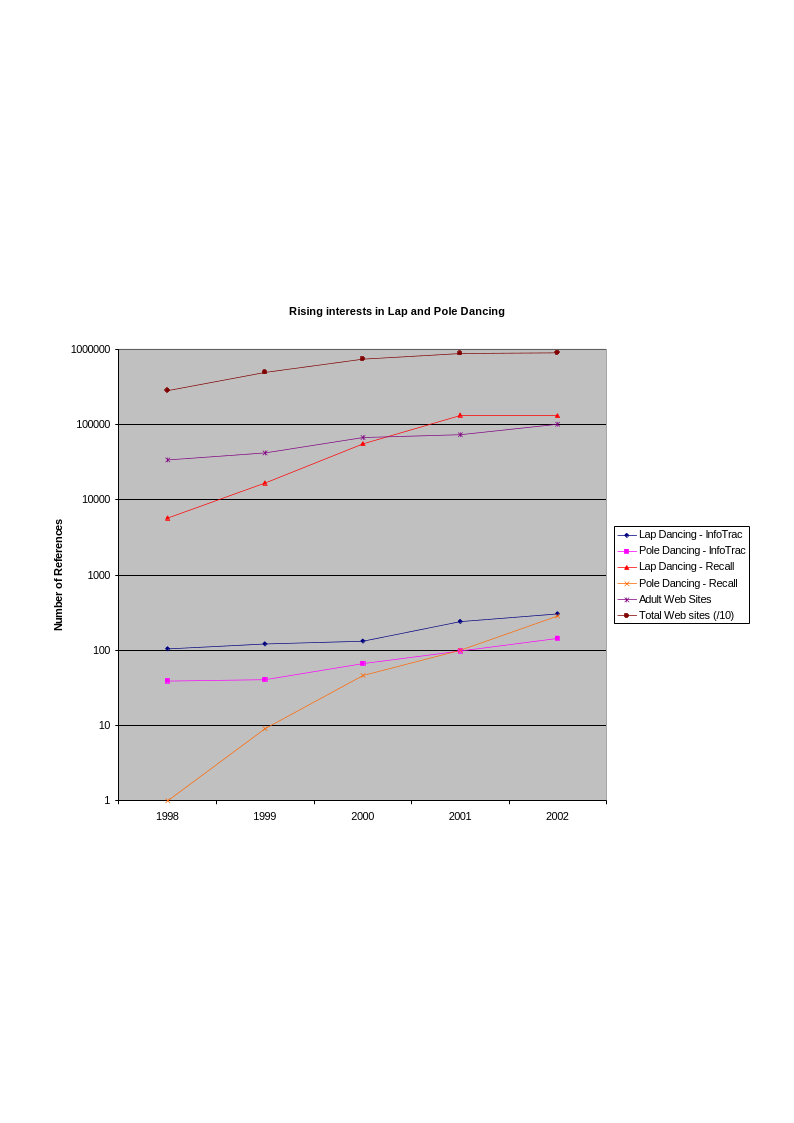
A recent confirmation of the degree that the trait for perversion identified in the search term data reflects broader cultural ideologies can be seen in popular mainstream media representations. The video of G-Unit’s remix of 50 Cent’s “P.I.M.P.” song includes three topless women dancing with the singers (the censored version is available at mpegrom.wallst.ru/sh_new.php3?video=888; the uncensored version is currently traded on Ebay.com). Other video clips have also enthisiastically embraced this exploitation of women to promote their music most notably Snoop Dog who regularly and with at least some justification describes himself as a pimp. The use of blatantly naked women crosses a boundary for music video clips - that have been seen as the most risqué of media (Ford 1999) - by being a ‘soft porn’ format rather than referencing it. This approach of referencing ‘adult’ films was most famously began with Duran Duran in their 1981 “Girls on Film” video. However, Duran Duran is not an isolated example. The cultural acceptance of pole dancing through its filmic presentations and its promotion as the ‘exercise regime of the stars’ ignores its purpose to display women for prostitution and the commodification of women’s bodies (Figure 40).
Other media representations also reveal the manner in which the perverse qualities of the Internet reflect wider cultural beliefs. The status of Quentin Tarantino as a contemporary Twentieth Century auteur reifies the media representations of extreme violence and disregard for fellow humanity as an art form. Tarantino’s films are argued to be more visually and blatantly violent than the works of previous auteurs but also as a reflection of contemporary culture (Botting & Wilson 2000). In the context of this thesis these observations regarding Tarantino appears to have valid justification.
Information Richness
Originally defined by Daft & Lengel (1986) as the “ability of information to change understanding within a time interval,” the concept has been applied with increasingly wide meanings. The capacity to transfer large quantities of specific information to individual clients is an underlying quality of the Internet that compels it to both business and private individuals. Jones’ (1994, 83) discussion of the fictional representations of virtual environments also identifies this feature. “Cyberspace is a virtual space of information, an area through which the mind, by means of a computer interface, has immediate access to a global information network. Databanks dot the landscape.” (Jones 1994, 83). The other five cultural traits identified here would be impeded without this specific quality and capability. Information richness describes the relative density of information at a particular locale. Other information rich localities precede the Internet, particularly libraries, classrooms and - in a different context - television. These ‘traditional’ locales have shaped many understandings of the Internet as a form of parallel cultural phenomena. This has resulted in the development of, for example, Internet-based libraries, e-learning and Internet-based television. In contrast to these preceding models however the Internet’s information richness is more directed, more detailed and offers a greater density of information. The multimedia aspect of the Web also enables an integration of capabilities that are not possible with other examples of information richness. The sound and images of television converge with the interactivity of a book and the immediacy of the telephone effectively intensifying the density of information that can be delivered to an individual user. The technology of the Web, specifically its hypertext capabilities reinforces the information rich experience by enabling the interlinking of distant sources into a potentially seamless stream of information.
The information richness of technological-enabled locales is particularly the focus for dispute surrounding web-based teaching and learning (Watt, Lea & Spears 2002, 64). The education perspective regarding information richness offers two conflicting perspectives. Critiques of the information rich classroom argue that increasing the density of information in this environment does not equate to be more positive learning outcomes (Lash 2002, 2). The general density of information within many spaces of contemporary cultural practice, it is argued, necessitates the development of more critical and discerning perspectives in which students are encouraged to utilise less high quality information in preference to large volumes of poor quality information. These critiques recognise the difference between the process of learning and the mere presence of large quantities of information. The alternative perspective offers the obverse opinion. The information rich classroom, it is claimed, increases the opportunities for diverse teaching practices and the means to reach students in a variety of new - and creative - ways (Bowman et al 1999). Neither of these perspectives however deny the presence of, or the opportunity for, information rich environments in a teaching and learning context and with more sophisticated applications of information technology to the classroom may not realistically be seen as contrary positions. Business, too, generally takes a positive view on the potential for information richness. This is particularly expressed in the ability to offer a dense collection of information regarding specific business practice. The advantage is a ‘simple’ economic one. Information delivered as a consequence of the client’s own volition reduces the need for staff providing the same information. Banks exploit the business opportunities of information richness by offering highest savings percentage rates for their ‘Web-only’ products. As these rates have approached (and even briefly rised above) national base rates the difference between bricks and mortar banking practice and Web-only alternatives are clearly significant.
The importance of the quality of information richness for the cultural complex also introduces another related debate regarding the Internet. The digital divide describes a coarse dichotomy of social relations constituted by the ‘information rich’ and the ‘information poor’ (National Telecommunications & Information Administration 1999; Silver 2000, 27). The issue of richness or poorness in this context is not simply determined by individual access to information rich sources such as the Web. ‘Being’ information rich also subsumes the skills to manipulate and use information to social and personal advantage. This social category is distinct from economic wealth or education, however, these and other factors do have an interlocking and positive relationship with information richness. The debates regarding the digital divide acknowledge and emphasise a growing social division that has developed and been accentuated with the increased use and acceptance of information technology. None of these debates dispute the presence of information rich locales in which the ‘rich’ of the digital divide interact and consequently benefit. Critical and emancipatory presentations of the digital divide argue for the need to reduce the extremes of this discrepancy (Mitchell 1995; Ebo 1998, 16; see Rowe 2002). The achievement of this aim is increasingly difficult in a cultural environment that incorporates an information rich environment as part of the everyday life - for the information rich at least.
The growth of the Internet and particularly the Web is itself the most appropriate evidence for the significance of the density of information and its importance in contemporary western mainstream culture. The capacity for increased information richness and density is a compelling justification for a wide range of uses for the Web including commercially, institutionally and personally. Quantifying the size of the Web, however, is notoriously variable with a range of indexes offering indicative evidence. The OCLC offers an annual calculation of total Web sites (Figure 40). This presents one metric for quantifying the Web. However, while OCLC is one of the most authoritative indicators available, it has limitations as the figure ascribes an equivalent value to small single page Web sites as it does to large central sites such as Yahoo. Indexes that estimate the number of total Web pages are also problematic as many sites dynamically generate their Web pages. For example, google.com may only be a few dozen pages in size but, when all the permutations of possible searches are considered, it may be millions of pages in size. Other sites also offer difficulties. Parked Web sites often utilise remotely hosted services from a different Web site, thus creating an exact duplicate. Estimating the number of duplicated Web pages between different servers is technically complex and requires the infrastructure equivalent to one of the large search engines to enable this form of identification. The recent but short-lived move by the domain name registrar Verisign to redirect all requests for non-existent domain names to a valid ‘holding page’ also makes the quantification of Web pages uncertain (Abreu 2003). Programmatic approaches to solving this problem, such as the large search engine systems, could readily be deceived by this strategy and this would inflate estimates of both Web sites and individual Web pages.
| Year | Count |
| 1998 | 2,851,000 |
| 1999 | 4,882,000 |
| 2000 | 7,399,000 |
| 2001 | 8,745,000 |
| 2002 | 9,040,000 |
- The total number of Web sites (source: wcp.oclc.org)
Other strategies for quantifying the Web have also been employed to overcome the inaccuracies introduced at this level of analysis. By examining the Internet at the more technical network layer an arguably less distorted picture is offered. A number of software tools have been developed that can map the Internet at this level. The most recent, opte.org, has been able to create network maps of approximately 1/4 of the Internet in a few hours. The developer hopes to eventually be able to map the entire Internet in a 24 hour period from a single conventional personal computer. In the context of this research however, despite the appeal of this approach, the network maps both the machines that are Web servers and those that are clients - personal computers. The growth of the network reveals increasingly personal connection and interest in the information rich environment of the Internet but it does not directly indicate the detailed development of that environment.
Contemporary Western Mainstream Culture
This research refers to a culture that is hallmarked by the cultural complex of artefacts that are themselves revealed through the collation and examination of the most popular search engines terms through a 16 month period. This culture is described as ‘contemporary’, ‘western’ and ‘mainstream’. None of these terms are unproblematic and, consequently, they are not utilised without critical examination and explanation. This description is also used in distinction and preference to descriptions such as ‘mainstream’ culture. The intention is not to label the artefacts and traits of the cultural complex identified and described in the analysis of Chapter 5 as being solely representative of this culture. The Web and the Internet intersect with the everyday lives of participants of many cultures in a variety of ways. In turn, the cultural practices conducted on the Web do not in themselves constitute a single and separate culture - a claim that was, at least, implied in some early theorisations of the Internet (see Burnett & Marshall 2003, 25). The problematic definition of the term, culture, also makes the identification of a culture based on the available evidence problematic. By labeling and defining the ‘culture’ that is implied in the identification of a series of desired artefacts and revealing the traits of the cultural complex mitigates the definitional ambiguity but it is although not entirely effaced. Identification of a cultural complex in an archaeological context is seen, in the absence of any other evidence, as being representative of the culture itself (Spier 1973, 5; Bahm 1992, 110; Gibson 2002, 137). However, evidence gathered from the Web and the Internet is not undertaken in an environment with such a paucity of material. It is consequently inappropriate to make a sweeping generalisation through the identification of an undifferentiated ‘mainstream’ or sweeping ‘western’ culture. My research offers tentative observation of many parallel ‘mainstream’ and ‘western’ cultures. Cultural complexity reveals the intricate balance that exists in the description of a particular series of cultural traits and desires. The identification of an all-encompassing culture - such as ‘western’ - involves a small number of artefacts and traits that are claimed to be essential and show a thread of commonality between groups of people and their practices. At the narrowest level of identification the difference between culture and sub-culture can become blurred. A tighter combination of interrelated traits and artefacts offers a more detailed perspective on a smaller group of people (Hebdige 1979, 76).
The gathered evidence supports identification of a coherent cultural complex that is representative of a pervasive and dominant set of cultural attitudes. The ‘Top 500 Search Terms’ used here reveals the continued popularity of specific search terms against a much larger background of millions of possible terms. In this way the collected data represents an average and distilled set of interests. There is no suggestion made by this current research that participants in contemporary western mainstream culture all share the same degree of interest, or even any interest at all, in all the artefacts being sought at the core of the cultural complex. The relationship between the cultural complex that has been identified, any specific culture and the participants of this or other cultures is a less definite and more fluid series of relationships. However, the artefacts and traits of the cultural complex do influence and have meaning to individual members of contemporary culture(s). The cultural complex is meaningful to participants of a culture because of their enculturation within it rather than as a directly observed museological experience. While no one person can be identified as holding an interest in all of the artefacts that are desired through the search engines or in subscribing to all the traits of the cultural complex many people do connect to many of these artefacts and traits in various combinations of circumstances. 200000 separate searches for ‘google’, 60000 separate searches for ‘incest’ or 40000 separate searches for ‘zip codes’ each month reveal a variety of juxtaposed interests. The evidence utilised for the Achelian or Aurignician cultures is informative here (Spier 1973, 6). The Achelian cultural complex includes evidence for the use and working of obsidian to create workable and incredibly sharp handtools. This evidence is received in the form of shards and remnants from the activity of creating these tools. However, it would be presumptuous and an over-reading of the available evidence to suggest that all Achelians were skilled obsidian craftspeople. Achelians, however, as a definite group of people did gain advantage from these stone tools. It is impossible to ascertain the level of awareness Achelians had regarding these artefacts but they possessed a definite long term relationship with them. Consequently, the traits of this culture are influenced by this combination of humans and artefacts. The importance of these specific tools within Achelian culture cannot be reified as the only material for tools of this culture or present the implication that it is only material artefacts that shape cultural traits - other less persistent materials in the archaeological record may also have been used. In effect the cultural complex does not represent a definitive collection of artefacts and attitudes that are drawn from a specific culture but are instead a series of tendencies and preferences that reflect the attitudes and activities of that culture at a particular historical moment. The cultural complex becomes - in the archaeological context - the defining aspects of a culture rather than reflecting it.
The use of ‘contemporary’, ‘western’ and ‘mainstream’ to describe this culture indicates the influences acting upon the cultural complex and the artefacts that are most sought after within it. It is ‘contemporary’ in the sense of immediacy and currency. The artefacts that are being sought reflect current understandings and attitudes towards the social world and its current composition. The contemporary aspect of these desires is reflected in the seeking of specific software titles, companies and Web sites. These are artefacts that currently have significance and meaning in themselves without becoming generic categories of goods. These are also, in most cases, artefacts that did not hold the same meaning or relationship to a specific artefact five or ten years ago and may equally relinquish that meaning within the next ten years. The level of dynamism reflected by this fluidity in the meaning of contemporary culture does not imply that the specific artefacts identified in the cultural complex are themselves temporary. Individual artefacts are significant for the current moment in a continuous but connected process of development and evolution that builds upon what has come previously in an artefactual and cultural sense and which will provide and inspire the artefacts that will become contemporary in the future. The recent evolution of file sharing software already exemplifies this process. The significance of Napster as the first file sharing application to gain popular acceptance was its capability to digitally concretise the practice of ‘taping’ and other means of music reproduction that had been practised since the ready availability of the cassette tape. However, Napster’s predominant position as the premier file sharing application has been lost with escalating legal action from the recording industry and the US-based RIAA (news.findlaw.com/legalnews/lit/napster/index4.html; see also laws.lp.findlaw.com/9th/9856727.html). The pursuit of these applications by the recording industry has shaped the structure and formats of file sharing application in order to shift responsibility regarding copyright to the users of the system rather than the system itself. This lack of decentralisation was a key reason why Napster could be pursued legally for copyright infringement, the system kept track of files – irrespective of whether they were legally copied or not. However, a variety of other systems have subsequently proliferated that are legally more difficult to pursue including Ares and BitTorrent (Ricart-Costa, Subriana & Valor-Sabatier 2004, 102).
‘Western’ is used in a similarly fluid and indefinite way to describe the artefacts and traits of the identified cultural complex. ‘Western’ has increasingly become a term of derision and indefiniteness in the light of scholarship that questions monolithic categorisations of what is an amorphous concept (Fox & Gingrich 2002, 3). These uncertainties suitably reflect the amorphous artefacts, practice and attitudes identified within the cultural complex. ‘Western’ is used as an exclusionary device to indicate a culture related to a range of nation-states including Australia, the United State and the United Kingdom. It is also a description for the media-obsessed, event-driven and consumption-oriented situations that are experienced in these, and other, nations that reify the average lowest common denominator experience of everyday life. ‘Western’ is not intended to be a description of a monoculture but rather of cultural practice in which difference is subsumed, recuperated and consumed until it eventually becomes part of then everyday until it is then discarded. An indicative example of this ‘western’ cultural practice of consumption can be found with the popularity of searches for ‘tattoos’. As a form of permanent body modification tattoos are traditionally the preserve of specific employment categories, traditional cultures or secret societies. However, the western acceptance of tattoos and their introduction into everyday life propels the interest in tattoos as a search term high into the list of regularly desired and sought after artefacts.
The culture being examined is ‘mainstream’. This is a term used widely to represent the inherent power relationships and structure that shape and define contemporary hegemonic culture (Oakley 1998). De Bord (1994, Thesis 23) also observes that “at the root of the spectacle lies the oldest of all social divisions of labour, the specialization of power. The specialized role played by the spectacle is that of spokesman [sic] for all other activities, a sort of diplomatic representative of hierarchical society at its own court, and the source of the only discourse which that society allows itself to hear.” The use of this term reflects the expansive scale of the culture being discerned from activities of seeking and desiring artefacts through Web-based search engines. Subtleties and variations of practice that can be discerned in and are a part of a culture are effaced by hegemonically dominant cultural attitudes. The data gathered for the current project is only capable of revealing these aspects of culture because it relies upon the popularity of individual search terms over a defined period of time. For an individual term to appear in the lists of persistent search terms its popularity must be sustained for at least four weeks. What is revealed of this mainstream culture is a relatively consistent series of general interests (Figure 4). From the evidence of these lists the traits and artefacts of this culture are hallmarked by generic categorical terms such as ‘jobs’, ‘jokes’, ‘bikini’ and ‘pictures’. The popularity mechanism that determines which terms will appear in a list largely prevents any detail from being represented. Collecting the ‘most popular’ ters leaves only broad meaning to be revealed through the popular terms that describes the gendered hegemonic mainstream aspects of this culture. These are the dominant attitudes and interests that reflect a primarily masculinist perspective. This is an acknowledgement of the androcentricity of contemporary culture that can be directly seen in the persistent interest in, for example, named pornographic Web sites, generic sexually oriented terms such as (presumably) ‘lolita’ and ‘beastiality’ [sic] and categories of artefacts such as ‘autos’ and ‘kelly blue book’. Being mainstream does not imply that the interests of the cultural complex are exclusively masculine. There is sufficient variety of terms that reveal what may conventionally be regarded as feminine, such as ‘baby names’, ‘recipes’ and ‘hair styles’. These ascriptions rely on classical, supposedly natural and prejudiced dichotomies of maleness and femaleness. Considered together this is a combination of attitudes and desires that is mainstream culture.
The argument that mainstream culture is hegemonically masculine is also a tacit critique of the arguments regarding gender fluidity (Poster 1990; Stallabrass 1995; Turkle 1997; Dodge & Kitchin 2000, 23) online. These arguments suggest that gender becomes increasingly fluid when a user of the Internet is online. However, to subscribe to this argument reinforces the ‘virtual’/reality dichotomy and is similarly based on the single premise that physical presence - in the same sense as artefacts - is the primary determinant of gendered identity. The mainstream argument however suggests that the composition and form of contemporary culture is so immured in the power relations of gender identity that to escape ‘simply’ by going online disregards the mediation of this influence.