There’s Nowhere to Begin — So Let’s Start
We are dealing with a function of the mind. Some might say the brain, but a sage once remarked that the parts of the brain appear to add up to more than the whole, so let’s not be too specific.
Innovation has something to do with thinking and thinking has to do with thoughts. So far, so good! What are thoughts made from? Can you see them? Yes, by George! Or, like atoms on a microphotographic plate, you can see where they’ve been, which is almost as good. The tiny little electric charges that whizz round the brain actually leave scars (or follow scars left by previous charges). This suggests that they are going from one place to another; and it’s fairly safe to assume that they travel with some purpose. If you look at a hugely magnified area of the cortex of the brain you will see also that the scars seem to gather at certain points, like infinitesimal railway junctions. Throughout the brain there are countless millions of scars and junctions. Let’s call these junctions ‘neuron complexes’. The brain of an unborn child shows comparatively few of these. That of an infant shows many more. That of an adolescent has such a dense mass of them that they become almost indistinguishable.
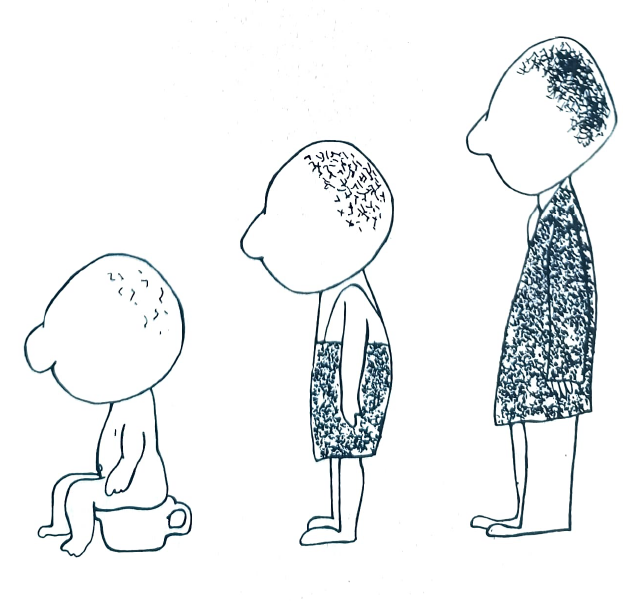
These are the collected stimuli that the brain takes in and etches for further use—never to be forgotten.
How does the brain translate received stimuli into this usable form? One knows. Fortunately, we don’t need to. Let’s simply use a figure of speech and say that the brain is a computer that makes its own symbols. Come to think of it, all our communications are in symbol form. Words, pictures, gestures, smells, sounds … And when the brain thinks, it is communicating with itself, using its own symbols to represent the ‘outside’ symbols that the conscious brain admits.
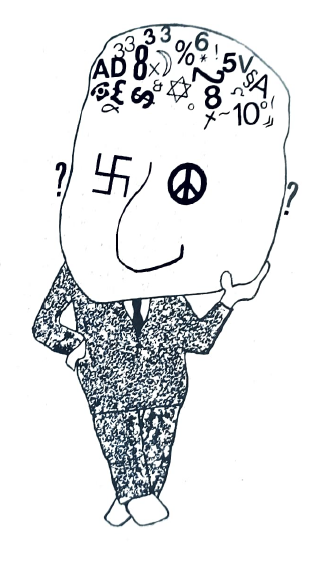
Jung—in ‘Guilt and Symbolism’—makes the point that the essence of a symbol is that it cannot be defined. This is an important detail to bear in mind. To take a few obvious examples (obvious in that they evoke emotional response)—the swastika, the Star of David, the black flag of anarchy, the red light of danger, the air-raid siren—these symbols all mean a great deal but they can’t be defined. They are themselves definitions, in a sense. Now this is true of all symbols, emotive or not. Even mathematical symbols like 1, 2 and 3. When we use these word-symbols to converse we use them as though they are precise; in fact they are extremely vague. Similarly, when your brain communicates with itself, it uses inexact concepts as though they were exact in their meaning. In fact, it gets even more complicated than that.
But first, let’s assume that the brain has a method of filing things in some sort of order. Let’s also assume that the ‘neuron complexes’—the junctions—are something to do with this method. (This really is an outrageous assumption, but it is a damned good, if ephemeral, stepping stone!)
Suppose that, as an infant, you are exposed for the first time to the new visual stimuli caused by seeing a dog. Within a few minutes, the simple visual symbol is extended by other related and more particular symbols—the dog’s movements, his colour, his texture, his noise. These all form a ‘dog-reference’ centre in one or more neuron complexes. Many of the dog symbols are related to previously received symbols and reference centres. If it is a black dog then a scar is etched linking the reference centres for ‘black’ to the newly forming reference for ‘dog’. So these reference centres grow in complexity with each new stimulus. If the experience is repeated (e.g. another black dog is seen) the electric charges do not have to etch new scars; they can follow existing ones. But of course no two experiences are ever identical so there must always be some new scars made. (Just a thought; is it not observable that the more intelligent and sensitive a person is, the more disturbed he becomes by repetition? Could it be that repetition ‘coarsens’ the channels, causing a sort of mental sclerosis?)
However, to go back to reference centres. Let’s suppose that there is another centre or group of neuron complexes related to ‘heat’. What happens when you are then exposed to the symbol called ‘hot-dog’? Whether you actually see the Frankfurter sausage simultaneously with hearing the word for it or simply hear the word only, the result is the same. You have to use at least three previously unrelated reference centres in order to build a new one for it. You need ‘heat’, ‘dog’, and ‘sausage’ at the very least. And, for a long time afterwards, the word-symbol ‘hot-dog’ will strike you as absurd, even if you hear it a great number of times, because, I would guess, the totally unrelated components that contribute to its reference centre sit very uncomfortably together. Just to show how vague are the symbols we use to communicate—and which the brain uses to think—this simple (and tiresome) expression ‘hot-dog’ can also represent its literal manifestation—a panting pooch—or, in the case of an American infantryman after a route march, sore feet; or a somewhat old-fashioned expression of delight; or a specific condition of part of an antique fireplace … or—is that enough?
When we use a symbol to communicate, or when we are thinking logically, we know the context in which to place the symbol, so other meanings don’t interfere with its use. For practical purposes, we can pretend that we are using it with precision. But the mind has a subconscious mind of its own. And in this function it has to use the same symbols without environmental demands of precision.
What happens then?