Great Discoveries Are Never Accidental
A while ago, we tried to find one famous innovator who was not eccentric. And, if you haven’t tried the exercise before, you were possibly surprised.
Here’s something else that may surprise you. Every single great discovery is ascribed to serendipity. They have all been called accidents. Now why this should be I do not know, unless we all have a dislike of innovators and this compels us to belittle their talents. Here are some examples: Newton accidentally struck by a falling apple; Fleming noticing an absence of pathogens on part of a culture; Mendeleev seeing the periodic table in a mosaic design; Watt watching the kettle lid rise (pure nonsense this—he didn’t invent the steam engine, he made the existing one work properly); Kekulé seeing the benzene ring ‘snake’ in the embers of a fire; the Curies noticing a glow in the dark; Faraday putting the plug in the wrong socket and discovering the electric motor; Archimedes spilling the bath water … there’s a million of them.
So, if they were accidents why didn’t they happen to Newton’s housekeeper? Or any one of thousands of laboratory technicians who had looked at cheese mould? Or the man who designed the mosaic? For the very simple and obvious reason that they could only be discovered by people who were looking for them and knew their significance when they saw them. Which means prepared minds, curious minds, eccentric minds and courageous minds.
Newton was the only man in the world who was about to get there at that moment in history and if it hadn’t been the apple that his subconscious used it would have been something else, soon afterwards.
Similarly, Fleming was ready for what he saw. He, too, had a heightened perception of a common phenomenon that acted as a catalyst. (I once read a clinical paper about antibiotics, written by a group of Japanese doctors. It departed from the usual medical, objective reportage in order to belittle Fleming by stressing that his discovery was a fluke. Bitterness can run deep!)
The same applies to all innovations. If they were accidental they would happen at random and only once in a lifetime. All the innovators mentioned above had strings of substantial discoveries to their credit. And they were deeply involved in the spheres in which they made great breakthroughs. But they were not considered academically sound by their contemporaries until their achievements became recognised. They were odd balls, every one.
Let’s look at one or two of these histories in a little more detail and see how the processes fit in with what has been said so far.
Watt was a clever, unconventional engineer. He was wrestling with the problem of Newcomen’s steam engine which was seizing up all the time. He put down his pen, went out to play golf and put the problem right out of his mind. The story (which may be apocryphal) goes that he was waiting to drive off the tee, following a rain storm, and noticed that a pool of water on the ground had a very shallow film of water leading off from it. In the bright sunshine the filmy patch evaporated while the pool remained unaffected. At that moment he realised that to make the engine work it had to have a separate boiler and condenser. Eureka!
Mendeleev was intrigued by the reports he read of new elements being discovered. Each one was isolated by ingenious research. Surely there must be some scheme to chemical structures, he thought. (We know that now, but what made him think about it then?)
He knew the characteristics of those known elements and knew there must be more, because his mind was up-to-date and prepared. He, too, decided to take a break from work. He went for a stroll round a cathedral, he looked at a mosaic—what could be consciously further from his mind than chemistry?—and received a heightened awareness. Keep looking, his subconscious said, that’s it. And it was. All the elements laid out in a family tree.
Faraday took two of his monstrous generators to a trade fair in Germany. Bear in mind that this was the gas age. An electrical contrivance was regarded as comical and useless. One of the generators was started. A labourer employed on the stand—there was no such person in those days as a technician or electrician—took the lead from the idle generator (in mistake for the lead to the string of light bulbs) and whacked it into the working generator. The idle one came to life, in reciprocal action. The onlookers fell about laughing. Faraday must have been surprised too. But he quickly realised that he was looking at an electric motor—a concept which was extremely sophisticated when you consider that electric power itself was not in use except in laboratories at that time.
One point to note in each of these three episodes—and it crops up time and time again—is that the moment of illumination happens when the innovator is not consciously applying himself to the problem. It looks very much as though logical analysis and conscious application have to cease in order for the subconscious projection to break through.
This makes sense if you accept that logic cannot lead to innovation, as suggested before, and that the conscious mind is restricted almost entirely to logical modes of thought, which must somehow be interrupted.
The implication is that, far from concentrating hard to find an original solution, one should not concentrate at all, so that there is a hiatus which the subconscious can use.
There are two clichés about genius. One defines it as ‘an infinite capacity for taking pains’. Another would have us believe that genius is ninety-nine per cent sweat and one per cent inspiration. I think both these are grossly misleading. The first should be rephrased: ‘an infinite capacity for curiosity and daring thought’. The second should be ‘ninety-nine per cent preparation and one per cent alertness’.
Another quality that one finds common to all great innovators is that success and encouragement improve the quality of their thinking and make them more daring. In this context, success and encouragement do not have to come from outside—although this helps. Innovators tend to be introspective and make their own standards of success. If we move away from physical sciences and into art forms, do you see how, for instance, three towering geniuses like Shakespeare, Rembrandt and Beethoven all demonstrate constant advance and improvement? Shakespeare’s plays improve chronologically, if a little unevenly (with one or two pot boiling exceptions, like Titus).
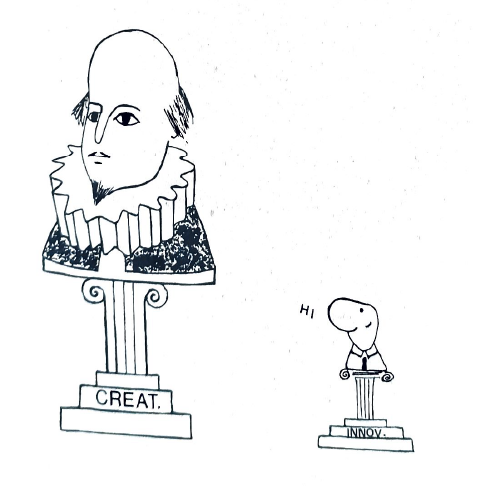
Rembrandt’s series of self-portraits go deeper into the soul and become more daring in technique. Beethoven worked to tighter and tighter disciplines while breaking more and more rules until with the C-sharp minor quartet he reached the zenith of the art form. Then with the final quartet (No. 16) he broke through into another world completely—this last work could have been written a hundred years later. God knows what his contemporaries made of it!
Occasionally, of course, a genius goes off the rails and makes a mistake. And it’s usually a beauty. Beethoven’s (ascribed) Battle and Jena symphonies. Shakespeare’s Pericles and Titus Andronicus. Michaelangelo’s St. Peter’s (St. Paul’s is better proportioned). Milton’s vain obsession with obscure classical allusion. Aristotle’s mischievous and dishonest medical pontifications. And (just for fun), Charlie Chaplin’s Monsieur Verdoux.
But the thing about these men is that failures bothered them little. They just forgot about them. Whereas orthodox experts try to avoid mistakes at all costs and bury them feverishly when they happen, the innovator is much less concerned. Although introspective, he is more outward-going, more generous and philosophical in attitude. He wants to give.
He seldom collects wealth because he needs only enough to indulge his imagination. He also suspects honours and adulation because they tend to corrupt and lead to contentment, when all his vital motivation comes from discontentment and restlessness. This is not to say that the innovator does not need encouragement and recognition. Of course he does, and he will respond to them very well. Praise and reward—especially when spontaneous and unexpected—will create an immediate feeling of reciprocation in him to outdo the giver. In more orthodox people, I suggest that praise and rewards are rationalised as ‘payment in arrears’ with a lesser sense of obligation involved.
One thing they don’t like however, is to have it implied that their creations are happy accidents. The man who utters such a thought is merely revealing himself as ungenerous and unaware of the courage needed in innovation.