Two Brains? — Crazy!
New ideas can be formed only in the subconscious. This statement will have the scientists among you laughing like drains. I can only say that if you are a scientist this book is not for you. Anyway, I think I can prove it.
Any elementary psychology book will present you with a list of mental states, such as conscious, preconscious, subconscious and unconscious. It would also be stressed that these states are not separate or divisible; they overlap, interact, intertwine and otherwise confuse the issue. This does not suit my particular line of thought so I’m going to ask you to assume something quite different. (As Sam Goldwyn is alleged to have said, ‘Don’t confuse me with facts.’)
Imagine that you have two separate brains. One we’ll call ‘conscious’ and the other ‘subconscious’. Keep believing that from now on.
The conscious brain is the only one you are aware of. Hence the name. You are using it now and, no doubt, it is doing a fine job. This brain is concerned entirely with aspects of self-preservation, which is why some screwballs believe that free will doesn’t exist. It is always logical, even when it thinks that six times nine is sixty-three, because wrong facts can still be used in a logical way, if you follow me.
The subconscious brain, for our purposes, is the seat of emotion, instinct, metabolic control, dreams and innovation. It is mainly illogical in its function because it has no need to be anything else. It makes its own private arrangements, so to speak.
These two brains are linked in a reasonably friendly way. In a healthy person, the subconscious brain is devoted entirely to its owner.
It is also a veritable powerhouse of thought; it makes the conscious half seem puny. This brain can actually think without symbols when it wants to. That is astonishing.
The two brains have common access to the memory store of symbols received and etched. (Imagine the despair of a neurologist who’s trying to discover the nature of memory as he reads that bit. Pure nonsense! But it serves our purpose.)
But, as we have seen, these symbols are vague things. The two brains are not going to use them in the same way, nor will they use them to represent the same concepts.
The conscious brain will use them in what it believes to be a specific, precise communicable way—as though addressing another person. The subconscious will use them in a totally practical way, to construct its own sublime fancies with virtually no reference to the outside environment.
Now let’s look at what happens with a new idea. The sign adopted by the ban-the-bomb crowd was this:
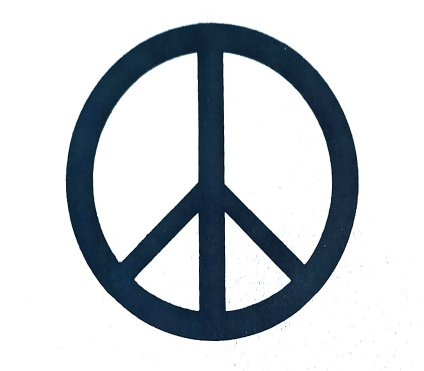
It evolved from this representation of the critical mass in an atom bomb:
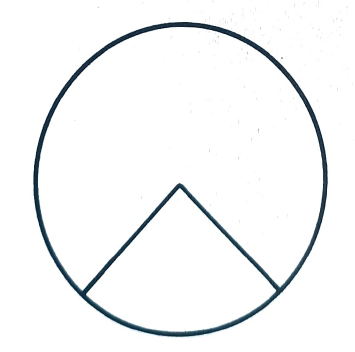
As the small section is thrust into the big cake of uranium isotope, it forms the amount necessary to start a chain reaction. Kerpow!
This concept was first formed, probably, in the mind of Rutherford. Before that, it didn’t exist. If the symbol for the concept didn’t exist, how was it ever expressed?
Your conscious mind is logical, and—if you’ll forgive the expression—limited. It’s limited to what it knows. Limited to its memory store. So was Rutherford’s. So where did this new concept come from? How was it first expressed?
For reasons which will become clear, the new concept came from the subconscious. And it was first expressed as an absurdity by his conscious mind, which then rationalised it by applying known logical references in place of the absurdities. (Don’t bother to sort that one out just now. Read on.)
The main thing to remember here is that your conscious brain uses symbols in a logical way while your subconscious uses them in any way that takes its fancy. But, since both brains have different functions, an hiatus occurs when your powerhouse is trying to communicate with your work-horse. It’s like a genius trying to teach a simpleton. Unless the simpleton has a happy moment in which curiosity, concentration and self-interest are combined, nothing will get through. You begin to see, though, that your subconscious brain has capabilities far beyond those of your conscious brain? What we are looking for is not a discipline of mind that will lead to construction of new ideas, but a release mechanism to let them out. That is really quite encouraging, isn’t it?