Interpretative Contexts
The foremost logical prerequisite of a rigid classification is that a mental item belongs to no more than one category. Such either/or logic presupposes a digital mode of thinking, which, unlike its analog counterpart, does not tolerate any “gray” shadings among mental fields. “Digital thinking” has a staccato character somewhat evocative of the on/off nature of the conventional light switch or the convulsive progression of time on digital clocks, in marked contradistinction to the smooth, legato style of the dimmer or the traditional analog clock (Zerubavel 1991).
Language is legislation, speech is its code. We do not see the power which is in speech because we forget that all speech is a classification, and that all classifications are oppressive. (Barthes 1978).
Understanding the collection of taxonomic classifications that have been developed from the source data is possible through a range of perspectives. The cultural situations that these perspectives can reveal ranges from the expansive overview presented by a time series of the consistently performing search terms grouped by the nine top level UDC classes to the weekly charting of the ‘surge’ terms at the detail of the nine hundred third level UDC classes. While these representations of the data are drawn from the same source and classified consistently through the interpretive lens of a single taxonomic scheme, the details that they articulate and emphasise provides a range of opportunities to examine the claims of this thesis and to support its overall argument regarding the significance of web-based exchange practices. More specifically, the taxonomic classifications show the extent to which the Web is part of a continuity of the practices of everyday life. Cultural continuity as it is expressed in the desire and seeking of specific artefacts of everyday life also reflects and extends Western mainstream culture as it is, and has been, expressed in other locations.
The search terms that have been classified are not considered as artefacts in themselves. They reference a human desire or motivation to obtain - in some way - a specific artefact. The taxonomy can be seen in this manner as an indicator of cultural desires for a variety of artefacts rather than a museological catalogue or collection. In this way the taxonomic collection of search terms is a project that reveals broad understandings, trends and situations of contemporary mainstream culture. However, an effort is also being made here to avoid the construction of a totalising narrative that implies that what has been undertaken is the classification or representation of a single ‘whole’ culture. It is also important to acknowledge that a taxonomy, any taxonomy, is an artefact of human manufacture and interpretation. This is an unavoidable aspect of taxonomic analysis. However, the craft of the taxonomer and skill of the researcher is to make a consistent application of their interpretations of the taxonomy across the entirety of the collected data in order to offer a systematic view of the observed situation. If a specific term or set of related terms are mis-classified any fluctuations in their popularity and interest can still be consistently identified through representations of the classification. What is endangered with a taxonomer’s misclassification is the capacity to make comparisons based on the relative popularity of sets of items across different classes. For example, in the current classification of search terms, the names of actors irrespective of gender or genre were all grouped together. This provides for their ready identification in distinction from other objects of desire. However, by not distinguishing in any further detail, assessing the relative popularity of types of film actors - such as mainstream Hollywood or ‘adult’ entertainment - is not directly possible although it is evident that both genres are well represented in the gathered data.
Considering these limitations, what can be understood by the taxonomic collection of the most popular search terms is a narrow view-port onto a larger more complex environment and cultural situation.
The taxonomic classification of search terms is large (sorted by term - Appendix 3 and sorted by UDC - Appendix 4) and incorporates a total of one thousand, nine hundred and thirty-one separate terms. There is, however, a degree of repetition in these terms in the form of spelling variations and case sensitive differences are treated as separate elements in the classification. For temporarily popular but hard-to-spell words this creates notable highlights and places undue attention on particular parts of the taxonomy - the 22 variations for the spelling of ‘Nostradamus’ and the 10 permutations of ‘Osama bin Laden’ are the best - and most extreme - examples of this bias. It is also clear from the unified list of search terms that have been classified that there is not an even distribution of the terms across all of the available UDC classes. However, such a distribution would, in itself, be an extremely unlikely occurrence even in the most closely managed environments of a library or museum. In most conceivable circumstances an even distribution of elements collected from the field across the nine primary UDC classes would be a potential cause for concern regarding the data gathering and classification methods being employed. An observation more central to this research that can be made of the collected data as a consequence of the classifications made with the UDC taxonomy is the relative stability and consistency with which particular classes of terms are being sought out. The week-by-week graphing of surge terms and consistent terms at the level of second and third classes of classification (Appendix 5 includes all the weekly graphs for all the consistent lists & Appendix 6 includes all the weekly graphs for the surge lists) not only share a similar balance in the distribution of elements between classes in the two sets of terms but there is also a general stability in this distribution throughout the entire research period. The changes that do occur in the distribution of interest for the consistently performing terms among the second level classes take place slowly over many weeks. It is only, and unsurprisingly, at the deepest level of classification that change occurs most dynamically and rapidly. There is a consistent weekly interest, for example, in some actor or musician but who that person might specifically be varies from week to week. The taxonomic classification incorporates one hundred and eight-six names of non-historical people across all the collected data including spelling variations. The specific interest in individuals varies to such an extent that - particularly in the lists of weekly surge search terms - the name of an actor or specific film may only occur once across the entire period of research. A more artefactually oriented example can be found with the generally consistent interest in MP3 files and the filesharing tools that are commonly used to obtain them. The specific terms and software that is being sought from week to week, however, varies. Kazaa, Morpheus, imesh and gnutella are all represented in the taxonomy as file-sharing software. A further 16 separate terms also reflects a desire for music in some form. These terms are very similar and as a group reveal the general form of the artefact that is being sought. This artefact is best represented by the single term that incorporates the majority of themes from the other 15 related terms - ‘Free Mp3 Music Downloads’.
In order to understand the taxonomic classification of search terms three contexts and three foci are utilised to offer a set of intersecting interpretations. Each context is used to broadly parallel an individual focus. The artefactual context examines what artefacts are being sought and desired as they can be discerned through the collected search terms. The most detailed lens of examination - the individual terms and the third level classes of the UDC taxonomy - are utilised to recognise the subtly of difference between the individual artefacts being sought and the variety of artefacts that are desired. At the closest level of detail a tension is revealed between the constant seeking of ‘newness’ in forms such as new movies, new music, new Web sites or new software and the narrow range of the types of activities and artefacts in which ‘newness’ is desired - most noticeably within media-based entertainment. Constantly shifting cultural interests are identifiable but it has clearly defined limits.
While shifting cultural interests is based on polling popular terms, this tendency can be observed in both the consistent performers and the surge term lists. The relatively small number of weekly searches required to gain inclusion in the surge term list suggests the validity of this observation as part of a wider-ranging phenomenon. For example, searches for ‘Kelly Hu’, the actor, only reach the surge data list on three occasions in three consecutive weeks: 20th April 2002 in position 300 with 174 searches, 27th April 2002 in position 136 with 280 searches and finally on the 4th May 2002 in position 263 with 197 searches. A more extreme example of the same phenomenon can be found with the searches for Jason Priestley, the actor, whose name only reached the surge list of terms in one week (17th August 2002) in position 266 with 121 searches. This most detailed examination of individual terms also informs the subsequent discussion of historical and cultural contexts. Artefacts irrespective of their provenance are also of, and for, exchange and are therefore an appropriate starting point for interpretation in the context of the current research question regarding the significance of web-based exchange practices.
The historical context is revealed as a consequence of the duration of data collection from the ‘Top 500 Search Terms’. The historical context reveals the subtle but continuously shifting popularity of artefacts being sought and desired. The historical context reveals specific artefacts that have passed from popular interest and equally those artefacts that have entered into the popular imagination. By selecting terms (and their spelling variations) from each of the popular UDC classes a general understanding of the ‘lifecycle’ of individual elements in these classes can be built up and comparisons can be made. A broader perspective complements the individual examination of artefacts and acknowledges the presence of relationships between them that is part of a cultural complex of artefacts and in a form of paradigmatic relationship with other artefacts. Understanding of the relationship between artefacts helps to identify a series of related artefacts that contribute to the semiosis and perpetuation of a cultural complex.
The historical context also shows the shifting interests between elements of the UDC taxonomy that can be described as conceptual or artefactual. Within the first and second levels of the UDC there are classes that are more generally artefactual such as 600s - “Applied Sciences and Technology” or the 700s - “The Arts, Sports and Entertainment.” There are more conceptual classes, most obviously the entirety of the 200s that incorporates all aspects of Religion. However, the Web-based focus of the data classified through the UDC does problematise this neat, and too-simple, class-based dichotomy between the conceptual and the artefactual. The 100s classify both Philosophy and Psychology, which clearly include many classes primarily concerned with conceptual aspects of human knowledge and experience. However, this is also the top-level class that includes the classification for pornography. Of the seventy-five individual terms that were classified within this top-level class, sixty-five of these are related to pornographic terms in a clearly artefactual sense. Forty-eight of these search terms can be specifically identified as the names of individual pornography web sites. The majority of elements found in this top level class consequently collect together a major series of sought-after artefacts in the form of pornographic images. The visible ‘excess’ of pornography reflects Baudrillard’s (1993, 12) observes that,
sexual liberation has succeeded only in helping sexuality achieve autonomy as an undifferentiated circulation of the signs of sex. Although we are certainly in transition towards a transsexual state of affairs, this has nothing to do with a revolution of life through sex - and everything to do with a confusion and promiscuity that open the door to virtual indifference (in all senses of the word) in the sexual realm.
The final context is described as the cultural context. The third context is a reflection of the material culture use of culture defined in Chapter 2 as “the collection of material culture that is generally believed to be representative of a distinct or identifiable group of people.” (Bahm 1992, 121) More specifically the classified terms are examined within the framework of a cultural complex. In this sense the classifications of the individual search terms are gathered together and examined within the broadest context of the UDC-based taxonomy. Rather than look at the aspects of the UDC or make comparisons regarding the relative popularity of classes of terms the groupings of terms are considered collectively. This context assists in overcoming any potentially mis-classified terms or terms that is closely inter-related to each other but is separated in a somewhat artificial way through the view-port of the UDC. Pornography, again, provides the clearest example of this issue. Pornographic Web sites have been classified together as similar sought-after artefacts however ‘sexual’ practices that could be considered immoral in a broader cultural context - such as ‘beastility’ [sic], ‘incest’ and ‘chillporn’ [sic] - are classified separately as acts of immorality. Baudrillard (1987, 72) observes that “sexuality has gone weightless. It is now reaching the state of ‘obscenity.’ But everyone conspires to mask its disappearance by setting up trompe l’oeil stage decore.” It should also be acknowledged that considering these practices as solely or primarily sexual ignores the debate regarding these acts as acts of power (Williams 1999, 15; Dworkin 2000, 26 & 31). Finally more ‘conventional’, or at least legal, sexual practices - such as ‘spanking’, ‘fisting’ and ‘masturbation’ - are also separately classified alongside classes for sexual orientation, ‘gay’, ‘lesbian’ and, the less clear slang term, ‘swingers’. Examining the cultural context of the taxonomic classification of the data approaches the limits of what can be realistically discerned regarding current cultural conditions and the experience of everyday life that can been seen through the lens of the Web. Looking at the collected sought-after and desired terms as a whole provides a window onto everyday life that also reveals much about the exchanges practices and the cultural complex of contemporary, mainstream and Western culture. The prevalent desire for both free and somewhat illicit material reveals a private side to contemporary culture that is not as readily discerned through interviews or ethnographic styles of observation. The ‘cultural view’ is also the context of generalisation that allows comparisons to be made with other research.
The Artefactual Contexts
In this section I identify some of the key elements within the UDC taxonomy that are of particular relevance to this work’s research question and its general hypothesis regarding exchange and the continuity of cultural practices. Exchange activities are identified through a set of artefacts that are continually sought-after and are claimed in this work to form the iconic core of an artefactual complex of contemporary culture (Appendix 7 - Appearance count of search terms). Inclusion in this ‘core’ was determined by examining the number of occurrences of a term within the 66 collected consistent performance lists. Ninety-nine terms appear either 66 or 65 times and with only a small number of exceptions these terms also appeared in 60 or more of the 66 ‘surge’ lists. Within the taxonomic classification data individual terms are examined to consider whether they indicate a seeking of, or desire for, an artefact. It is evident from the union list of gathered search terms (Appendix 3) that most of the elements refer to some form of artefact. A direct observation that supports this claim is that only a relatively small number of the search terms can be described as ‘verbs’ or ‘adjectives’ rather than ‘nouns’, although this would admittedly take the definition of what an artefact is to a particularly extreme form of generalisation. The intended results for these searches and what is being sought through the use of these terms cannot be seen solely as the name of specific web sites. Only one hundred and forty three in the total union list of terms classified can be specifically and unambiguously identified as being a search for a particular Web site. In most cases this can be identified by the inclusions of the ‘www.’ prefix or ‘.com’ suffix to the search term. Other terms do suggest that this is the intention for conducting the search but the term itself is more ambiguous. This is the case for company names (such as Ikea or Dell) or the names of specific software (imesh or gnutella) where the domain name parallels the name of the company or software development.
One word that remains unclassified by itself but appears regularly as part of other searches is the term ‘free’. The ninety-seven occurrences of ‘free’ within terms in the taxonomic classification is of clear relevance to the discussion of web-based exchange practices and the general cultural context in which the use of web search engines is situated. Many of the iconic artefacts of the cultural complex are also included among the list of ‘free things’. The desire for, and the implied availability of, ‘free things’ is one of the six traits identified by this work in Section 6.2 as being part of the cultural complex of contemporary western mainstream culture The range of combinations and the terms themselves are revealing when they are listed in classification order. This ordering groups like terms conceptually together in relation to the artefact being sought rather than solely as a common desire for ‘freeness’. The bracketed numbers after each of the search terms list below is their UDC classification.
Free (?), free stuff (?), free downloads (004.6), Free Downloads (004.6), Free Software Downloads (004.6), Free People Finder (004.65), free people search (004.65), Free People Search (004.65), Email Free (004.773), Free Email (004.773), free email (004.773), free fonts (044.22), free internet (044.738), Free Galleries (084), Free Images (084), free pics (084), free pictures (084), Free Pictures (084), free erotic stories (176.7), free porn (176.7), free sex stories (176.7), freeones (176.7), freeones.com (176.7), free hentai (176.7:741.5), Free Resume Examples (331.5), free credit report (336.77), Free Background Checks (343.13), free incest stories (343.54), freeware (394:004.4), free cards (395), free e cards (395), Free E Cards (395), Free Ecards (395), free ecards (395), free e-cards (395), free email cards (395), Free Email Greeting Cards (395), free greeting cards (395), Free Greeting Cards (395), Free Online Greeting Cards (395), free christmas cards (398.3:395), Free Christmas Cards (398.3:395), Free E Valentine Cards (398.3:395), free valentine cards (398.3:395), Free Valentines Cards (398.3:395), free christmas screensavers (398.3:645.2:004.5), Free Christmas Wallpaper (398.3:645.2:004.5), free christmas wallpaper (398.3:645.2:004.5), Free Christmas Clip Art (398.3:766), free sex (57.017.5), free sex pics (57.017.5:084), free sex videos (57.017.5:791.43), Free Diet Plans (612.3), free motorola ringtones (621.39), free nokia ring tones (621.39), Free Nokia Ring Tones (621.39), Free Nokia Ringtones (621.39), free nokia ringtones (621.39), free ring tones (621.39), free ringtones (621.39), Free Backgrounds (645.2:004.5), Free Desktop Wallpaper (645.2:004.5), free screen savers (645.2:004.5), Free Screen Savers (645.2:004.5), free screensavers (645.2:004.5), Free Screensavers (645.2:004.5), Free Wallpaper (645.2:004.5), free wallpaper (645.2:004.5), free samples (658.845), free clip art (766), Free Clip Art (766), Free Clipart (766), free clipart (766), free graphics (766), Free Music (78), free music (78), free sheet music (78), Free Download Music (78:004.6), free mp3 (78:004.6), free mp3 downloads (78:004.6), Free Mp3 Downloads (78:004.6), Free Mp3 Files (78:004.6), Free Mp3 Music (78:004.6), Free Mp3 Music Download (78:004.6), free music downloads (78:004.6), Free Music Downloads (78:004.6), Free Song Downloads (78:004.6), Free Game Downloads (79), free games (79), Free Games (79), Free Online Games (79), free online games (79), free movies (791.43), free fantasy football (794), Free Chat Rooms (81-25), free essays (82-4).
Although this is a lengthy list the individual terms are grouped quite tightly around a small set of types of artefacts; most particularly software, images and entertainment (in the broadest sense of the terms). Each collection of terms also shows a broad desire for items and the means that allow the customisation and personalisation of ‘everyday’ technology such as computer desktops and mobile phones or the sending of electronic cards for celebratory days and holidays. Focusing attention on the visual and exterior aspects of high technology itself reflects the visual orientation of contemporary culture and the ways that cultures’ subsume and mould artefacts, particularly inventions, in their own image (Gilfillan 1970, 10). Interest in customisation also reflects the maturation of these technologies, as there is increased individual capability to manipulate some of its non-technical aspects. Complex technologies other than personal computers have similarly achieved this level of usability with general adoption into contemporary culture - most notably the car (Miller 2001; Dant & Martin 2001) and mobile phones. The extent that there is interest in high technology artefacts that can be identified from the classified search terms also incorporates the strong interest in the MP3 file format and downloadable music. The MP3 file format is especially interesting in this context as its original purpose and design was to overcome the constant technical limitation of the Internet - the incessant demand for more data to be moved through limited bandwidth. The efficiency and the purposeful design of the file format itself for multimedia formats makes it suitable for music data. However, the popularity of the file format is primarily a result of its use within peer-to-peer file sharing software to digitally exchange music and the ease with which it can be used to copy (or ‘rip’) commercial material. The development of the desire and capabilities for customisation and ‘do-it-yourself’ within the cultural complex is possible because of the ready availability of artefacts that can support this attitude. Significantly - in the context of a web-based locale - the type of artefacts that support this attitude are primarily found within a digital provenance. In the material culture sense these artefacts can reveal the traits of a culture and the cultural situations that utilises them because these artefacts are ‘of’ this culture. I argue that customisation and do-it-yourself attitudes expressed towards digital items are important traits of the cultural complex of contemporary western mainstream culture that can be identified through the collected search terms.
Free music and software is generally not gathered from mainstream Web sites or from the Web at all but from other Internet-based services. In this observation lies a tacit confirmation that these terms and activities reveal the wider ranging meaning of Web-based search terms. The use of file sharing software has enabled the relatively easy and ready transfer of MP3 files (as well as other file formats) from ‘peer’ to ‘peer’. With the acceptance of this innovative distribution method for music it has made such an impact on licensed forms of distribution that major record labels have had to acknowledge and experiment themselves (Borland 2003). It is still important to stress, however, that the key point of significance for this form of distribution is that it is free and based around sharing. This attitude for sharing draws, among other sources, upon the earlier founding sentiment of Bulletin Board Systems (BBSs) from the 1980s when users could freely download software, images and documents with few formal restrictions. However, BBS operators usually monitored their comparatively fragile and low bandwidth systems for ‘file leeches’ - people who downloaded heavily without themselves uploading new files to the system. Users of BBSs who had high upload to download ratios were often rewarded with privileges such as extra login time, access to restricted parts of the system or the ability to manipulate and control part of the system. While this is the most obvious example of computer mediated interaction, this sentiment can be similarly identified in the rhetoric of early Internet writings (Dyson et al 1994; Negroponte 1996; also see Raymond 2001) regarding the ‘community’.
Desire for freeness within the iconic core of the cultural complex can be discerned through the terms in the taxonomic classification. Within the UDC schema the 004 class subsumes most aspects of software, software development and computing in general and the 394 class represents the gamut of social life as a broad catchall for activities not shown elsewhere. The 004 and 394 classes are well represented in the taxonomic classification of the collected data. In the present union list of classification the only type of artefact - with the exception of ‘miss universe’ and ‘shareware’ - that is classed at the 394 class are the various filesharing programmes. This is based on the understanding that peer-to-peer file sharing software is a form of sociality that was not specifically predicted or catered for within other classes of the UDC. Classifying these software in a separate class that is distinct from the 004 software classification emphasises their significance beyond being ‘straight’ information technology and rather places significance on the these systems’ capacity and need for human reciprocity and interaction. Both Kazaa and Morpheus are included within the core of the cultural complex as highly sought-after artefacts that facilitate access to ‘free things’ - but primarily MP3 files.
The 004 class of software and computing is also important in this discussion as it incorporates search terms that have been classified in relation to the illegal manipulation of software such as serialz, crackz and warez. While some of the interest in these terms may be generated out of curiosity, the purpose of these particular types of software is based on a single motivation - to gain unlimited access to a licensed software product without paying the required fee. This is entirely compatible with the attitude for ‘free things’ within the cultural complex and the popularity of the MP3 file format. In this case the immediate possibility for gaining a ‘free’ product overrides the longer-term possibility of criminal action. The popularity of the specific spellings of these terms - albeit the relatively simple use of ‘z’ to indicate pluralisation - suggests that there is sufficient cultural knowledge of the intention and meaning of these terms among the ‘web searching’ population of Internet users that the more conventional spelling of warez or serialz (with an ‘s’) were not found in the collected data. ‘Cracks’, however, does appear in the taxonomic classification. The 004 class is also important for highlighting other key artefacts of, and influences on, the cultural complex. Seven specifically information technology-based companies (Dell, Hewlett Packard, Intel, Microsoft, Netscape and Norton) are incorporated within this class. This class is also rich with the iconic services of the Web that are represented by specific web addresses such as Google.com or hotmail.com, general concepts such as ‘virus’, ‘browser’ or ‘email’ and more technical concepts such as ‘http tunnel’, ‘web hosting’ or ‘internet access’. Software and file formats are also found within this class, for example the compression utilities ‘winrar’ and ‘winzip’ and the ubiquitous element of many web sites, ‘animated gifs’.
The range of named viruses represented in the 004 class offer an antithesis to the generally community-oriented basis for the cultural complex of artefacts and the ‘free things’ attitude that can be associated with the other elements in the 004 classifications. Viruses, as a general category of ‘virtual’ artefacts, are not items generally sought out or desired for themselves. They are not intended to be willingly shared, collected or used. Viruses are, at worst, fatally destructive to a computer system and, at best, an annoyance. Baudrillard (1993, 67) firmly positions viruses (and other artefacts) within the framework of contemporary culture;
the high degree to which AIDS, terrorism, crack cocaine or computer viruses mobilize the popular imagination should tell us that they are more than anecdotal occurrences in an irrational world. The fact is that they contain within them the whole logic of our systems: these events are merely the spectacular expression of that system.
Some viruses do, however, also offer a tacit but crude critique to the commercial exchange of software that centres upon the (conventional) business practices of the Microsoft Corporation. Viruses are generally only effective on specific configurations of hardware and software, which generally incorporates one or more versions of the Windows operating system. This is partly due to the popularity of this series of operating systems over its distant rivals. It is also, in part, a reaction to this success and the various security holes that exist in software that is developed in a closed-source environment such as the one that is found in Microsoft (cf. Raymond 2001). The range of viruses that are evident through the period of data collection overly emphasises their importance as sought-after or desired digital artefacts. While there are a number of specifically named viruses included in the data most have relatively brief lifespans of interest. The Nimda virus which was seen as an especially virulent form appeared for only two weeks in the surge list of terms, on the 21st September 2001 as nimda (position 15, 1960 searches), nimda virus (position 65, 812 searches) and Nimda (position 203, 373 searches) and then a week later (28th September 2001) as nimda in position 272 with 286 searches. Another virus, goner, only appeared once (8th December) in the surge list at position 178 with 339 searches. An important comparison to the appearance of these specific virus names is the relative rarity of the generic term ‘virus’ in the collected data. The term never reaches the list of consistent performers and only twice on 21st September 2001 and 8th December 2001 during the Nimda and Goner attacks does it appear in the surge list of terms. This indicates that the appearance of individual virus names as a popular search term does not reflect a desire for the virus itself but for (free) information that will assist in combating its presence on an individually infected computer. This is compatible with the ‘free things’ attitude represented by other search terms also included in this class.
In contrast to the relatively short-lived interest in any particular virus, other elements of the 004 class appear more consistently over longer periods of time and as a consequence are included within the iconic core of the cultural complex (Figure 9). Excite, the search engine, appears eleven times (in its various permutations) in eight separate weeks of the collected surge term data. Another search engine, Lycos, appears fourteen times in fourteen separate weeks of surge list data. However, Google, which is arguably the most popular search engine at the current time and is clearly placed within the core of the cultural complex as it appears 242 times (with its various permutations) in every week that surge term data was collected. This consistent interest is not surprising in the light of the documented popularity of search engines or the claims that search engines are the most common starting point for locating the Web (Pew Internet 2002; Pew Internet 2002a) What is unusual considering the source for this data is that these terms are used to query another completely different search engine. While the individual rationale for searching for a search engine from a search engine cannot be ascertained from the available data, a form of an explanation can be found by locating these better known search engines within the core of the artefactual complex as being representative of a broader range of cultural traits and a specific vision of the ‘virtual’ that prevents a direct one-to-one functional comparison with ‘other’ search engines. Google, particularly, has encouraged this situation by avoiding an initial public offering (IPO) for many years that was the hallmark of many web-based business ventures and the speculative business models they were based upon (Reinhardt 1998; Robinson 2000; Spector 2000; Conrad et al 2001). The company has also resisted the general business trend to present themselves as a one-stop media company that offers a large collection of free services that are funded through advertising revenue. The relative success of the portal approach to search engines is evidenced by the competitors to Google such as Altavista and the failed Excite@Home portal. It is no coincidence that while Google is central to the cultural complex; Altavista does not appear in either the surge lists of terms or the consistent performers list.
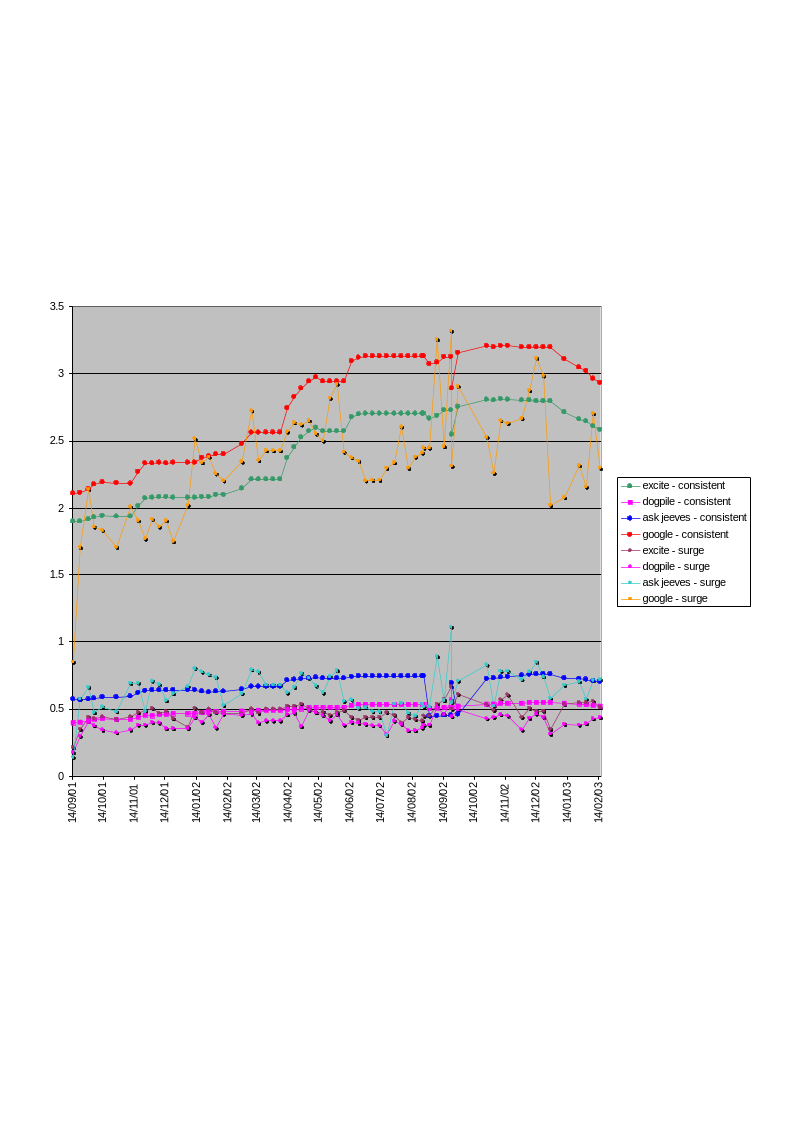
The only other search engine - in distinction from Yahoo the web directory - which appears consistently throughout the list of terms is the meta-search engine, Dogpile. Dogpile is the only meta-search engine classified in the collected data and its popularity suggests that it is also a core element of the cultural complex. Dogpile itself claims that it is the most popular meta-search engine. The position of Dogpile should be regarded with some caution, however, as not only is it the only meta-search engine in the represented in the data but also because the data for the lists was originally gathered from a meta-search engine ‘spy’.
The two other core elements of the cultural complex found in the 004 class of the UDC are Yahoo and Hotmail. Yahoo is particularly significant to this research as it was one of the first categorised collections of web sites. Yahoo is actually an acronym meaning “Yet Another Hierarchical Officious Oracle”. Yahoo is not only central to the cultural complex identified through this research but to the Web itself. The almost mythical centrality and importance of Yahoo to the Web is not related solely to the quality of the directory of Web sites it provides. The collectively edited and widely distributed Open Directory Project at one time used as the directory service for Google and other search engines is arguably a more authoritative system. This is also the case for the specialist directories that focus on a specific class of web sites. The SOSIG (www.sosig.ac.uk) and ISWorld (www.isworld.org) gateways provide a far more authoritative service for their focus disciplines than Yahoo does. Similarly the World Wide Web Virtual Library (www.WWWVL.org) is housed on a range of web servers around the world and edited by experts in the field of their own Library ‘aisle’. This makes the WWWVL a more definitive library of Web-based material than Yahoo does. Both these ‘competitors’ differ from Yahoo by being collaborative and voluntary systems that focus on the sole task of presenting an ordered and hierarchical directory of web-based resources. However, Yahoo’s importance is not based on the quality of its directory. Its early availability on the Web contributes to this status but it is the mythical stories relating to its creators and its development positions it at the core of the cultural complex. Having the credentials and mythology associated with Web longevity has assisted Yahoo in becoming and remaining an icon of the Web for western mainstream culture irrespective of its commercial and corporate impetus towards profit.
Hotmail’s reputation as the first web-based email service and the myth relating to its purchase by Microsoft similarly assists it to a position within the core of the cultural complex. The concept of offering emails services through a web-based interface was an innovation developed outside the realms of corporate computing. The purchase of Hotmail by Microsoft in at the end of 1997, reportedly for $US 385 million (Reinhardt 1998) however, provided legitimation that ensures its position within the core cultural complex. Unlike other Microsoft products, Hotmail’s success is a form of ‘proof’ for the power of independent developers over a corporate computing work environment (Raymond 2001). Despite their philosophical differences in development strategy, this approach of acquiring software projects is common practice within Microsoft as DOS (originally called QDOS and developed by Seattle Computer Products (Cringely 1996, 132)), Internet Explorer (containing a core of code from a company called SpyGlass (Berners-Lee 1999, 99)) and Powerpoint (originally called Presenter and created by Forethought (Belleville n.d.)) similarly all started as independent software development projects. As with Yahoo, Hotmail’s position is heavily based on its historical precedence as the first web-based email system. As with Yahoo, Hotmail has its faults. The very popularity of the system can make it hard to find a suitably unique email address and this popularity can also flood the Hotmail web servers with legitimate activity making it hard to use. The popularity of Hotmail has also made it a convenient address (although not necessarily the location) with which spammers launch their campaigns. While these issues may impair the actual functioning of Hotmail this cannot detract from the importance of a web-based email system. Enabling other ‘traditional’ Internet service to utilise the consistent and familiar Web interface serves breaks down the complexity and steep learning curve associated with the interfaces and ‘front ends’ with which older non-graphical software were designed.
It is not a coincidence that the elements of the core cultural complex that are classified within the 004 class are different but significant services for contemporary cultural practice; a search engine, a meta-search engine, a Web directory and an email system. These four services form the core of many other commercial and community-based developments and are also a basis for comparison. The free availability of these services means that any new search engine, web-based email service or similar will always be compared to the capabilities and features of these iconic services. Such a heightened level of significance perpetuates their centrality within the cultural complex and strengthens their iconic meaning.
Other individual iconic artefacts that are core to the cultural complex are scattered throughout the UDC taxonomy but this does not imply that they are isolated or disconnected from one another. Artefacts are not impoverished as a search term by being less directly ‘computery’. Their meaning in relation to cultural practice is equally important and contributes to the specific form of the cultural complex of contemporary mainstream culture. In many respects it is those elements classified outside the 004 - computing - class that reveal the details and complexity of mainstream culture. The classification classes that are well represented in the search data is also an index of the degree that Web based computing has become an integral aspect of that culture. Strong evidence of Web-based computing related activities also lend support to an effacing of the ‘virtual’/corporeal dichotomy. It is not possible to look at the collection of desired artefacts and suggest that all ‘free things’ are somehow connected to computers or are even ‘obvious’ choices for inclusion in the cultural complex. The most popular artefacts reveal an underlying cultural logic to contemporary mainstream culture. The remaining elements in the core of the cultural complex that will be discussed and considered within this framework of the cultural complex are ‘Ebay’, ‘Amazon’, ‘Dictionary’, ‘CNN’, ‘ampland’, ‘the hun’, ‘voyeurweb’, ‘literotica’, ‘tattoos’, ‘kazaa’, ‘morpheus’, ‘ecards’, Christmas & Halloween, ‘ringtones’, car & autos, ‘hotels’, ‘recipes’, ‘wallpaper’, ‘southwest airlines’, ‘zip codes’, ‘clipart’, ‘roms’, ‘jokes’, ‘chat rooms’ and ‘maps’.
The presence of Ebay and Amazon within the cultural complex’s core is significant because these are the representatives of successful ‘pure’ eCommerce. Each has taken a different approach to how the Web can be used to conduct business. Ostensibly these two businesses are antithetical to a ‘free things’ attitude in the cultural complex. However, they do reveal other attitudes that are equally aspects of the cultural complex - ‘participation’ and ‘do-it-yourself’. Ebay’s rationale - as an online auctioneer - is based heavily on the need for participation and interaction. The failure of a range of eCommerce ideas and projects through the early part of this century has also elevated Ebay to become the dominant method for individuals to ‘get into eCommerce’ and to ‘make money on the Internet’. The range of unsolicited commercial emails that make offers to support this type of success do not provide quantitative proof of this claim but do reveal the range of promoters who hope to gain from the success in this area. More tangible evidence for the popularity and success of this ‘DIY’ eCommerce can be found in the seller’s ratings and records on the Ebay site itself. Some seller’s have sold so many items - as indicated by the number that is automatically attached to each seller’s id - it is clear that this activity occupies many of their working hours (and even waking hours). The content of one of the more virulent recent spam emails also emphasises how you can give up current employment to sell items full time on Ebay (www.at-homeworks.com/ebay_sellers_toolkit.htm). Wholesale and trade directories now advertise the suitability of some of their items for Ebay auctions (www.auction-sources-exposed.com/) and a range of software has been developed around the Ebay system to assist people as buyers or sellers such as those offered by hammertap.com and SeeBay (webempires.netfirms.com/SeeBAY/product.html). Another indication of Ebay’s success is found in the range of items available and, in a more negative light, the range of suspect, fraudulent or simply unexpected items for sale including body parts, whole people, dirt, souls and a sense of humour (www.whattheheck.com/ebay/) This material and the range of available support mechanisms for buyers and sellers assist in placing Ebay at the core of the cultural complex.
Amazon’s role as a harbinger of eCommerce practice has taken a somewhat less certain path. As a company it became very large, very rapidly and took a very long time to become profitable (Spector 2000). The competition that it faced from ‘bricks and mortar’ booksellers, but particularly Barnes and Noble prevented it from entirely defining the practice of online bookselling. However, while Barnes and Noble took a primarily electronic catalogue approach to the selling of books online, Amazon incorporated - and continues to incorporate - features that are compatible with the cultural attitudes relating to participation and ‘free things’. One of the earliest features of the Amazon Web site was the capacity for any user of the site to post reviews and opinions about individual items. There was no requirement that you had purchased the book through the Amazon site effectively making this system a free large-scale opinion poll. More recent developments at Amazon have similarly promoted these attitudes. Amazon’s signing off on an agreement with publishers to enable full text search of the contents of books gives the potential for Amazon to offer a search engine that could rival Google in its capacity to offer free access to a vast body of human knowledge and experience (Wolf 2003).
The presence of the term ‘Dictionary’ in the core of the cultural complex similarly reflects attitudes and the desire for ‘free things’. In contrast to the volume of searches for the ‘Dictionary’ or ‘Online Dictionary’, searches for the specific ‘Websters Dictionary’ or any other named dictionary are rare. The curious element of this search is the ready availability of a dictionary in desktop software such as Microsoft Word. This makes explanations regarding this term somewhat more complex and generally speculative. The limitations of the desktop dictionary found in Microsoft Word or other text editors may provide one rationale. The users of these types of dictionaries may not want the product embedded in a text editor or they are critical of the shortcomings of these dictionaries. These users are seeking a dictionary through search engines with the implied expectation that it will be free. It is unfortunate in this situation that the search term data cannot reveal anything more about the motivation or demographics of the people seeking dictionaries as this would be needed to gain clearer understanding of the context in which a dictionary is being sought out. The format of a dictionary, any dictionary by definition, is entirely compatible with an attitude for information-richness.
A more definite element with a clearer rationale for inclusion in the cultural complex is ‘CNN’. It is the only news oriented element found at the core of the cultural complex. Other specific terms such as ‘NBC’ and ‘CBS’ as well as generic terms such as ‘news’ and ‘newspaper’ are regularly found in the weekly search term lists but none reach an equally dominant level to that of CNN. CNN’s rationale for continuous and live news differentiates it from these other companies in form and practice (Dellinger n.d.). CNN also holds an increasingly metonymic relationship to news. It has also benefited from the role it has played in times of large scale disasters and emergencies, particularly in relation to war and terrorism. The CNN reporting of the two gulf wars and the twin towers terrorist attack coupled with the syndication of these reports worldwide has popularly made it the basis of comparison for journalism and media reporting (Flournoy & Stewart, 1997; Dellinger n.d.). Although these sort of claims may not withstand critical analysis of CNN’s techniques or bias the basis for its presence in these lists is based upon popular use of search engines and it is in this respect that CNN dominates. CNN’s reporting style and 24 hour format also supports an attitude and desire for ‘information-richness’.
The presence of pornography - in some form - within the core of the cultural complex is not unexpected. The ‘adult’ element of the Web is perhaps the most bemoaned (Ferguson 2003; Castles 2003) of all its services. Four pornographic web sites are named: ‘Ampland’, ‘The Hun’, ‘Voyeurweb’, ‘Literotica’ in the core of the cultural complex. It is difficult to claim that these four represent ‘different’ aspect of pornography; however, there is some degree of demarcation in style and focus. The four sites and other similar unmentioned ones are a literal representation of Baudrillard’s pessimistic claims that “after the demise of desire, a pell-mell diffusion of erotic simulacra in every guise, of transsexual kitsch in all its glory. A postmodern pornography if you will, where sexuality is lost in the theatrical excess of its ambiguity.” (Baudrillard 1993, 22). All four web sites reveal an intersection of the range of the attitudes that inform the cultural complex. All four sites are founded around the attitude for ‘free things’ as access to pornography at these Web sites is largely unrestricted and funded by advertising revenue from ‘paysites’. The ‘information-richness’ of these sites also provides a clear basis for the inclusion of these particular directory-style sites. Voyeurweb, too, hints at the attitude for DIY and participation that is found elsewhere within the cultural complex. The presence of Pornography is problematic within the cultural complex as it cannot be accepted uncritically without recognition of the relationship it holds to power relations more generally (Williams 1999, 15; Dworkin 2000, 26 & 31).
The importance of tattoos within the cultural complex is perhaps the most unexpected of the included search terms. The commodification of the body and its contextualisation as an artefact is confirmed by the popularity of the four pornography Web sites and is reinforced with this term. Two corollary terms, ‘Tattoo Designs’ and ‘Tattoo Pictures’ assist in some way to clarify the popularity - and consequently the importance - of this term. Seeking designs suggests that this term represents two intersecting desires, to get a tattoo and to see other people’s tattoos. The implied series of action upon, and permanent use of, the physical body makes the term particularly interesting as it is the only element at the core of the cultural complex that specifically requires a corporeal presence (or more simply ‘reality’) to sustain the term itself. Hentai and other forms of ‘virtual’ pornography have even removed the need for the physical presence of a human to construct a visual image. I cannot currently locate a gallery of ‘virtual’ tattoos. Tattoos also drives an attitude for ‘customisation’ to a logical extreme in the sense that a tattoo is a customisation of one’s own skin that does not directly impact on the body’s internal operations - an organic analogy to Windows wallpaper or WinAmp ’skins’. The popularity of tattoos as a cultural statement, a fashion adornment (Larrat 2003; Perlingieri 2003) and a search term reveals the close intersections of interest that can be found between the use of the Web, everyday life and the identified cultural complex.
Ecards - electronic greeting cards - were an early example of the interactivity that was capable through a Web-based interface. The original development by Blue Mountain allowed free access to a range of images that could then be customised with a message. With technical development of the Web, new features were also added to the customisation options including an attached soundtrack, animations and more sophisticated message handling. The many imitation services that sprung up all followed this general format and approach. However, unlike other innovators and originators such as Yahoo and Hotmail, Blue Mountain (BlueMountain.com) has never received a similar level of recognition. Its corporate sale to the Excite network in July 1999 for $US780 million - half of which was represented by a straight cash payment (Conrad, Grice & Borland 2001) may have had some impact on obscuring the recognition of Blue Mountain as the original ecard web site. More significantly, for the identification of ‘free thing’ and for the company itself, was the decision to introduce paid membership and to restrict the amount of free content available on the site. The ability to support the desire to customise and for DIY attitudes remains available at Blue Mountain – but only as part of a paid membership. The relative simplicity of the ecard concept may also impact on the ability for any single ecard supplier to become iconic. The base element of customisation - the main image of the card - is also the main limitation of any one system. If one ecard site does not have an appropriate image or that site is charging for its use it is possible to move to the next site. Attitudes towards ecards and ecard sites contrast with a search engine or web-based email system where the pivotal customisations come from the search term or inscribed message. In this way each ecard site is distinctive because of their different opportunities for customisation while web-based email and search engines are functionally and more visually generic.
‘Ringtones’, ‘Wallpaper’ and ‘Clipart’ each reflect the customisation attitude and also imply the desire for ‘free things’ that enable the personalisation and customisation of a commercial product. Nokia, through interchangeable covers and ringtones and Microsoft through ‘skins’ and ‘themes’, for example, have tapped an important aspect of contemporary cultural practice. It is important to note that while the elements of customisation are part of the core of the cultural complex neither Nokia nor Microsoft appear with the same degree of intensity in the lists of search terms. Nokia only appears in the context of ‘Free Nokia Ringtones’ not uncoincidentally confirming a more prevailing desire for ‘free things’. The absence of these two companies as popular search terms also indicates that it is the act of, and ability for, customisation that is being sought. Nokia’s introduction of the customisable mobile phone has contributed in no small part to the success of the mobile telephony even if the company itself has not profited as well from this rapid uptake of technology as might be supposed (BBC 2003). In fact, the phone-based downloading of ringtone and icons for modern mobile phones has itself become a big business that has millions of downloads and billions of US Dollars in turnover (Gracia 2003; Marriott 2004). Using the Web to locate ringtones interestingly reveals an indirect logic that supports the argument for the presence of six predominant attitudes of the cultural complex identified in this thesis in Section 6.2. Commercial ringtones are obtained by phone however as an information-rich location and an important source in contemporary culture for ‘free things’ the Web is where people who are unwilling to pay for their ringtones through the phone seek their ringtones - with the presumed expectation that what they find will be available for free.
Wallpaper, the background image of an operating system’s graphical user interfaces, are found on hundreds of Web sites and like ecards no one site can offer a definitive collection of images to satisfy every taste, interest or indeed cultural preference. The importance of ‘wallpaper’ as a search term can be better understood by the fact that the results generated by a search are the ‘best’ directory of screen wallpaper available online. The regularity and number of searches for wallpaper also reveals the close association between attitudes for DIY and customisation. Those who create their own wallpapers are not likely to be searching for ‘free wallpaper’. However, the skills and time necessary to create wallpaper while not high may be more than offset by the ease that it takes to download an image and install it onto an operating system as wallpaper.
Clipart also balances the attitudes for customisation and DIY. As with wallpaper, no clipart site can offer the range of possibilities that is sought by each individual user of clipart. Clipart relationship to the attitude for ‘free things’ is also problematic. The most readily available and free clipart is generally the most clichéd, overused and of the poorest quality. This is best evidenced by the clipart supplied in the Microsoft Office application suite when conference attendees are confronted by endless Powerpoint presentations that share common colour images, poor line images and standard layout templates. The quality and relatively small choice offered by Microsoft Office may actually be the reason for the popularity of clipart and its presence as a core element of the cultural complex. The most popular clipart web sites including the generic clipart.com, have attempted to build a business between the contradiction of offering commonly and publicly available free images and individual’s users preparedness to pay for images that will genuinely customise and personalise their communications. Clipart.com has also attempted to draw upon prevailing attitudes for participation by encouraging those who are more graphically adept to contribute to their Web site’s own information-richness in order to expand their collection of commercial and free clipart.
Generic terms, including ‘car’ or ‘autos’, ‘hotels’, ‘recipes’ and ‘maps’ all figure highly in the cultural complex. These terms reveal the level of information richness that is provided by the Web and web search engines. These terms represent central themes and starting points for more refined searches and activities. While it might be assumed that recipes and maps are also being sought after as ‘free things’ this is not certain and is not a combination used in any of the collected data - there are no searches for ‘free recipes’ or ‘free maps’.
A curious inclusion as a core element of the cultural complex is ‘Southwest Airlines’. Southwest is the only ‘bricks and mortar’ business included within the cultural complex and it can only be utilised by people within the US. While Amazon and Ebay are both US-based companies their eCommerce focus and their effort to register regional domain names such as ebay.co.uk gives them an international or at least wider provenance. Southwest Airlines does share some of the features that can be identified in Amazon and Ebay. Each employs what are (or were) innovative business strategies for their specific sectors (www.southwest.com/about_swa/airborne.html) and each business does claim that their innovation helps to reduce the price of their goods or services. Southwest claims on their web site that they are “the United States’ only major short-haul, low-fare, high-frequency, point-to-point carrier.” This is perhaps the closest to ‘free things’ that any commercial enterprise could sustainably offer. The Southwest Airlines Web site reveals two key reasons for its importance within the cultural complex. “Southwest was the first airline to establish a home page on the Internet.” “On May 30, 2002, the Jupiter Media Metrix named Southwest the airline that best utilizes the Internet and provides brand synergy between its main line and online presence.” As a result of the publicity and Web longevity of Southwest over 50% of the company’s flight bookings now come through its Web site. The intertwined relationship of the Web and Southwest’s core business reveals the close interconnection between search terms and their relationship to cultural practices, organisations and artefacts beyond the Web.
The importance of travel and spatial references to corporeal experience within the cultural complex is also found with the inclusion of ‘maps’. While various attempts have been made to chart the Internet and the Web in some form of cartographic manner (www.cybergeography.org/atlas/atlas.html), maps have a clearer meaningful representational relationship to the physical world. Many map services are available online with the claimed largest, Mapquest, but none have a predominant position in terms of reputation and none are the pre-eminent site. The competition for market dominance in the mapping field is evidenced by the unusual presence of a general term rather than a specific Web site in the cultural complex. The inverse situation can be seen with search engines where Google predominates while the term ‘search engines’ sits at the very periphery of the cultural complex’s core. As with search engines all of the map sites have opted for a business model that is predominantly based around free products. The majority of services at sites such as mapquest, multimap, streetmap.co.uk, maps.com and the services offered by various automobile associations are free. Each services relies on additional value-added commercial services to sustain the delivery of free ‘things’ through products such as satellite photographs and specialist printed maps. Maps and particular those in the form of driving directions - another term also on the periphery of the core of the cultural complex - are closely associated with the use of cars. There is also a close relationship both on the mapping sites themselves and in the general connection to travel between the terms ‘maps’ and ‘hotels’.
While ethnographic knowledge of the people who initiate searches can only be inferred from the terms they use, the presence of so many terms related to the general activity of travel within the core of the cultural complex does suggest a highly mobile people. Southwest Airlines, car & autos, hotels and maps are the most evident of a still wider interest in travel with a range of terms found just outside the core of the cultural complex including driving directions.
The inclusion of ‘zip codes’ within the core of the cultural complex is significant as, like Southwest Airlines, it is a regional phenomenon that is specifically US-based. Like Southwest Airlines, zip codes relate to travel - albeit by proxy in the physical items of mail. The close relationship of zip codes to ‘snail mail’ also references a form of communication that in many respects is a more expensive competitor to email. It is also cost, or rather the desire for ‘free things’, that provides explanation for the inclusion of zip codes within the core of the cultural complex. By way of an explanation for this claim one of the more prominent results from a search for ‘zip codes’ at google.com is zipcodedownload.com - a business offering the entire US zip code database for $29.95 (September 2003). While the product is ‘simply’ a database of all the available zip codes in the US, zipcodedownload.com makes a number of claims for their database and more broadly the zip code system itself. A prominent claim is that zip codes provide, “The Power To Innovate, The Power To Sell, The Power To Help You...Succeed.” Comparisons are also offered with other company’s products that include suggested prices between $US100 and $US2000.
However, this is not the only site concerned with zip codes and many offer free zip code tools and data. The National Address Server (www.cedar.buffalo.edu/adserv.html) provides the capacity to actually produce accurate address labels based on a minimum of entered data. However, the site also stresses that this service is intended for personal use only. Similarly, the US postal service, who is the primary users of zip codes, offers the ability to check zip code information on their Web site. The key connecting theme between these various services and the major rationale for the inclusion of zip codes in the cultural complex is that they are free. Being a free source of ZIP code data does not, however, in itself explain the desire for zip codes. The US postal service offers some enlightenment, however, in its zip FAQ (www.usps.com/zip4/zipfaq.htm) which briefly describes the history of zip codes from their introduction in 1963. In 1983 the US Postal Service introduced zip+4 which results in a 9 digit number that identifies very specific geographic locations in the US (similar to the current UK system). The nine digit zip code scheme, however, is not compulsory. The rationale for this change is to improve mail delivery performance. It is primarily designed for businesses that post many individual items of mail. The desire for zip codes twenty years after this change may be the result of the complexity and confusion caused by this newer system. The business focus of extended zip codes may also offer a partial explanation. One sector of business that most heavily uses the postal service are bulk mailers and bulk advertisers. The increasing use of this form of marketing by a widening range of businesses may provide some explanation as these businesses look at ways of reducing running and operational costs by accessing free information.
An attitude and desire for interaction and engagement is reflected in the importance of ‘jokes’, ‘poems’ and ‘chat rooms’ within the cultural complex. As ‘chat rooms’ are specifically Web-based phenomena that were among the earliest forms of Web-based interactivity the range of ‘rooms’ now available is unquantifiable and easily ranges into the thousands. The success of this form of interaction and the relative ease that they can be set up and maintained on any ‘standard’ web site has resulted in the bifurcation of chat rooms into more and more specific areas of interest. Almost any popular band, television programme or fan club has some type of chat room. The majority of these chat rooms are free to access.
‘Jokes’ are a form of communication with a broad provenance that are part of the core cultural complex reflected in the most popular Web search terms. Less common but more specific terms suggest the types of jokes being sought: ‘dirty jokes’, ‘funny jokes’, ‘halloween jokes’, ‘thanksgiving jokes’ and ‘christmas jokes’. Jokes figure significantly in the lists of surge terms and are generally ranked within the top 10 of the list. The most notably exception to this trend was in the list compiled immediately after the 9/11 terrorist attack on the World Trade Centre when ‘jokes’ was ranked 42nd. Proposing an inverse relationship between an interest in jokes or humour more generally and significant events of public tragedy is beyond the capacity of the available data but it does suggest that this is an area for further detailed investigation.
‘Poems’ are also consistently desired during each week that data was collected. As another form of literary expression, poems form a counterbalance to the general focus of the desire for jokes. The most common qualification to the generic search for poems is ‘love poems’. However, the impact of annual celebrations is also identifiable with ‘christmas poems’, ‘mothers’ day poems’ and ‘valentine’s day poems’ all briefly figuring in the weeks leading to these festivals in the surge list of terms.
The term ‘roms’ is somewhat unusual and outside the general corpus of everyday speech. However, both ‘nes roms’ and ‘snes roms’ appear consistently and are at the core of the cultural complex. Roms are physical items containing a Read Only Memory (ROM) chip that contain the data for a game intended to be played on either the Nintendo Entertainment System, hence NES, or the Super Nintendo Entertainment System usually described by the acronym SNES. This system of distributing games was intended to prevent illegal copying and distribution by intimately bringing together the software of the game with a specific and non-standard hardware device. Other games systems, but particularly Sony’s Playstation and Microsoft’s Xbox, use the more readily copied but more conventional CD format to distribute games. However, this does not imply that the distribution method has lead to the success of the Playstation or Xbox over the Nintendo system.
However, the Web does not offer an alternative free avenue for obtaining NES or SNES roms. The majority of sites that offer free ROMs are emulators. Games downloaded through the Web are intended to be played with the aid of intermediary software that makes the PC act and respond in the same way as the original games consoles. Arguably emulators ‘dumb down’ a PC in order to make them work with older technology.
Another aspect of the desire for NES and SNES roms that prevents the exchange of copyrighted material from being condemned in the same manner as popular music is the degree of ‘link hell’ that users are subjected to by the sites that figure prominently in the results of searches for these terms. ‘Link hell’ - in this sense - refers to the barrage of pop-up webpages and a convoluted navigation path through advertising and commercial web pages that a user of a search engine is subjected to when seeking a specific thing. The trail to a sought-after object is punctuated with advertisements for associated products that have a high likelihood of being of interest to a person with an interest in ROMs. The end result of these trails - when the searcher does not give up completely - is a dead end, an advertisement or a teaser for a commercial product, or a link back to the smaller number of free sites that actually offer the ROM software being sought. ‘Link hell’ is a phenomenon that can also be linked with searches for fonts and clipart.
Christmas and Halloween have also been included in the core of the cultural complex as two specific events that figure heavily as terms in their own right but also as a qualifier to many other search terms. Other annual events also appear in the list of surge terms but none make it into the list of consistently high performing search terms. To enter this list requires sustained attention from the users of a search engine for at least a month. Some indication of the significance and the degree to which they collectively consume cultural attention can be found in the range of ‘Christmasy’ artefacts that are being sought in the weeks leading to Christmas itself. Items such as clipart, wallpaper, screensavers, songs, cards, carols, music, jokes, crafts, trivia, party games and jokes are all prefixed with ‘christmas’. The earlier set of items suggests that the seasonal customisation of computers is a common activity in the weeks leading up to the holiday. The range of items being sought indicates the extent that Christmas activities are planned with the aid of a search engine. The absence of ‘christmas recipes’ in the list does however suggest the maintenance of some personal and private traditions. It might be argued that the Christmas material being sought is an attempt to overcome some of the repetition and sameness that is found in most individual’s and family’s annual activities. However, Baudrillard’s (1993, 41) observation regarding the contemporary status of events offers an equally plausible explanation; “in earlier time an event was something that happened - now it is something that is designed to happen. It occurs, therefore as a virtual artefact, as a reflection of pre-existing media-defined forms.” The interest in Christmas also reflects the attitude for customisation that is a defining feature of the cultural complex - an attempt to cast a ‘personal’ - but pre-manufactured - touch on this annual event. The exception and perhaps one of the central elements to Christmas celebrations are the rituals relating specifically to food that are more personal and specific to individuals and groups. Another aspect to the interest in Christmas ‘things’ may be a reassertion of what are claimed as the authentic aspects of Christmas and an, at least covert, rejection of the consumption emphasis found in most contemporary celebrations of Christmas.
The twinned impact of Halloween with Christmas reveals a wider explanation for the significance of these two holidays appearing within the core of the cultural complex. These events are both celebratory and entertainment oriented holidays that have lost much of their original religious connections. The entertainment aspects of these holidays associate them with attitudes for participation and customisation. This is shown in part by the various ways in which Halloween is used to qualify searches. There is also a parallel between the Christmas artefacts being sought and those that are sought for Halloween. However, there are also sought after items that reflect the more heavily entertainment oriented nature of the holiday over the Christian basis for Christmas. The underlying themes for Halloween are reveals with search terms including ‘halloween costumes’, ‘halloween recipes’, ‘halloween games’, ‘halloween pictures’, ‘halloween clipart’, ‘halloween stories’ and the ‘history of halloween’. Halloween Web sites are also revealing as they reflect the impetus and focus of the holiday. Halloween-online.com offers a series of links to other Web sites including The Yard Haunter, Got Fog which claims to be the Web’s premier source for fog machine information and Pumpkin Carving 101 which similarly claims to be the #1 source for pumpkin carving information. The information richness relating to Halloween is even more evident at the generic Halloween.com which offers information relating to various broad aspects of the holiday including “the Christian Perspective”, “Scary Tales, Fun and Games” and, somewhat more obtusely at the head of the list of options (December 2003), the “Vampires” link produces a further series of links to “vampire” Web sites.
The annual nature of these holidays coupled with the more or less compulsory participation for the people of contemporary, western, mainstream culture immediately promotes the case for their inclusion in the core cultural complex. The opportunity for ‘free things’ and the information richness of Halloween and Christmas sites all further support their inclusion as core elements of the cultural complex.
The inclusion of ‘jobs’ in the core of the cultural complex is a result of the information richness that textually describes a job. The vast range of job-based web sites also makes search engines one of the few means of accessing a broad range of these sites in order to maximise the chances of locating an appropriate advertisement. A situation already previously identified in relation to clipart, fonts and wallpaper. Job web sites have also tended to specialise by either region or work specialisation. This further increases the necessity for the jobseeker to access a broad range of web sites.
Another aspect of seeking jobs through the Web is the relativity level of anonymity and privacy that this affords. For employees who are seeking a new position judiciously concealing their intentions is more easily achieved through the Web than by telephone, personal visits to employment agencies or other means.
The Web has also widened the audience of potential jobseekers that each employment agency can expect to have. Broad audiences have enabled the cost of recruitment through agencies to be borne entirely by the future employer and more significantly it has made job-seeking entirely free. The ready availability of job information complements increased employment mobility (Australian Bureau of Statistics, Labour Mobility, 6209.0) and reflects the increasing rarity for workers to remain with a single employer for long periods of time.
Perhaps the most likely class of employment that would be expected to make most use of the Web is for ‘tech jobs’. Unsurprisingly, this is the only qualification of the ‘jobs’ search, however, it only reaches the surge list twice on the 8th and 15th of February 2003 which were also the last two weeks that data was collected. Rather curiously these two surges reached 7th and 8th position in the lists for these weeks while the broader term ‘jobs’ was ranked at 33rd and 48th in the same weeks.
The significance of ‘gay’ within the cultural complex is also a reflection of the desires for privacy and anonymity found with many elements at the core of the cultural complex. The acceptance of homosexuality as sexual preference and lifestyle is in no way a universal aspect of contemporary western mainstream culture. The ability to gather information about ‘being gay’, to in some way participate in ‘gay’ activities and to meet like minded people is readily accommodated through the Web without immediate fears for safety. The need for safety – in a variety of ways - is confirmed by the only qualification to the term ‘gay’ in the data: ‘gay.com’. This site is clearly targeted to a middle-of-the-road political and cultural sentiment with a US focus. The site offers a range of material that covers the entire gamut of lifestyle possibilities and is supported by mainstream advertising including Visa and DVD and CDs - featuring the Will and Grace back catalogue. The site claims to have over 1.7 million personal profiles and offers memberships which provide access to specific parts of the site including the details of these profiles. The inclusion of gay within the core of the cultural complex reflects the claim that “gays and lesbians tend to be particularly active Internet users and more comfortable than heterosexuals with shopping and dating online,” (www.jsonline.com/bym/tech/news/jun03/150197.asp 2003). In addition to this interest, Chatterjee (2001, 83) links together two aspects of the core cultural complex with the observation that “pornography becomes a cultural space in which alternative sexualities can be articulated and explored.” The combined activities of these two groups in addition to the confusion of sexualities identified by Baudrillard (1993) all contribute to the popularity of this Web site and this sexuality and lifestyle online.
These claims in themselves do not entirely explain the degree to which gay is such a sought after artefact within the collected data. Some percentage of these searches can be seen as regular users of gay.com or similar sites mistakenly typing the term into a search box. But even discounting this possibility the repetition that the term appears in both the lists of consistently performing terms and the surge lists suggests that there is a regular and steady influx of users the Web who are gay, identify as gay, are gay-curious or gay friendly.
The core of the cultural complex represents approximately 5% of the total number of sought after artefacts that were classified from the collected data there are many more that are located in the shadow of this core. These desired artefacts generally support or are premised on at least one of the six central attitudes that shape the cultural complex - ‘free things’, ‘participation’, ‘information richness’, ‘do-it-yourself’/‘customisation’, perversion and privacy/anonymity. There is also a great deal of association between the core of the cultural complex and those artefacts that are located outside it. Consideration of the wider collection of search terms is pursued in the third section of this chapter which shows the heavy degree that other terms group around those in the core of the cultural complex. The second section of this chapter similarly extends the examination of the cultural complex by identifying the regularity that individual terms (as well as classificatorily similar groups of terms) appear with very similar proportions of interest throughout the period of data collection.
The Historical Contexts
In this section I examine the research data within an historical context. Attention is particularly given to those ‘things’ identified in the previous Section 5.1 as forming the core of a complex of desires and sought-after cultural artefacts. Heavy use has been made in this section of visual representations to clarify the discussion. Visualisation offers a means to enable comprehension and representation of the vast amount of textual data that was originally collected and the similarly large amounts of data that were generated as a consequence of the classification of each search term.
The historical view of gathered search terms presents an expanded view of the cultural complex that represents its persistent features. An historical view of the gathered research data also reveals the shifting interests in particular artefacts of contemporary culture and the shifting fame of individual ‘celebrities’. More significantly the historical view of the data reveals the consistent levels of interest in a wide range of the cultural items and practices. By representing the volume of searches for a particular term as a percentage of the total number of searches for that week comparisons can be made directly between each week of the collected data. As the size of the sample from each week varies the consistency of week-by-week interests is still more revealing. The combination of data from the list of surge terms and the consistent performers also reveals the details and variation between short-term and long-term cultural changes of practice, attitude and interest. Long-term changes are reflected through the list of consistently performing terms. In general this change is gradual and with few fluctuations against the observable long-term trends. The surge list reflects a different aspect and level of cultural practice. Weekly surge lists reflect volatile variations from week-to-week with many terms rising briefly into the list and then rapidly disappearing.
The first view of the gathered data is an overview of the data showing the weekly fluctuations for each of the nine top level universal decimal classification classes (Figures 8 and 9). This overview is also the starting point for the third - cultural - perspective. The graph of the consistent terms between September 2001 and February 2003 (Figure 10) reveals an extremely consistent balance between the nine top-level classes. Three major historical discrepancies appear during this period. The first discrepancy is readily identified as the medium term impact of the 9/11 terrorist attacks on New York. In the two months after the attack the 200 class is represented. This class incorporates all aspects of theology and religion. The term primarily represented in this class is ‘Nostradamus’ and all its spelling variants. Any form of religious or theological references is completely absent from the gathered data after this period. The other class that proportionally increases during this same two month period after September 2001 is the 900 class which covers geography and history. Other classes accommodate these increases with inversely slight decreases, this is most noticeable in the 100 class that is described as ‘Philosophy and Psychology’ but in the context of the current data includes classifications for pornographic terms. The second discrepancy occurs in late August 2002 when a large increase in the search for terms classified within the 600 and 800 classes is balanced by a reduction in the 100 class again. Such a visible ‘spike’ in the generally consistent balance of terms foreshadows the third, more subtle, discrepancy in the consistent search data, a general narrowing of interest in terms from the 100 class and increases in the 000 and 600 classes towards Christmas in late 2002. These are relatively small variations that should not overshadow the general consistency of the weekly lists of consistently popular search terms. Relative stability between individual classes is further evidence for the close articulation that popular search terms have with contemporary western mainstream cultural practice.
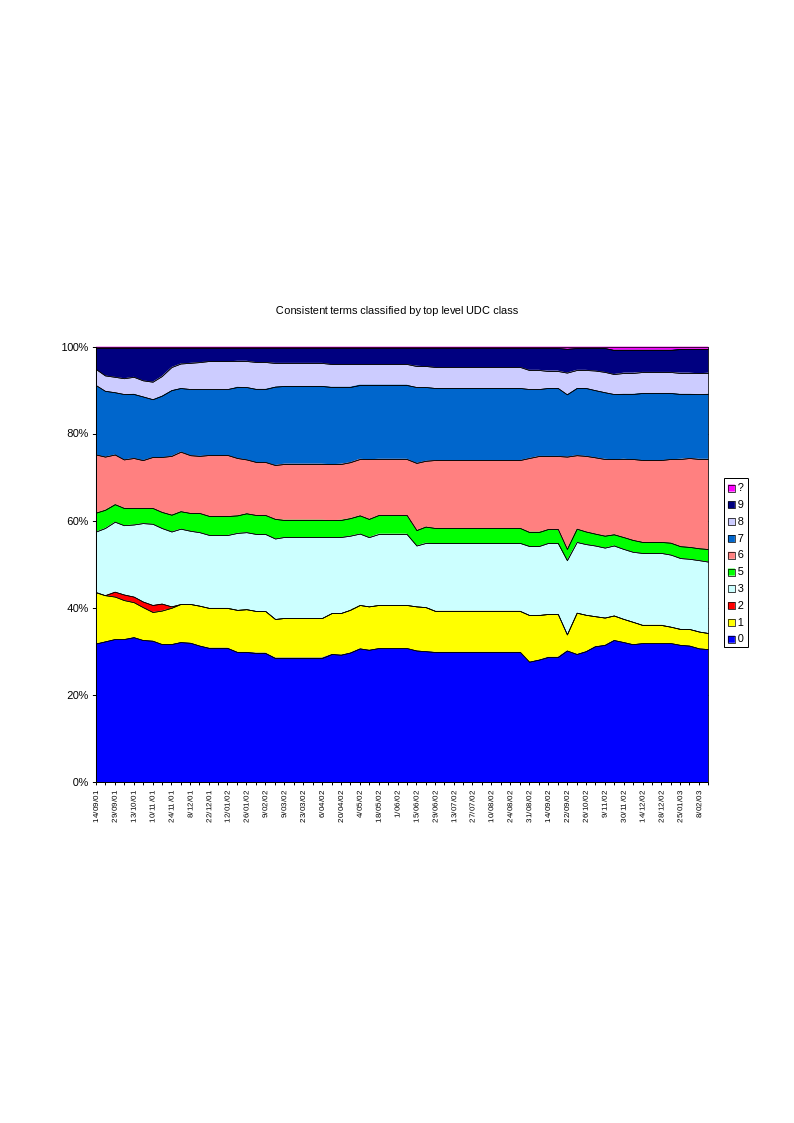
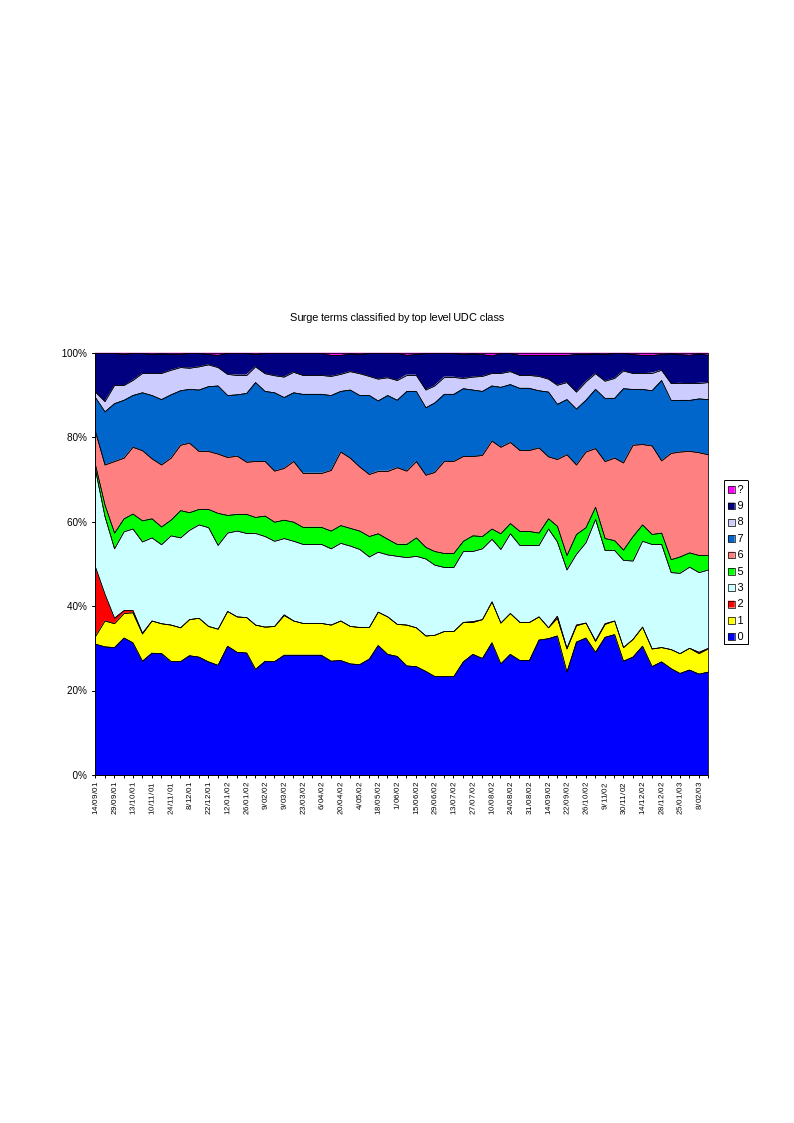
The same approach applied to weekly surge lists of search terms (Figure 11) reveals a more volatile balance between the nine UDC top classes classes. However, the impact of the 9/11 terrorist attack, the spike of late August 2002 and the gentle rise towards Christmas 2002 can all be discerned. Less significant spikes reflect the rapid rise and fall of interest in specific topics and artefacts that overlay the more consistent appearance of topics related to search engines, pornographic Web sites, software and music. There is a degree of semiosis that can be identified in this historical view of the data. A more asemiotic collection of data would not reveal fluctuations in individual classes that then return to a more consistent baseline relationship with other UDC classes.
A starting point for the specific examination of search terms in the historical context of the gathered data are the most popular search engines, Dogpile, Google, Excite and Ask Jeeves. The chart (Figure 12) shows a number of consistencies between the search engines as well as some significant differences. The most visible similarity is the mirrored movements in the percentage of the total sample for the consistent performance of Google and Excite. As these are searches for the actual domain name the consistent performance of these two terms provides an indication of the relative levels of use - or at least the intention to use - these search engines. The accuracy of this twinned movement also indicates that this particular search activity is significantly influences by regular ‘robotic’ (and by implication software driven) activity. The chart also reveals the shifting combination of activities that individuals collectively conduct on the Internet. The shifting percentage of searches for these engines indicates fluctuations in Web usage between search-oriented and unfocused free-form activities. One anomaly in the steady rise of search activities through the latter half of 2002 in the Google, Excite and more visibly in the Ask Jeeves data occurred in the week that included the first anniversary of the 11th September terrorist attacks on New York City and Washington. The downward trend recovered over the subsequent four weeks until the week of Christmas 2002. There is a shift in web activity from unfocused search - searching for search engines - to more focused and directed activities. Similar movements are also reflected with more subtlety in the surge data list for the 14th September 2002 which incorporates variations upon searches for ‘September 11’ at 3rd, 7th, 20th, 21st and 24th position. The consistent performance data for Dogpile and Ask Jeeves represent much smaller percentages of the total number of searches conducted and do not so closely parallel the other two search engines’ performance. However all four search engines reveal a consistent presence in the overall data revealing a generally stable level of significance and, by implication, usage.
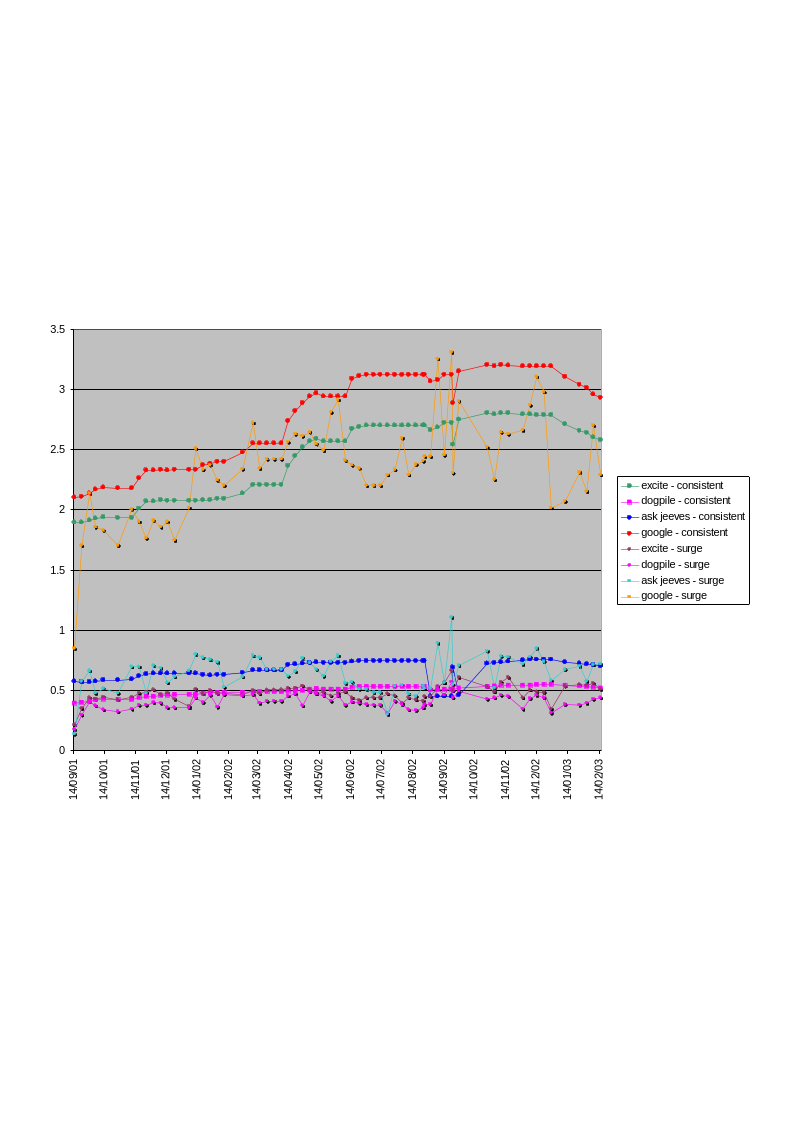
The surge data (Figure 12), in contrast, reflects a greater level of instability with the weekly interest in Google changing by an entire percentage point across the duration of the week-by-week data collection. The volatility of weekly interest in Google reflects the smaller scale of the sample that generally incorporates about 100,000 individual searches in contrast to the 5,000,000 searches sampled by the consistent performance list. As a result the observed fluctuations in the weekly Google surge data could be caused by approximately 100 or less searches. Personal communication with search engine optimisations (SEO) specialists suggests that their own examination of the Web for clients could cause this level of fluctuation (pers. comms with Top-Pile representatives, Internet World North, Manchester, 6th November 2003). Other robotic examinations of the Web could equally influence the observed surge data in a systematic manner. There is no regular peaking of surge interest in the search engines that is apparent from the gathered data. The expectation, if these automated activities were solely responsible for the volatility for the list, would be for a peak to occur in the same week of each month. No pattern of this type can be discerned during the entire period of data collection suggesting that these activities may only contribute to the identified volatility surrounding these terms but is not the sole explanation.
The importance of search engines within the broader cultural framework of the Web also suggests that these fluctuations reflect surges of general interest in public affairs. The greatest peak in the surge data for Google is found in the week before the first anniversary of the September 11, 2001 terrorist attack followed the next week by the greatest drop in the surge list for the term Google. Other influences on the interest in Google may relate to economic cycles - three of the highest peaks of interest in Google are for the weeks ending 12/1/2002, 9/3/2002 and 1/6/2002 implying a near-quarterly release of figures or social ritual - two of the lowest peaks of interest in Google are the Christmas weeks of 2001 and 2002. The temporal overlap of these influences produce the variable peaks in the surge data for Google and this prevents the clear identification of any single central causal factor. Weekly variability reveals that the desire for Google - and other search engines - shifts with general cultural attitudes and opinions. In itself the information about Google is not sufficient to extract specific details about the specific cause of a particular peak in the surge of interest in the term ‘google’. Google, in this sense, is a specific representation of the Web making interest in this search engine a sign of general interest in the Web itself.
The examination of the surge and consistent data for the directory Yahoo, the world’s largest service provider AOL and one of the premier eCommerce sites, Ebay reveal a different more focussed and specific series of interests (Figure 13). The surge data while volatile is less susceptible to the large weekly variations seen with the search engines and closely reflects the commercial influences that shape the interest in these three terms. When Ebay announced (February 2002) that it would be raising the fees for auctions this was immediately reflected in the surge list by a drop of 2% from 3.2% of all weekly surge list search terms to 1.2% (the total sample of searches). The surge list interest in AOL also dropped in the same week from 0.4% to 0.2% of the total sampled search terms suggesting that the impact of one commercial decision has a roll-on effect for other well-known eCommerce operations. Increasingly the intertwined web of common ownership between the largest Web businesses, such as the intimate business interrelationship between Yahoo, Altavista and Overture and others make this association a valid assumption.
The Yahoo surge data hits a high point on the 27th July 2002 rising 1.3% to 4.4% of the total searches. Such a dramatic rise suggests that an important announcement occurred in this period. Speculation occurred in this week that Yahoo would continue using results from Google for its web search - this announcement was only formalised some months later (Sullivan 2002). Speculation may have arisen as a consequence of Google winning the contract to supply search results to Ask Jeeves search engines (www.google.com/press/press02.html). While this is an apparently trivial speculation it is clearly a significant decision for users of Web-based search engines.
In contrast to the volatility of search engines the data for AOL does not change noticeably across the period of data collection. Stability in the week to week interest in AOL may be a result of the nature of their business, providing access services for the information rich. The historical stigma of being an AOL user in the context of the Internet may be a moderating influence on the weekly data. The only group of Web users likely to search for the AOL home page are AOL users themselves. The integration of the AOL home page as part of the setup process for new AOL users to the Internet also avoids the need for users to actually search for it. The AOL home page is the first page AOL users see when they start up their web browser.
The historical interest in Ebay does not offer clear indications for its variations and surges in interest. The interest in Ebay through the period of data collection is not during periods of gift giving - Christmas - but between March and June 2002. This places greater emphasis on the relationship between the interest in Ebay as a search term and its business activities and corporate identity.
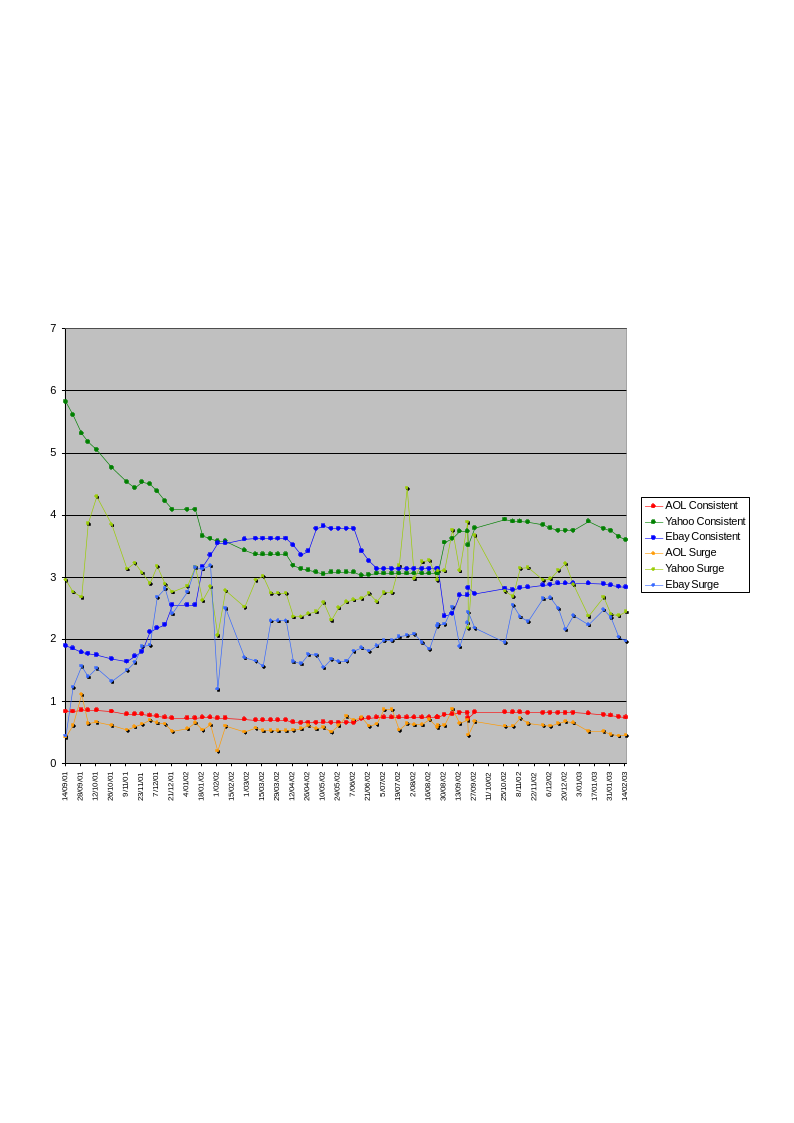
The interest and significance of other computer oriented companies are, in comparison to Web-based businesses such as Ebay, less consistent and highly variable. Intel, Microsoft and Netscape due to their fame and importance as leading information technology companies are among the small number of businesses included in the gathered data. However, the representative percentage of these three in the weekly surge data is very low - under ¼% of the total searches conducted - and only Intel appears regularly in consecutive week’s of data (Figure 14). These infrequent appearances appear to be closely linked to corporate activity and media announcements.
One rationale for the relative lack of interest in these companies is their role in relation to contemporary culture at large and the use of the Internet in particular. These companies provide the infrastructure and the framework for the Internet. The solely technological relationship of these companies to everyday life results in them not being a focus for specific searches.
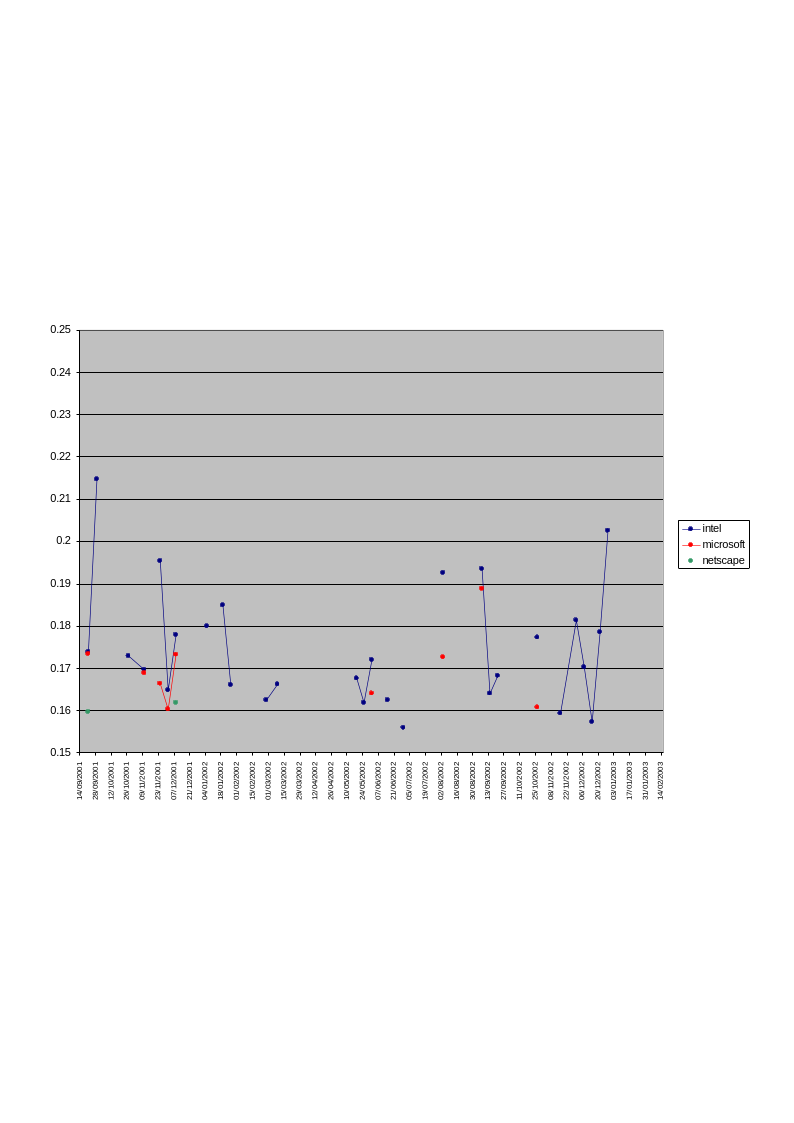
One of the key qualities that define the complex of artefacts that are desired through search engines is their ‘freeness’. Charting the historical variations in the searches for the term ‘free’ and for all the search terms that include the word ‘free’ reveals an upward surge of interest in the February 2002 to June 2002 period (Figure 15). This also mirrors the surge of interest in the consistent data for Ebay.
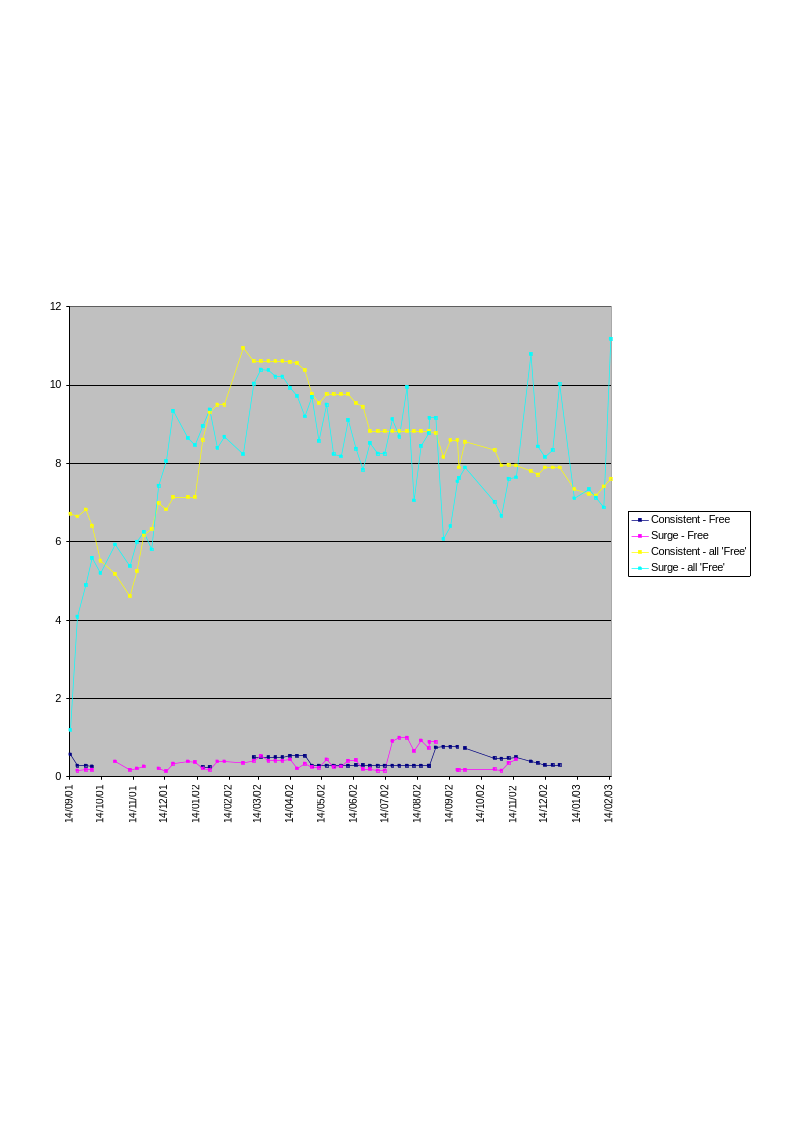
While all the ‘free’ things considered together form a somewhat amorphous categorization the consistent volume of ‘free’ searches is a more significant point of discussion. Representing over 8% of all searches for such a long period of time reinforces the importance of ‘being free’ for the Web.
The Cultural Contexts
The cultural context of the gathered data and its relationship to the artefactual complex is examined through the ‘wider lens’ provided by the examination of the nine top level classes (consistent data, Figure 16; surge data, Figure 19), the second level - with 90 classes (consistent data, Figure 17; surge data, Figure 20) and the third level - with 900 classes (consistent data, Figure 18; surge data, Figure 21) - of the Universal Decimal Classification taxonomy. Multi-level examination of the data provides a view of the data that brings together terms with similar meanings and intentions in a way that can be simultaneously compared with other classes. These views of the taxonomy are distant from the specific human intentions and desires represented in the original searches. A representation of this type has the effect of flattening out or at least moderating the influences of any single term in a specific week of the gathered data set. These week-by-week views of the gathered data also offer a means for overall visual comparisons in a manner that echoes DNA “fingerprints”. As one intention of the classification process is to group conceptually-like sought after artefacts the three charts for each week offer different levels of magnification on the same dataset while remaining understandable and readable at each level.
The finest level of magnification has a key shortcoming in its visual representation - nine hundred separate classes cannot be easily shown in limited space offered by the printed page. The most detailed level of representation may offer few additional benefits over the other magnifications as only a small subset of the classes are ever utilised in the current taxonomic distribution of search terms. An obvious example of this lack of difference between the three levels of magnification is found in the top level 100 class. This class is primarily the container for pornographic Web sites that are all classified at the third level class of 176. As a result of this overwhelming popularity the percentage of total searches in the three views are the same for the top level 1 class, the medium level 10 class and the 176 class. Similarly the classes that incorporate reference to information technology also maintain the same percentage level of representation across the three views of the data.
The coarsest and top level view of the data in contrast overly groups together concepts and artefacts. This prevents a more subtle level of comparison within classes that cover a wider range of popular searches. The 6 level class - Applied Science - and 3 level class - Social Science - both contain a diverse range of classifications that would overly represent the significance of these classes in their entirety at the coarsest level of representation. These factors all make the 90 class middle-level magnification of the UDC a compelling choice. The rationale for this choice can be made visually with the surge and consistent charts for the first week of data collection, the week ending the 14th September 2001.

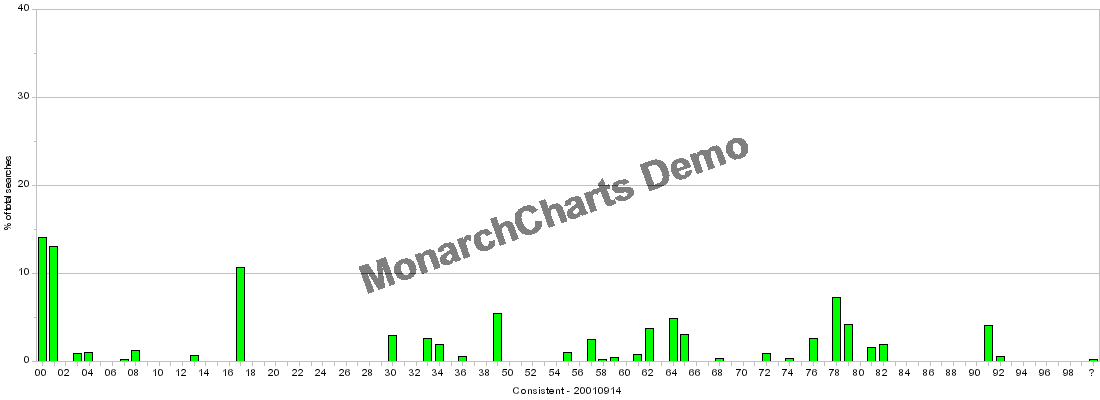
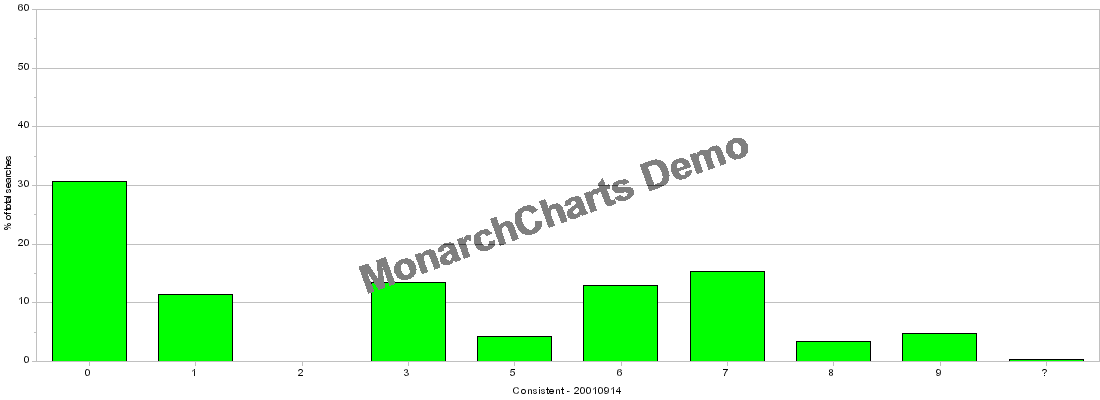
These three charts reveal the relatively minimal difference between the 900 and 90 class representations. The two ‘computer spikes’ at 00 and 01, the ‘pornography spike’ at 17, the ‘fame spikes’ at 62 (actors) and 78 (music) and the ‘travel spike’ at 91 are equally evident in both charts. The variety of other classes within the top level 3, 6 and 7 classes are also not obscured through the process of accumulation found with the broader 9 class chart.

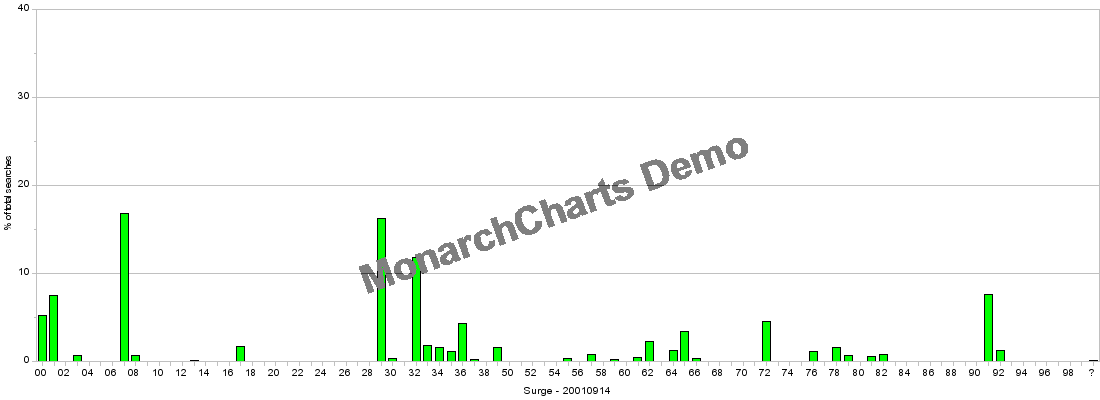
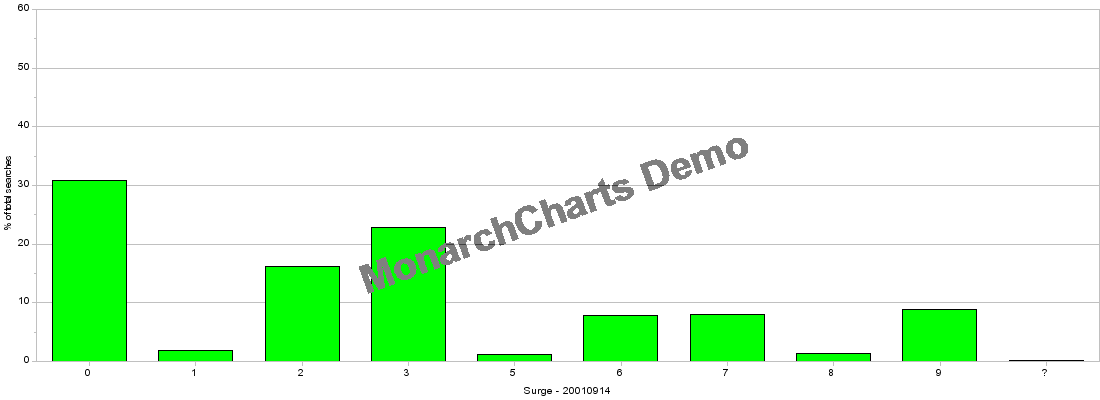
The 90 class level graphing of weekly data is the primary view used to discuss the cultural contexts of the gathered data and the relationship of these searches to contemporary western mainstream culture and its associated cultural complex. Focus is given to the surge search term lists to examine the detailed change in interests through the period. The consistent performers list produces a reliable reference representation. The benefits of a reliable set of data can be seen in the graphing of the average values of the 90 classes (Figure 22). The majority of the graphs of the individual weekly data closely parallel this average representation. The twinned computer spikes (00 and 01), the pornography spike (17), the twinned acting and music spikes of fame (64 and 78) and the travel spike (91) generally appear in these same proportions week-by-week. The celebration and sociality spike (39) varies more significantly but the influence of Christmas and the Thanksgiving/Halloween period is such a major influence on the total period of data collection (incorporating two of both these celebratory periods) that the 39 class does noticeably shift from week-to-week.
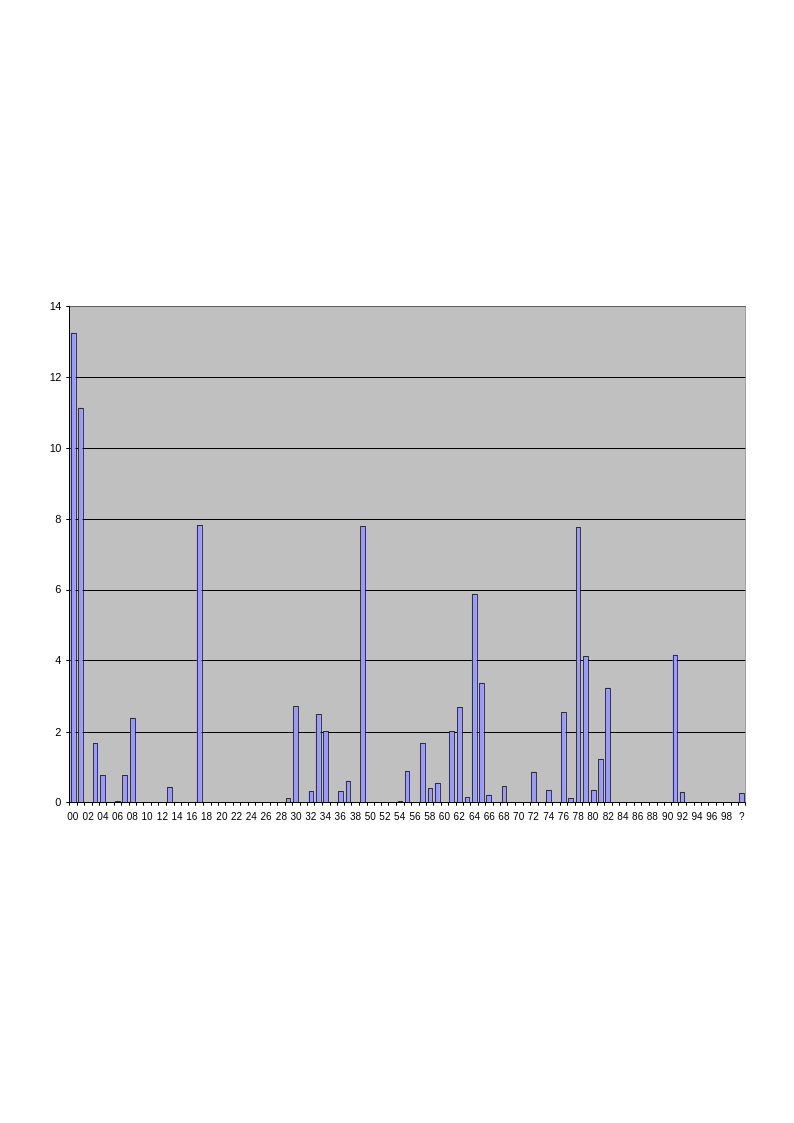
In contrast to the relative stability of the consistent data the surge data charts from the 21st September 2001 week of data collection presents an unusual view of Web search activities and is a reflection of the significant cultural impact of disastrous human terrorist activity. The categorical spikes that can be seen in the consistent terms data are also visible in the surge data. This activity is complemented by other more unusual activity. The appearance of search terms within the religion and theology class provides evidence for a massive cultural shock. The rise of other classes in this week also confirms this shock. The 07 class, incorporating searches for newspapers and news sources, is the most popular class for this week’s data. Interest in these religion and news does not appear again in any of the remaining collected data. The cultural response to this terrorist activity is also reflected by diminishing interest in other classes. Both the ‘pornography spike’ (at 17) and the two ‘fame spikes’ (68 and 73) are still identifiable in this week’s data but with noticeably reduced significance.
An important utility of the surge data in the cultural context that is so immediately revealed in this first week of data collection is the manner that search terms show the mainstream response to contemporary weekly events. Baudrillard (1993, 37) argues that
we are subject to a veritable bombardment by ‘superconductive’ events - by the kind of untimely intercontinental whirlwinds which no longer affect just states, individual or institutions, but rather entire transversal structures: sex, money, information, communications, etc.
The ‘surge’ data provides a finer level of analytical granularity as the sample is drawn from searches over previous 24 hours. Gathering search surge information allows breaking news stories, the fleeting fame of individual celebrities and specific festivities to be emphasised. The immediacy of events does not so readily evidence itself in the consistent data lists which record a persistent and consistent level of interest in activities, people and artefacts that is not so sensitive to daily variations. In the case of the 11th September 2001 attacks the immediate response was to seek revelatory guidance in the form of Nostradamus’s writings and authoritative news sources including newspapers and electronic media outlets such as CNN. This seeking of knowledge in various guises is a collective response to the unknown - terrorism on American soil, an unknown group, the scale of the disaster and the reasons for this aggression (Piper 2002). The immediacy and shock of the 2001 terrorist attacks and the fear of the unknown that it generated subsided rapidly. By the following week (21st September 2001, Figure 21) the balance between the classes in the surge list has shifted. The immediate shock of the unknown revealed by the interest in Nostradamus is mediated by surges in the 92 class with variations on ‘American Flags’ and the 32 class for the many variations of ‘Osama bin Laden’. The previous emphasis on predictions and current news has dropped and the ‘pornography spike’ has crept upwards towards more ‘regular’ levels.
These trends reveal a better informed and increasingly patriotic response. Patriotic fervour hints at the extent to which contemporary western mainstream culture and search engine activity is US-focused and dominated. The rising pornography spike reconfirms the gendered hegemonic mainstream aspects of this culture and the rapidity that many cultural participants and their everyday practice loose interest in any specific event - even ones of such enormity (Piper 2002). The consistent term data for the 21st of September (Figure 23) reveals the balance of underlying cultural practices that the short-term interests in the surge data orbit around and tend to move back towards after unexpected or celebratory events.
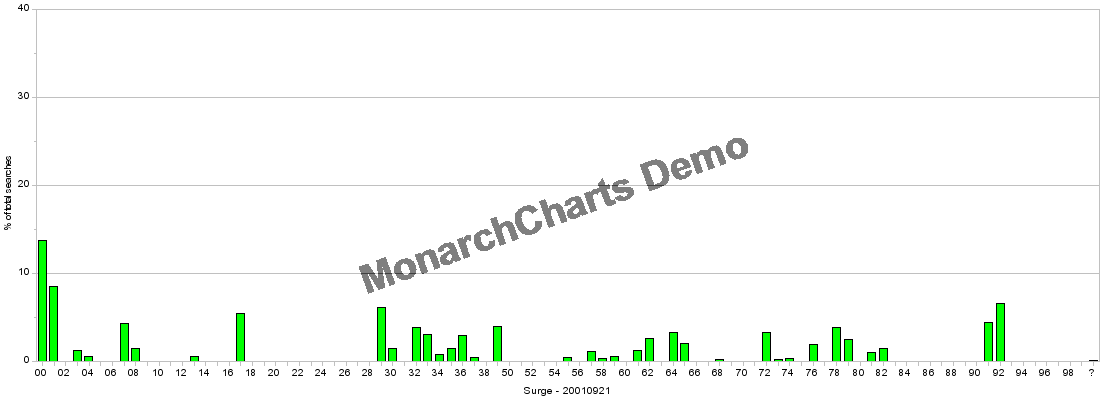
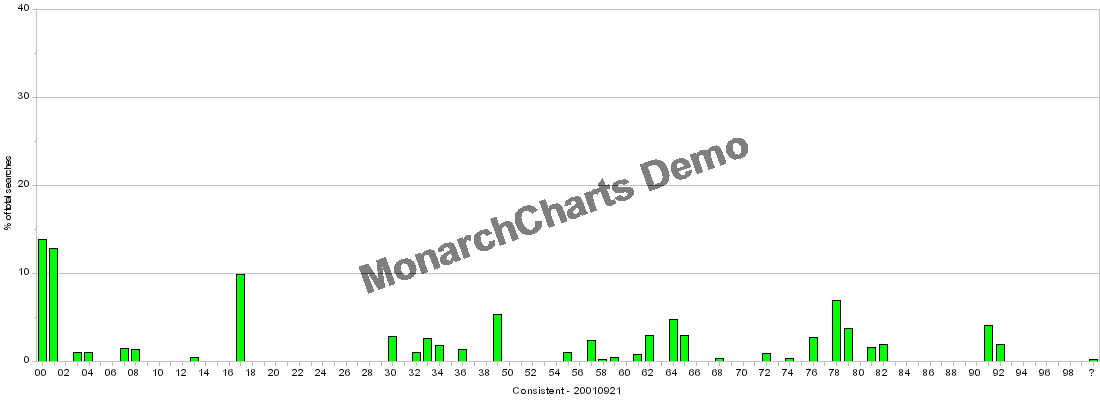
The response to the 11th September, 2001 terrorist attacks that can be discerned in the first few weeks of data collection is completely absent 2 months later in the surge data for the 10th of November (Figure 25). The 00 and 01 computer oriented spikes, the pornography spike and the two fame spikes more closely reflect the consistent search terms patterns. However, other events have appeared. The spikes at the sociality and celebrations (39) and the domestic science (64) classes have both noticeably risen as has the labour and economics (33) class. The trade and communication (65) class has also risen. A combination of movements such the one in this wekk captures the combined influences of a closely grouped series of regular events. The domestic science class is dominated by searches for recipes of ‘festive’ foods such as ‘Deep Fried Turkey’ and ‘Candied Yams’ as well as ‘prom dresses’ and ‘Christmas wallpaper’. The 39 class reinforces these intersecting activities with searches for ‘pumpkin carving’, ‘ramadan’, ‘christmas’, ‘halloween’, a variety of celebratory cards, clipart, puzzles, trivia and poems. Other aspects of this class include classifications for costumes, and ‘prom hairstyles’.
The rises in the 33 (economics) and 65 (business and trade) classes reflect the wider consequences of these celebratory activities and their position within a capitalist economy. The 33 class includes search terms such as ‘jobs’, ‘loan calculator’, ‘IRS’ and ‘tax forms’. Although it is generally finance oriented this class also classifies all the various US state lotteries. Surges in interest around lotteries indicate the degree that financial planning is a regular activity prior to Christmas and the end of the calendar year.
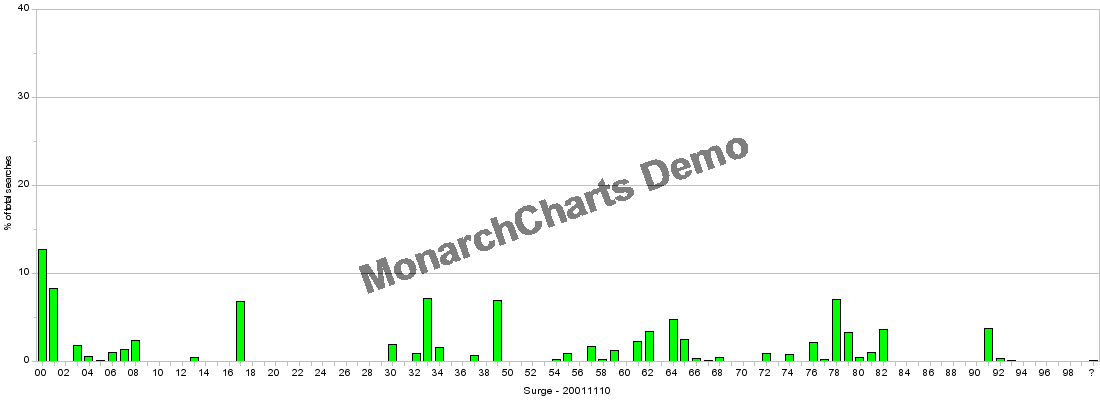
The surge data from the 9th November 2002 (Figure 26) shows a consistent picture in terms of the importance of four classes (33 - economics, 39 - ways of life, 64 - domestic science, 65 - business) although the balance with other classes have altered slightly.
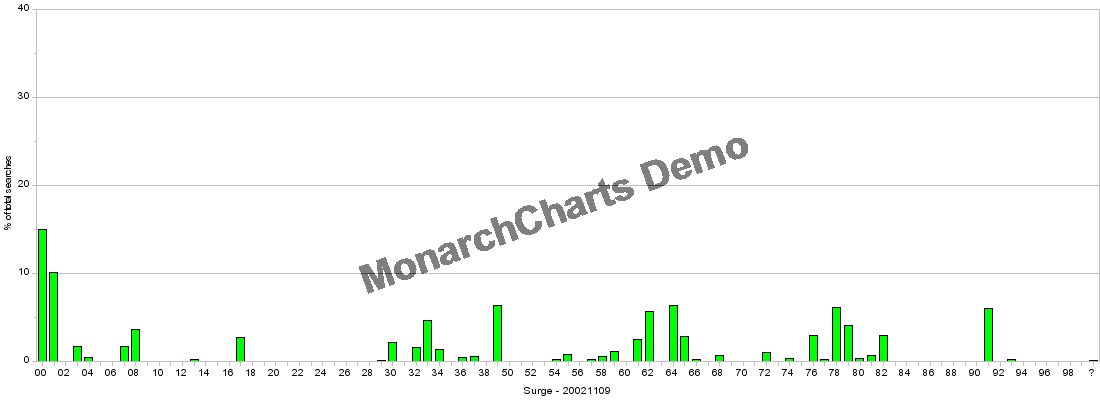
The week prior to the Christmas weeks of 2001 and 2002 (22/12/2001 - Figure 27 and 21/12/2002 - Figure 28) show a shifting combination of priorities in which increasing attention is being placed on the celebration of Christmas rather than its ancillary preparations. A general drop in the interest for other popular classes accompanies the increased focus on the celebration class. However, across these two Christmas celebrations (2001 and 2002) there is no single class or coherent group of classes that declines in response to the increasing interest in holiday. The difference between these two Christmases is most visible among the most popular classes; computers (00) pornography (17), finance (33) and actors (62). These shifting differences in a period that is so clearly influenced by a single annual event reinforces the utility of this cultural perspective on the classified search terms. It shows that despite the importance of Christmas, other unrelated activities, desires and events still continue to influence the searches being conducted in that week. A complex intertwining of influences can be seen with a discernable consistency in the literature class (82) between the two Christmases. Rising interest in literature is not directly a Christmas influence but rather reflects the December release dates for the first two Peter Jackson movie adaptations of the Lord of the Rings trilogy which were times to coincide with Christmas holidays.
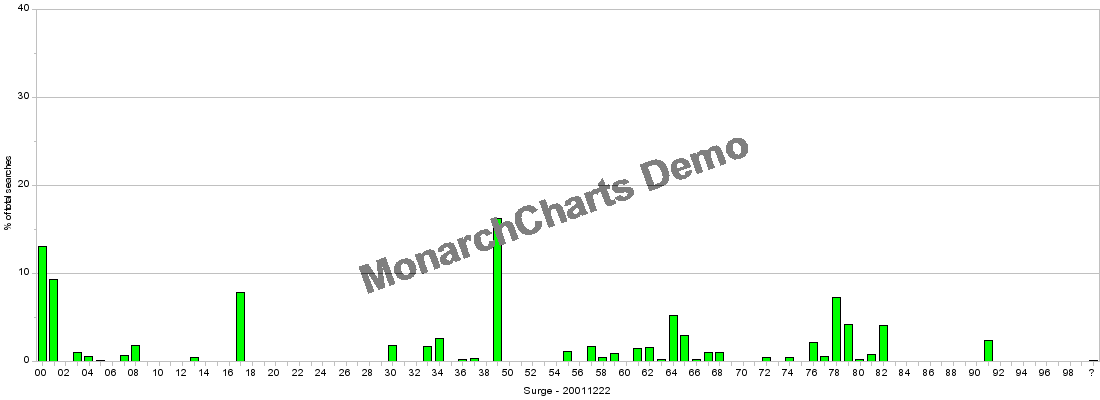
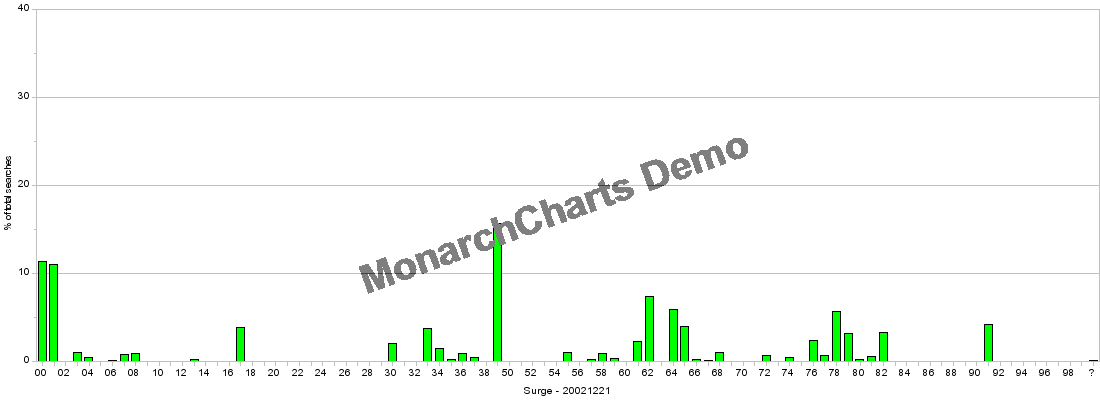
The rising popularity of some classes of activities and artefacts is sometimes accompanied by sinking popularity with other classes. This is an identifiable tendency rather than a direct cause and effect or correlative relationship. The most identifiable of these combinations can be seen in the shifting balance between the celebration and sociality (39) and the jobs and finance (33) classes (Figure 29). Explanation for these related shifts is not a simple inverse relationship as the jobs and finance class includes the classification of various US state lotteries and powerball competitions. The 39 class covers a large range of topics that includes the peer-to-peer sharing systems such as Napster, Morpheus and Gnutella, free e-cards, a variety of celebrations including ‘secretary’s day’ and ‘wedding’, sexual relationships such as ‘masturbation’ and ‘gay’, fantasy creatures such as ‘unicorns’ and body modifications such as ‘tattoos’. The tendency is for the activities represented in the 33 class to sink when the activities of the 39 class rise to 10% of the total number of classified searches. The one week in which searches within the 33 class proportionally rose above the 39 class was on the 28th December 2002. This was the result of a surge of interest in US ‘Powerball Results’. The Christmas jackpot was $US170 million and the previous draw 4 days earlier had a jackpot of $US177 million. Both these figures were significantly higher than the ‘average’ jackpot. More commonly, proportional rises in the 39 class during a given week also reveal a proportional drop in the 33 class. Conversely weeks in which drops in the proportion of searches in the 39 class are observed the proportional level of searches in the 33 class rises towards the level of the descending 39 class. The relative proportions of these two classes meet when the proportion of total searches in the 33 class increases over 6%. These observations suggest an inter-relationship between these two classes and are a tentative confirmation that with the process of classification I have captured a general principle of relationship between related but specific and individual search terms.
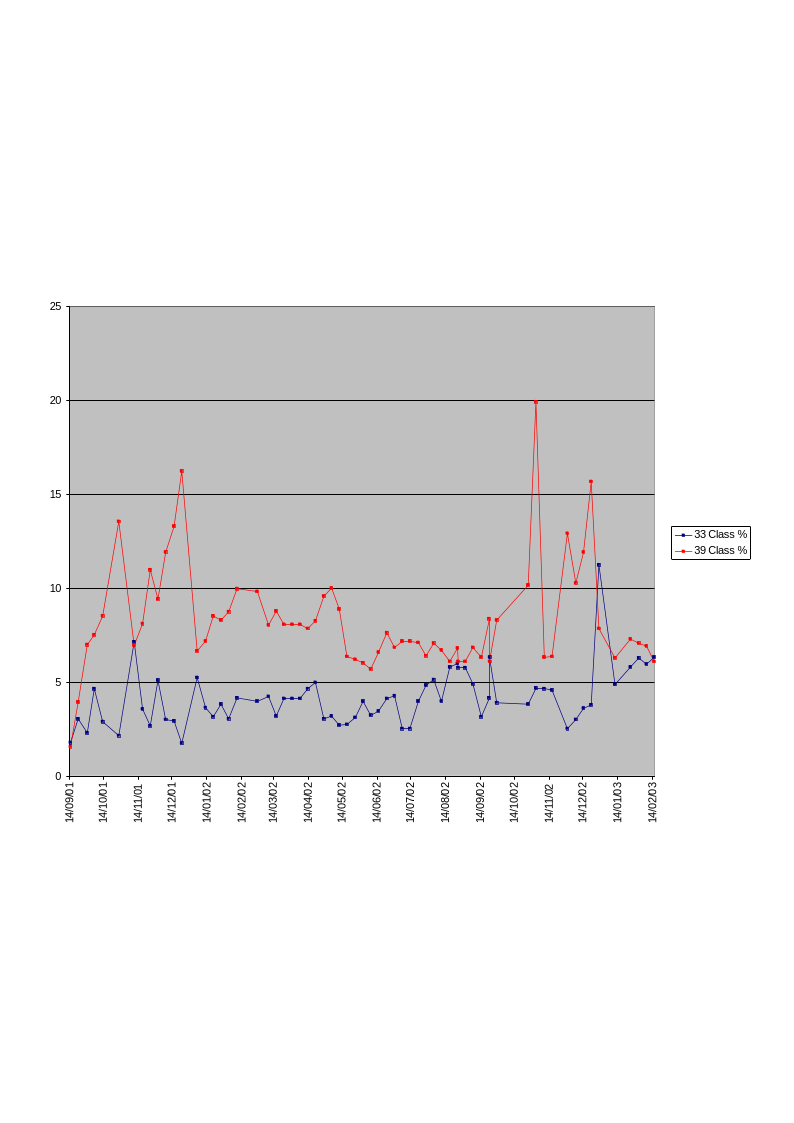
Other weeks produce single anomalies that relate to mainstream media reports and the related cultural responses that this can produce. In the case of the 13th October 2001 the rise of the health class (61) over the entertainment classes at 62 and 78 shows the large number of searches for ‘anthrax’ - the number one surge search term in this week. Interest in anthrax reflects the media panic being developed on top of the terrorist attacks in the previous month (Kellner 2003). The anthrax scare produced an isolated spike that reflects a desire for knowledge regarding anthrax which follows upon fears generated through mainstream media from unsubstantiated US Government concerns and an ‘internal’ terrorist attack that relied on the fear generated through the 11th September, 2001 attacks (Rosenberg 2002; Piper 2002, 55). The spike is isolated from the general interests of everyday life and as a consequence its impact, influence and interrelation with other classes is only to produce a general reduction in other classes representation for that week’s searches. Panic subsided over the ensuing 4 weeks and was again overtaken by more mundane events.
Somewhat unexpectedly the peak in the 61 class reappears again in the surge data for the 8th December 2001. However, this is a different health panic that is a more closely tied to the Web itself. This week saw a surge of interest in ‘anorexia’ but this interest was more specifically defined by searches for ‘pro-anorexia’ or, the slang term, ‘pro-ana’. An anomaly like this is of particular interest because of the interconnections between the Web, mainstream media and the weekly surges identified in Web searches. The debate and interest in pro-anorexia Web sites - sites that argue for anorexia as a positive body image for women - grew around pressure for these sites to be formally shut down (Dolan 2003, 1). The social outcry was reported widely (for example, on ABCnews.com, WTEN.com, msn.com and shift.com without date or attribution) and subsequently the number of searches increased to the point that the many variants of this search term (and its underlying interest) reached the surge list of terms. Recent estimates suggest that there are approximately 400 pro-ana Web sites (Dolan 2003, 1; Zwerling 2003) which shows that the interest in this topic during this week heavily outweighed the available supply of information. The relative stability of the other classes during this week - and in the lead up to Christmas - places the pro-ana peak in a similar context as the anthrax panic. Such a visible panic is a media-driven event that is distanced from the practices of everyday life but nonetheless an aspect of contemporary, western, mainstream culture.
The 5th January 2002 data reveals a different type of unexpected and isolated anomaly. The weather class (55) rises rapidly in this week. Internationally weather conditions were particularly disastrous with heavy snow and extremely cold conditions in Europe and bush fires driven by winds, high temperatures and dry conditions in Australia. The US was experiencing record high (Winter) temperatures in the mid-west states. However, another weather event offers a more primary rationale for this spike; the expectation of the first snowfalls in the eastern US. The lack of any specific geographic qualification to any of these terms suggests an underlying assumption regarding the type of weather - or more specifically its location - that is being sought. Only the 97th and 270th most popular search terms in the surge list for this week hint at any type of location for this interest, in the form of capitalised variations of ‘local weather’. In the context of the Web this is an overly vague and indefinite specification that reflects an assumption regarding the dominant focus of the Web in general and suggests American assumptions underlying these searches.
The weekly list of consistent search terms has a recognisable and steady equilibrium over most of 2002. There are weekly variations in the emphasis on particular classes but no anomalous spikes. During this period the gathered data shows that despite the individual weekly variations in the specific terms being searched for and desired by individual users of Web search engines the balance of the types of interests they express fall repeatedly into the same class. The stability represented in the data for the first week of July 2002 also shows that celebratory events - such as Independence Day - with a solely US focus are not necessarily capable of shifting or manipulating the more ‘usual’ tendencies found in the gathered weekly data. The cultural stability suggested by the regular appearance of the same search terms is maintained until the anniversary of the terrorist bombings. In this week (14th September 2002) the news (07) and politics (32) classes rise significantly but then sink to more ‘usual’ levels by the next week. The pattern of activities seen in the last quarter of 2001 and after the bombings is repeated in the last quarter of 2002. The influence of the terrorist attacks appears in early September - first as an unexpected event and the following year as a memorial - but these are followed by the late October/early November peak that relates to the Thanksgiving and Halloween celebrations. Christmas then introduces the next peak of interest that appears in the celebration and sociality (39) class. Christmas also introduces influences on the popularity of the games and sports class (79) and a reduction in the popularity of the news (07) class. In the week following Christmas the 79 class rises to become one of the dominant spikes in the graph. Interests represented by this class includes computer and console based games and more importantly ‘cheats’ relating to these games. Traditionally, the Christmas week is a period for annual sporting events such as the Sydney to Hobart yacht race but there is no reference to any specific sporting event during these weeks and the only sport being sought out in this week’s list is the less traditional ‘paintball’. The post-Christmas spike, instead, appears to reflect a response to gifts of computer software and the desire for (free) information that assists in solving their intricacies. The brief rise of this interest in ‘cheats’ to help complete computer games also reflects a brief holiday period with the general return to work in the new year which diminishes the impetus and abilityto complete games.
These celebratory periods, and especially the Christmas period, are also indicated by a consistent drop in the reference and business classes; dictionaries and definitions (03), Internet domain names (04), business (06) and news (07). These groups of classes generally represent a small percentage of the total number of searches conducted. The most volatile of these classes is news (07), however, the graph (Figure 30) reveals that its most volatile aspects period represents the 11th September terrorist attacks, its anniversary and its after-effects. The mid October 2002 peak in the news (07) class reflects a ‘news heavy’ period. This was the week of the terrorist bombing in Bali, Saddam Hussein’s successful re-election and George W. Bush’s statements that, with hindsight, can be seen as his first tentative declaration of war on Iraq. The mid-May peak is somewhat more complex as it is an intersection of the tensions between the US Government and militant Islamic groups and the Web itself. The peak related to the release of what has become known as the ‘Daniel Pearl Video’. This video is a propaganda piece released by an Islamic militant showing the beheading of the US journalist Daniel Pearl who was accused of being a spy while he was researching underground Islamic groups (Bartlett 2002; Rosenbaum 2002). The US authorities acted to censor access to this video but it was placed online on Web sites by Americans who justified their action by invoking their ‘freedom of speech’ liberty (aztlan.net/pearlvideo.htm).
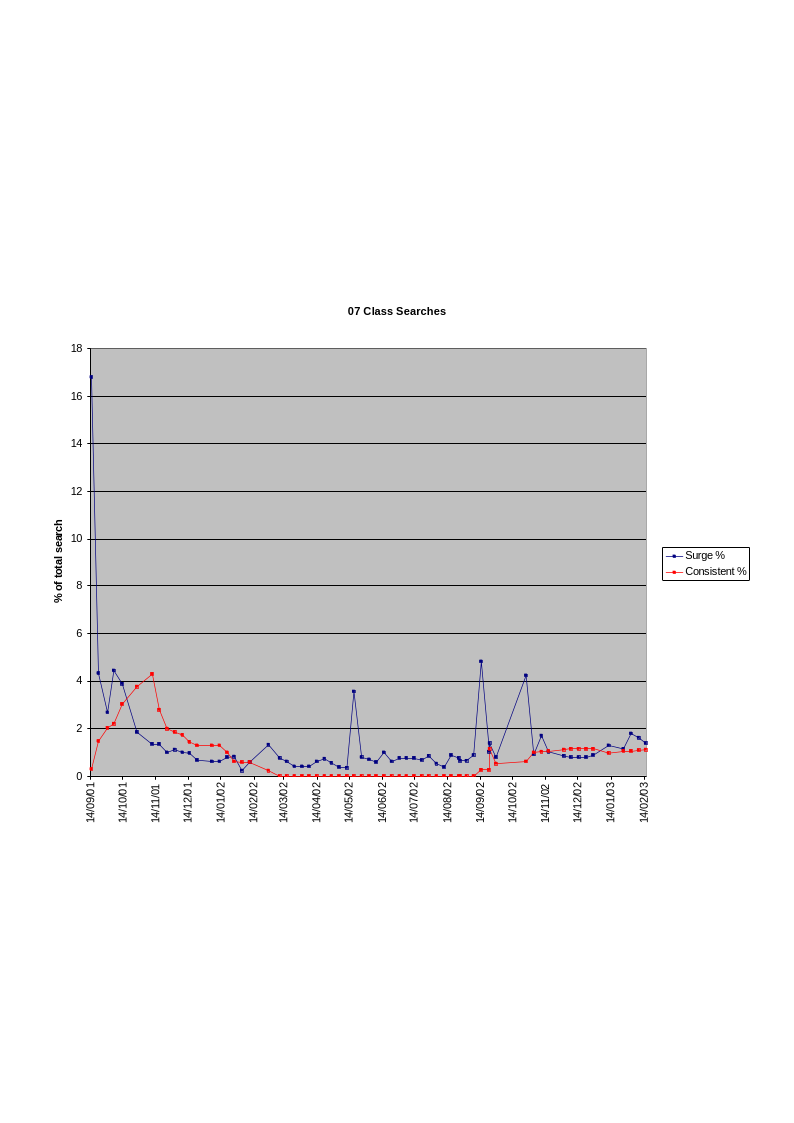
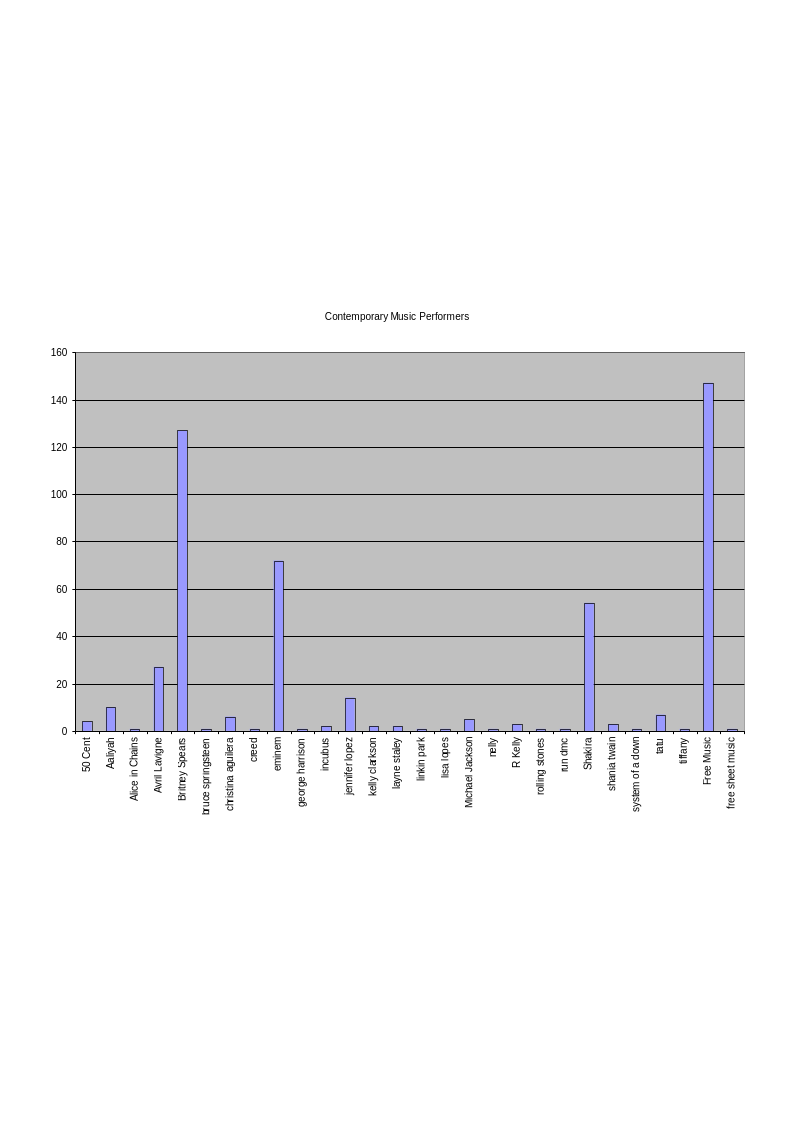
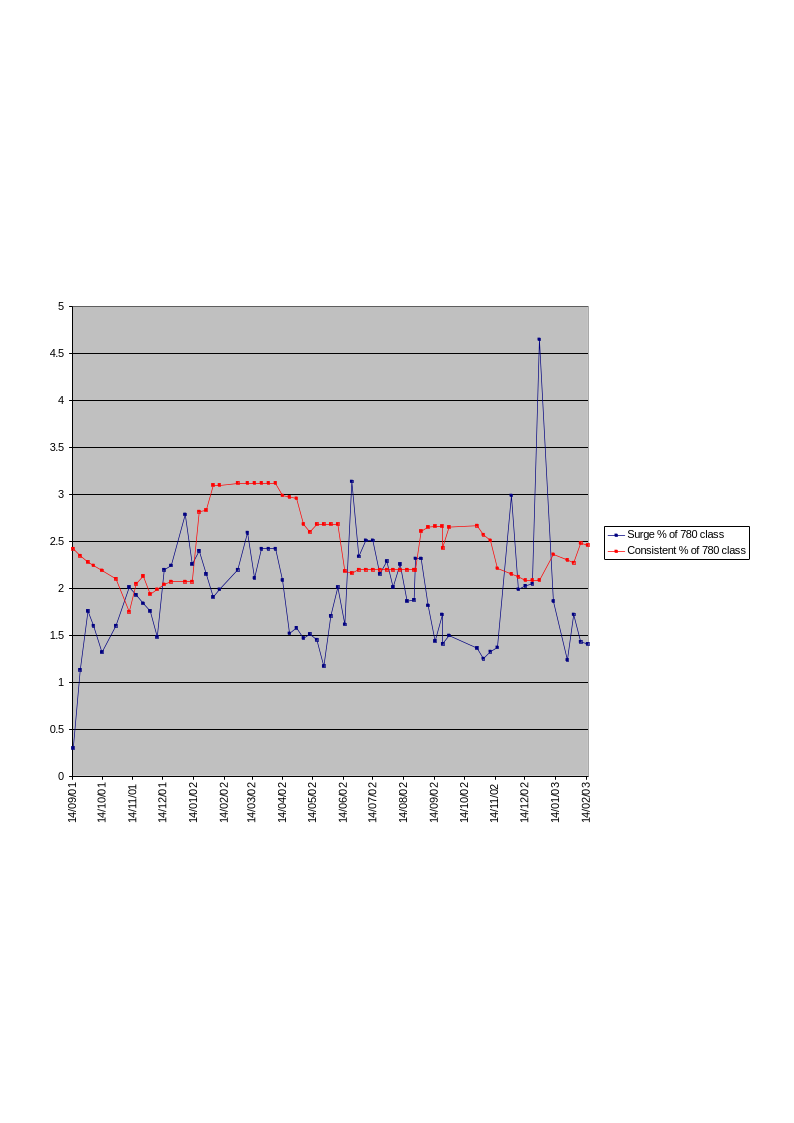
These two charts (Figures 31 and 32) provide one example of how the cultural perspective of the search term data reveals a general tendency despite the vast range of specific terms that contribute to a single class. The 780 class is used to classify contemporary popular musical artists and the generic term, ‘Free Music’. The first chart (Figure 31) show the total number of times that each of the artist’s name appeared in both the surge lists and the lists of consistently performing terms. The lists offer the potential for an individual name to appear over 132 times; at least once in each list without including spelling variations or more specific search such as ‘50 cent lyrics’. Irrespective of this broad view and possibility only the generic term ‘Free Music’ and ‘Britney Spears’ and ‘Eminem’ appear more than once in any week of collected data. In this class the terms appear consistently as between 2% and 3% of the total searches conducted while the surge list shows greater variability with a significant contribution to this variability being the rush for ‘music downloads’ in the post-Christmas 2002 holiday. A period already identified in the discussion of the news (07) as a holiday with “unusual” activity.
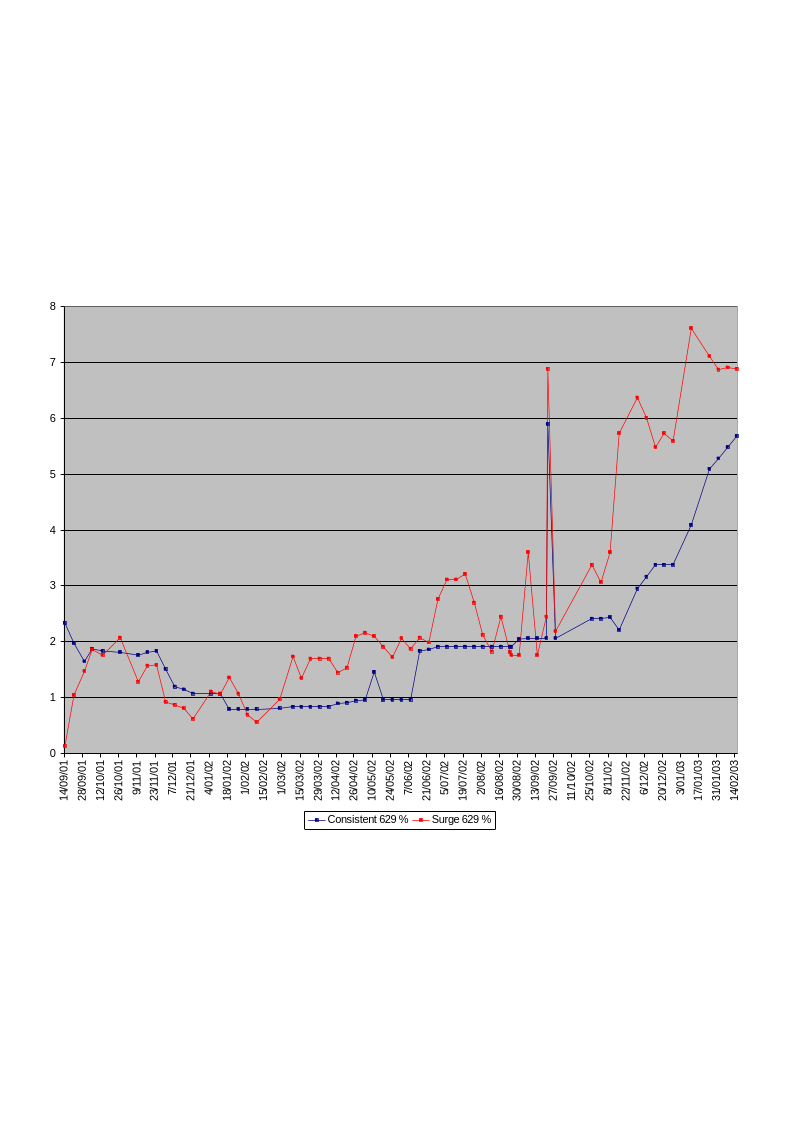
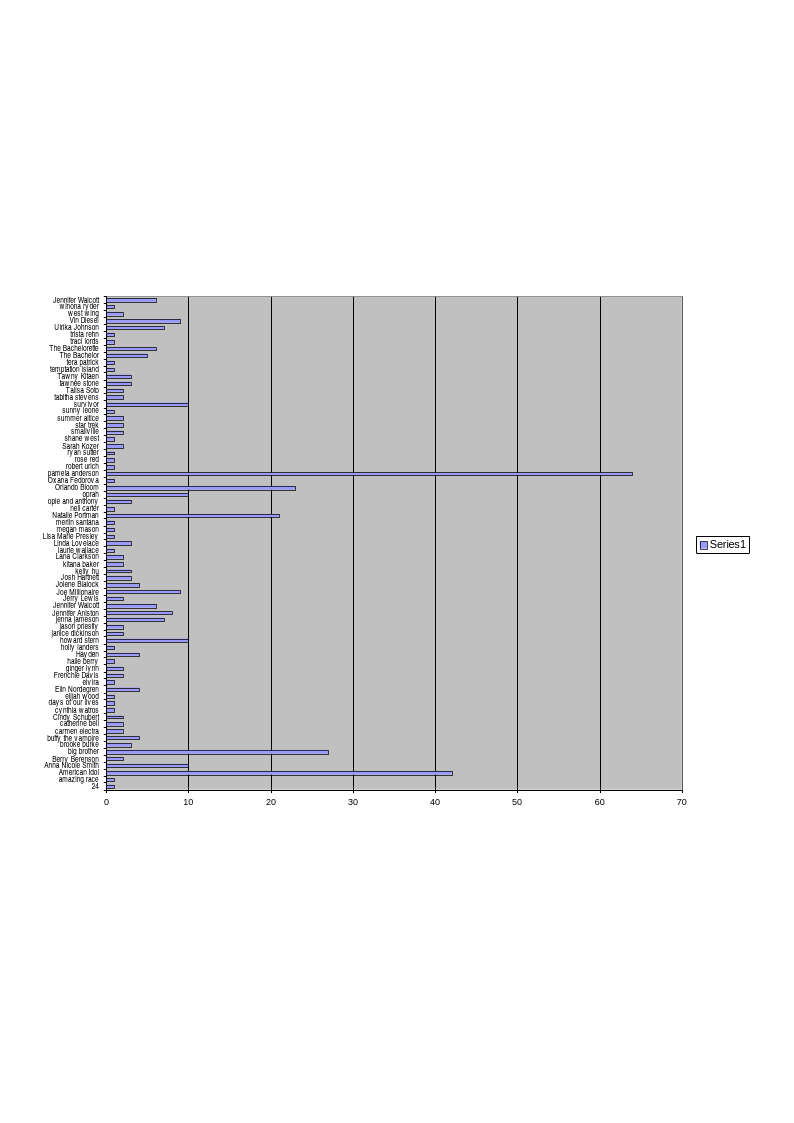
Applying this same perspective to the media (629) class reveals a similar situation (Figure 33). The majority of the terms classified in the 629 class are actors, television programmes and films. Figure 33 shows the variety of people and programmes that are being sought out by the users of Web-based search engines. Pamela Anderson predominates over any other individual with 64 appearances across the 66 weeks of surge and consistent search lists. Orlando Bloom with 23 appearances and Natalie Portman with 21 appearances are the second and third most common individuals respectively. American Idol with 42 appearances, Big Brother (including all its regional and spelling variations) with 27 appearances and Survivor with ten appearances are the three most popular television programmes. The remaining 64 individual films and television programmes individually appear less than 8 times throughout all the weeks of gathered data. Forty-one of these terms relating to individual actors or television programmes only appear once or twice across the entire period of data collection.
The relatively brief appearance of any single actor or television programme in this class can be contrasted with the overall representation of this class in both the consistent and surge list of terms (Figures 32). Initially in both types of weekly lists the 629 class appears regularly at between one and two percent of the total searches conducted. After June 2002 this percentages consistently increases towards 5% of the total number of searches conducted. The sampling of individual actors and television programmes however is gathered across the entire period of data collection. The pattern of activity concerning so many individuals suggests that there is a general rise in the interest in actors and television programs but that still no one single actor or television program occupies the attention of users of Web-based search engines for very long. The cliché that fame is fleeting is appropriately applied in this context. While Pamela Anderson and Orlando Bloom’s fame is temporarily assured no other actor can be reassured by their momentary appearance in the lists of the most popular search terms. In the wider context of this work the relationship of fame to the cultural complex and contemporary mainstream western culture is foreshadowed by De Bord (1994, thesis 60) who claims that “media stars are spectacular representations of living human beings, distilling the essence of the spectacle’s banality into images of possible roles. Stardom is a diversification in the semblance of life.”
The cultural context of these observations presents a complex overlaying of interests and influences that cannot be readily disentangled with a conclusive identification of particular causal factors. Nor, is this the intention in the presentation of this perspective. The cultural context emphasises interconnection and relationship across the various classificatory classes. A holistic context offers a view of contemporary western mainstream culture that reveals how certain classes of artefacts are consistently flagged as important and relatively stable in their relationship to other classes. Cultural stability is achieved irrespective of the influences of recent history such as the terrorist attacks of 11th September 2001. It is important to observe too not only those artefacts that regularly appear week-by-week in the gathered data but those artefacts that do not. There is a consistent absence of references to many of the UDC classes. Religion and theology only appears as references to Nostradamus and only in the context of the terrorist attacks. The many classifications for Science in the first half of the 500 classes only appear rarely and almost exclusively in the context of a predicted meteor shower. Only this search term that class reveals the connection of science to everyday life: ‘Meteor Showers Tonight’. Other professionally oriented or industry specific classes also appear in the data rarely. The agriculture class (63) is only represented by four terms; ‘fishing’, ‘gardening’, ‘Marijuana pictures’ and the potentially misclassified ‘poison ivy’ which is possibly a contemporary filmic reference to the Batman films. Similarly the dual history classes (93/94) whose scale reflects the usually large section in a conventional library’s holdings is almost entirely empty. The terms that are classified in this class reflects a brief and event-driven connection of history to everyday life and specifically to the celebrations of ‘black history month’. These absences reconfirm a central claim of this thesis that the Web is increasingly an integral aspect of everyday life in the context of contemporary western mainstream culture rather than in a library or museological sense. The fact that the data gathered for this research is founded upon the rising or falling popularity of specific terms reinforces the scope of this perspective as more technical and specialised searches will not garner sufficient interest across the broad spectrum of people utilising Web based search engines to be presented in any given week’s most popular 200 or 300 search terms.
A significant absence across the entire collection of research data is the general lack of any geographic identification. Such an omission could be mistakenly read as a reflection of US dominance and cultural hegemony. While this may offer a partial explanation, a weather search term offers a different perspective. The term, ‘Local Weather’, may reflect an assumption of the Web’s proximity to one’s own physical location. ‘Local weather’ embodies a level of self-interest and assumes that one’s own local weather will be available and discernable from out of the huge collection of many potential local weathers.
The graphical representations of classified terms utilised in this discussion must be seen as the ‘tip of the iceberg’ for hundreds of thousands of other searches that are conducted each day. A large proportion of these terms would be classified within the already popular classes but some of the other terms would appear in currently unrepresented classes. A small and selective sample of the search terms used at search engines such as Google and Yahoo that resulted in a link to the spaceless.com domain shows the variety and detail of terms that are continually being used (Figure 35). The spaceless.com sample is from only the first 3 days of November 2003 with all the terms that produce a link to this specific domain. This information was gathered from spaceless.com activity logs indicating that not only was this the search term used at a Web-based search engine but that the person conducting the search completed this activity by following a link from the search engine to spaceless.com. In effect, this shows that the search was not randomly or mechanically generated and that the search itself represents some form of genuine desire.
how to cite references from the internet
Warming up your engine
home remedies to remove facial hair
Plato’s Education theory
good wine japanese food
hell michgan
strange cultures
japlish images
LINGUISTICS FOREIGN LANGUAGES TEACHING
tires squealing low air
dog cause a traffic accident
paris urban spaces
sell photos postcards
“spanish crown jewels”
market for hickory nuts
craik, j -researcher
online courses in sexual intercourse
yahoo sex education viagra
drink wine belly button
medieval castle by the sea
how to make a hollowed out book
computers and social skills
loyalty ethics
different references materials in the library
example programs in java swings
International Association of empirical Aesthetics
- Terms used at a search engine with the final destination at spaceless.com
It is worth noting that none of these search terms are single words, a clear distinction from most of the data gathered for this research. As more complex search terms that combine various aspects of human knowledge and action these terms would also not be so readily classified in any single class of the UDC. The search term, ‘yahoo sex education viagra’, being a clearly difficult example. These more complex and consequently individually rarer search terms clarify some of the intentions and desires underlying the term itself. They are more revealing of the individual everyday life practices of the people conducting the search. For example ‘how to make a hollowed out book’ offers a strong indication of a potential individual future action. A similarly complexity of classification is also found in the phrase; ‘drink wine belly button’.
The observations regarding the gathered data within this cultural context perspective is a necessary double abbreviation of a complex situation. The classification process abstracts a general meaning from specific search terms, which are themselves, a representative selection of many thousand more search terms. However, this produces clarity in relation to understanding what artefacts are being sought and desired through the Web. The various ‘spikes’ of popularity reveal a consistent and shared series of interests. These interests consistently include information and communications technology (found in the 00, 01, 39, 64 and 79 classes), pornography (17), celebrations (39), media and automobiles (combined in the 62 class), music (78) and travel (91). However, these classifications are not themselves mutually exclusive. For example the celebration class includes ‘Christmas screensavers’ and ‘Christmas clipart’ and the music class includes terms such as ‘Free MP3 Files’. While these terms include references to technology they are classified by the type of artefacts they represent rather than their form or delivery medium. This helps to clearly represent a range of interests and desires that might otherwise be obscured in a homogeneous ‘technology’ classification.
The cultural view of the gathered search terms, then, reveals a consistent series of interests in a small range of areas. The most popular interests expressed through Web-based search engines relate closely to experiences of everyday life within contemporary western mainstream culture. De Certeau’s general observations regarding everyday life reflect these observations
…our society is characterized by a cancerous growth of vision, measuring everything by its ability to show or be shown and transmuting communication into a visual journey. It is a sort of epic of the eye and of the impulse to read. The economy itself, transformed into a “semiocracy”, encourages a hypertrophic development of reading. Thus for the binary set production-consumption, one would substitute its more general equivalent: writing-reading. Reading (an image of a text), moreover, seems to constitute the maximal development of the passivity assumed to characterize the consumer, who is conceived of as a voyeur in a show-biz society (de Certeau 1988, xxi).