Would You Prefer People to Think of You as Eccentric or Orthodox?
Let me put it another, more devious way: would you like your boss to write in your personal annual report ‘he is eccentric’? Or ‘he is orthodox’? Nasty, isn’t it? Because you already caught the drift in the chapter heading and were leaning towards ‘eccentric’. Then you had to switch back. Never mind; it shows your heart’s in the right place.
What I’m about to say is this: Great Innovators have always been eccentrics. All great innovators. And anyone who gets a new idea is, at that moment at least, an eccentric to some degree.
You may just be doubting that line about all great innovators … You may even be sifting through a few names. I’ll help you. For instance, the Princeton faculty once voted for the ten greatest originating geniuses of history (they had Einstein on the campus at the time and considered that they were looking really for the other nine) and this was their list: Aristotle, Socrates, Plato, Galileo, Da Vinci, Shakespeare, Newton, Darwin, Pasteur and Einstein.
Personally, I think Pythagoras has a far greater claim than Plato (who was really a ‘continuer’ of Socrates) and for all Da Vinci’s marvellous curiosity, I’d say Michaelangelo or Giotto or Rembrandt had more impact on the world of art. And any list of ten that leaves out Beethoven is for Philistines. But that’s as may be. It’s remarkable that such a list includes three Englishmen. Three-tenths of the world’s greatest innovators? But not surprising, really. If you allow that innovation stems from eccentricity one must agree that an environment that tolerates eccentrics is most likely to produce them. Historically, England has been safely isolated from the hurly-burly of war and tyranny and oppression and persecution. Its society was able to develop without much fear and, most importantly, in an atmosphere of relatively free speech. Eccentrics are considered dangerous in rigid, autocratic regimes. They are regarded only as figures of fun in free societies. Come to think of it—what is the Americans’ unshakeable caricature idea of the Englishman? And the Germans’? And the Yorubas’? A genial eccentric, that’s how they see him. And England has more eccentrics to the acre than anywhere else on earth, which is why it has produced a significantly higher proportion of original thinkers than any other society.
But we still haven’t proved the connection between originality and eccentric thinking. Let’s add a few more names to our list of innovators. Democratus (who postulated the atomic theory 3,000 years ago), Caesar (a villain, but the first administrator), St. Augustine, De Brahe, Kekulé, Mendeleev, Freud, Watt, Ben Franklin, Faraday, Edison, Descartes, Hertz, Marconi, Tolstoy, Dickens, Wagner, Lincoln, Churchill, Debussy, Picasso, Hervey, Byron, Hemingway, Gershwin … you can go on willy-nilly, and what do you find?
Eccentrics—to a man! And a woman, come to that. Barbara Hepworth won’t mind being tabbed eccentric, along with Sappho, George Sand, Emily Brontë, Edith Sitwell, Colette, Joan of Arc and Madam Curie.
Tell you what. You think of one great innovator who was a conventional, uneccentric person. J. S. Bach, you say? An inoffensive, regular little home body whose life was uneventful? So how about his twenty-two children? Anyway, it isn’t necessarily the behaviour of a man that makes him eccentric—it can be his mental processes alone. And that’s what we are interested in.
If a new idea breaks rules—and surely that’s acceptable without argument—it must come from a brain that has no deep respect for rules. What do we notice about eccentrics? They disregard accepted rules and modes. Or, at least, they treat them with indifference.
The classic idea of the mad inventor or the dotty artist is broadly if superficially acknowledged to be true of life. But the idea seems to imply that the subject is crazy because he is an inventor. How about inverting it and suggesting that he’s an inventor because he’s mad? Why is it that in this age and period of society when the achievement of identity is both essential and (for most people) impossible, we find so many exhibitionists? Young people traipsing round like sleep walkers from some nightmare world of the absurd, drenched in defiant self-consciousness. Art directors from the half-real world of advertising, padding about office buildings on bare feet. Daring young bucks in bowlers who sport hair down to the shoulders (usually ungroomed and unwashed). These people are aping the eccentric, hoping to convince the rest of us that they are creative and therefore worthy. But the trappings count for little. There is one hell of a difference between the genuine, salt-of-the-earth eccentric (who is largely unaware of his oddness) and the tiresome exhibitionist (who is entirely aware of it). The exhibitionist is not true to himself or anyone else—and self-consciousness puts a terrible brake on the search for new ideas. Distinguishing between the two (vital if you’re employing creative staff) is not difficult. Simply being on guard for it is sufficient—your common sense will do the rest.
But let’s not be rotten to the other side. Orthodox minds are just as necessary to a society as eccentric minds. Where a deal of responsibility is called for you’ll find orthodox minds in charge. People who know the facts, use the facts and don’t like deviating from them. You would feel a lot safer in the hands of an orthodox brain surgeon than one who was given to sudden, bright ideas. Which is why surgeons and physicians generally are not innovators. They’d never qualify if they were. Their brains would not be orderly enough to absorb the huge body of knowledge necessary to do so.
The other professions also tend to require orthodoxy. The classic way to succeed in these spheres is to excel in the conventional—that’s to say, know the facts, use them and don’t take irresponsible risks.
You can see why we have such a cockeyed educational system. We are trained in school to conform and to excel in the conventional because, historically, the worthy professions are those we should aspire to. The examination system is based squarely on this platform. It is a test of stored facts and the facility for juggling with them. This is fine for the person who is born with an orthodox skill. But what about the sceptical, rebellious, experimental eccentric? When teacher says, ‘If you heat a gas it expands’, the orderly mind cements that little fact into place. The curious mind immediately doubts it and spends the next vital minutes trying to disprove it instead of listening to the established facts. Innovators are notoriously poor scholars, and brilliant scholars seldom surprise the world.
(Yes, yes—of course there are exceptions, but don’t let’s haggle. They are few.)
The same phenomenon applies to those arrogant manifestations of technocracy, I.Q. tests. In the first place the perpetrators don’t know what they are testing, or how they are measuring it (since, to be scientific, the second must depend upon a knowledge of the first). So they make an arbitrary, factual test and then apply a pragmatic form of measurement. What if the person tested is more ‘intelligent’ than the one who set the test? Anyway, what is this test really? A trial of logic, a race against the clock.
It reveals a certain facility for rational thought, which might well indicate a capability for one of the logical, orthodox professions. How could it ever indicate a deep talent for music or motor car design?
I once took part in a very interesting meeting in which members of the Society for Innovation Research addressed MENSA in response to their plea, ‘Why is it that, with I.Q.’s of 150 or more, our members don’t rise above the average in achievement and inventions?’. The reason seems to be that having a well-oiled, well-ordered mind that can sort out complex factual problems rapidly is to be obsolete in this world of computers. And, being orderly, such a mind simply isn’t geared to the random, illogical changes of direction that innovation requires.
(However, one might expect to find ‘high I.Q.’ people involved in programming computers, perhaps?)
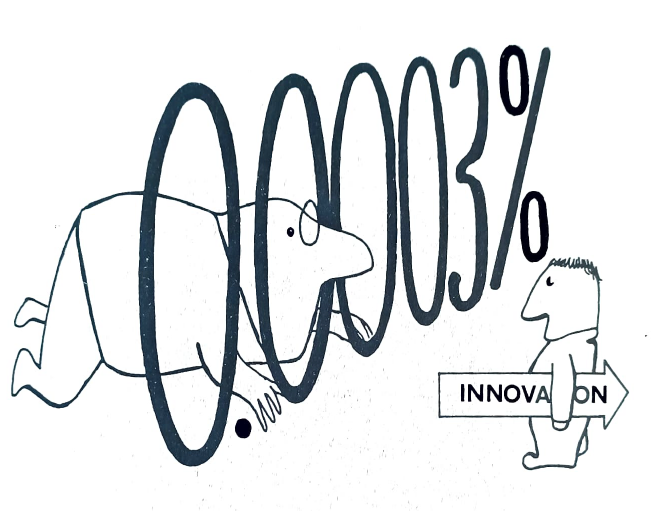
There is a strange paradox in modern society. On the one hand, people want to maintain the status quo—clinging to the devil they know and suspecting change in any form—on the other, they seek what is optimistically called ‘progress’. They want new ideas—always providing these ideas are not uncomfortable, which is an impossible demand. The mass consciousness sees to it that positions of responsibility are held by orthodox people. The same applies to businesses. The bigger the company, the more orthodox-minded are the men in charge. That’s why small companies produce most of the bright ideas. Although there are rare exceptions. One major international corporation, at least, has a remarkably enlightened attitude towards innovators, paying them full-time salaries to work half-time for the company and half-time for themselves. But most big corporations put their expensive research adjuncts into systemised straight jackets.
Which brings us back to you. How can you produce new ideas, or promote the new ideas of your staff when the whole system around you is aimed at stabilisation and the avoidance of risk? Just to underline the gravity of this situation, let’s examine what was probably the most notable squashing of a new idea in modern history.
Galileo—an eccentric in spades—found a way of proving that the earth went round the sun. Any schoolboy of ten could demonstrate this today, of course, but it was sensational at the time. Called to account by the College of Cardinals he explained the new symbol-concept to them in terms of other symbol-concepts that were common to all present; leaving no possible doubt as to the new truth. But these worthies made him recant publicly. Why? Because it was widely believed that the earth was the centre of creation. Although this was not Catholic dogma, it fitted neatly into the scheme of things and had been encouraged to some extent by the church. If it was to be denied, the gates of doubt could open much wider and thereby threaten the authority of the church.
This is not necessarily a cynical point of view. Despite the undoubted corruption that existed, it is quite possible that their Eminences truly had the interests of the simple faithful at heart in wishing this suppressed.
There are countless parallels to this story. It is the classic example of reaction to the new idea.
Now let’s examine some more reasons for reaction, in a bit more detail.